 ZS Laser Equipment

Introduction
A groove weld is one of the most important welding methods used in structural fabrication, pressure vessels, pipelines, heavy machinery, shipbuilding, and modern metal manufacturing. Whether using traditional arc welding or advanced laser welding technology, groove design directly affects weld penetration, weld strength, filler metal consumption, distortion, and overall production efficiency.
In traditional welding processes, groove preparation is often essential because the welding heat source must reach the root of thicker materials. With the rapid development of laser welding, however, many thin and medium-thickness materials can achieve full penetration without large groove angles, significantly reducing machining costs and welding time.
Understanding groove welds is therefore critical for engineers, fabricators, and manufacturers seeking to improve welding quality while reducing production costs.
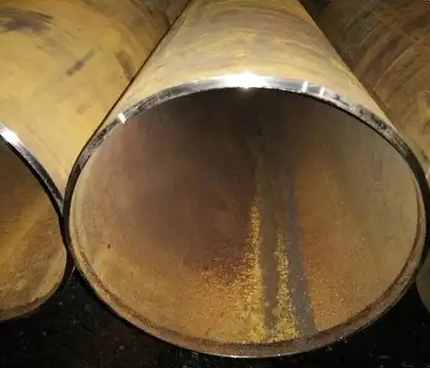
pipe bevel
What Is a Groove Weld?
A groove weld is a weld made within a groove formed between two workpieces.
The groove may be created by machining, grinding, flame cutting, plasma cutting, or laser cutting before welding.
The primary purpose of a groove is to:
- Ensure adequate weld penetration
- Improve joint strength
- Allow filler metal deposition
- Reduce welding defects
- Facilitate welding of thick materials
Unlike fillet welds, groove welds are commonly used when two plates or components need to be joined edge-to-edge.
A properly designed groove weld can achieve:
- Partial Joint Penetration (PJP)
- Complete Joint Penetration (CJP)
Many people mistakenly believe every weld must be fully penetrated. In reality, the required penetration depends on the service conditions.
For critical load-bearing structures, full penetration is often required.
For many industrial products, however, partial penetration groove welds can provide sufficient strength while reducing welding costs and distortion.
Why Groove Design Matters
The groove geometry determines:
- Weld accessibility
- Heat input
- Filler metal consumption
- Welding speed
- Penetration depth
- Residual stress
- Distortion level
A poorly designed groove can lead to:
- Lack of fusion
- Incomplete penetration
- Porosity
- Cracking
- Excessive deformation
For laser welding applications, groove accuracy becomes even more important because laser beams are highly concentrated and require precise joint fit-up.
Common Types of Groove Welds
1. I-Groove Weld (Square Groove)
I-GrooveI\text{-Groove}
The I-groove is the simplest groove design.
No bevel is machined on either plate edge.
The plates are positioned together and welded directly.
Characteristics
- No groove angle
- Minimal preparation cost
- Fast production
- Lowest filler consumption
Typical Applications
- Thin sheet metal
- Laser welding
- Stainless steel fabrication
- Battery enclosures
- Precision components
For laser welding, I-grooves are often sufficient for material thicknesses up to several millimeters because of the laser’s high penetration capability.
2. V-Groove Weld
The V-groove is one of the most commonly used groove designs.
One or both plates are beveled to form a V-shaped opening.
Typical Groove Angle
- 60°–75°
Advantages
- Easy to machine
- Good accessibility
- Suitable for manual welding
Applications
- Structural steel
- Pressure vessels
- Pipe welding
- Carbon steel fabrication
V-grooves are frequently used when welding medium-thickness plates.
3. U-Groove Weld
A U-groove features a curved profile instead of straight bevels.
Advantages
- Less filler metal required
- Reduced welding time
- Lower distortion
Applications
- Thick plate welding
- Pressure equipment
- Heavy machinery
Although machining costs are higher, U-grooves become economical on thicker materials because filler metal savings are significant.
4. X-Groove Weld (Double-V Groove)
An X-groove is essentially two V-grooves joined from opposite sides.
Advantages
- Improved penetration
- Reduced weld volume
- Better stress distribution
- Lower distortion
Applications
- Bridges
- Structural fabrication
- Heavy equipment
- Offshore structures
For thick materials, X-grooves are often preferred over single V-grooves.
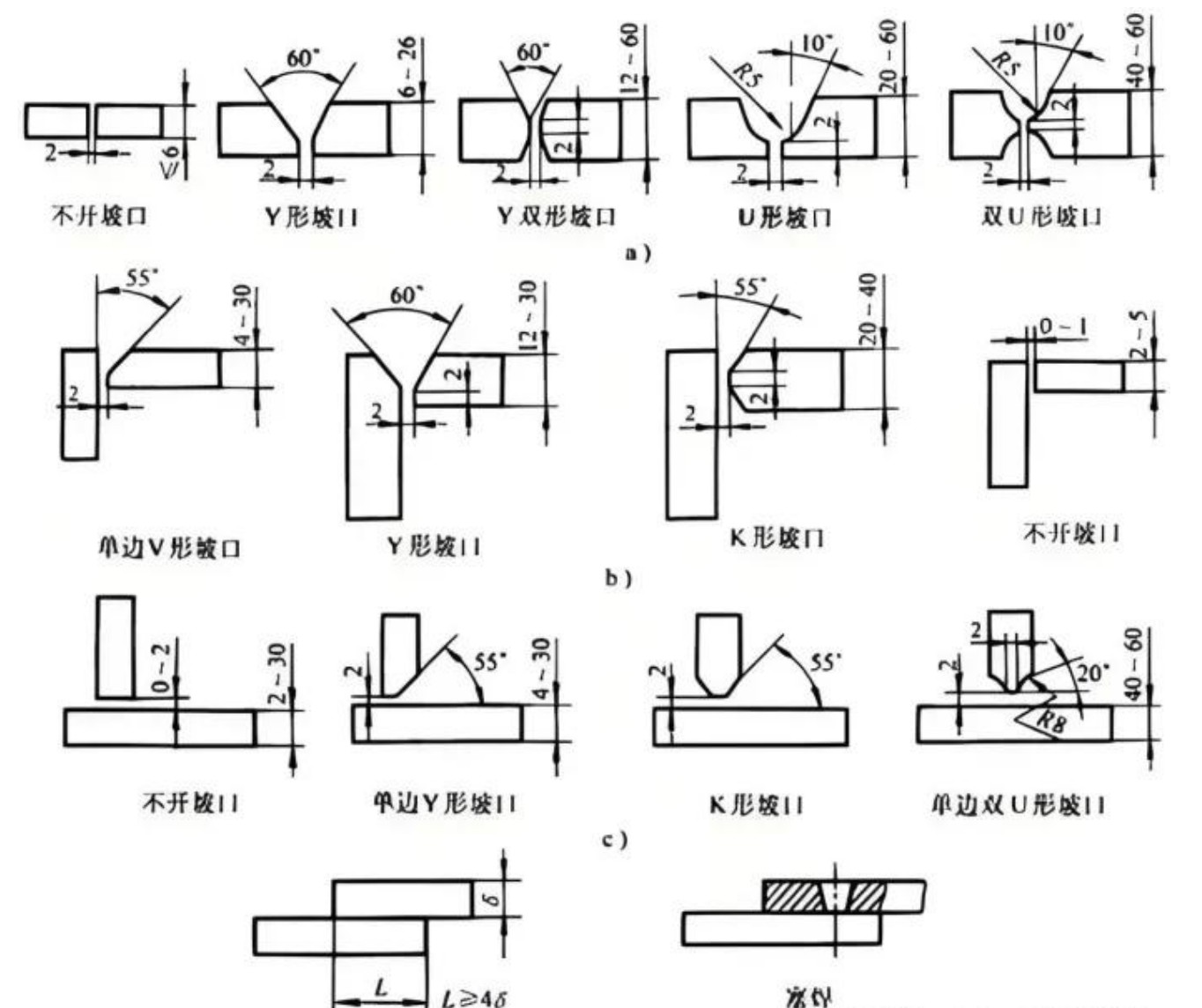
All kinds of groove weld
5. Y-Groove Weld
A Y-groove uses a smaller bevel angle than a standard V-groove.
Advantages
- Lower filler consumption
- Better control of distortion
- Good welding quality
Applications
- Thin plates
- Medium-thickness steel structures
- General fabrication
6. K-Groove Weld
A K-groove combines bevels on both sides of one plate.
Advantages
- Reduces weld volume
- Lowers residual stress
- Improves productivity
Applications
- Heavy structural welding
- Thick steel fabrication
- Construction equipment
7. J-Groove Weld
The J-groove has a curved preparation on one side.
Advantages
- Lower filler metal usage
- Improved root access
- Reduced cracking risk
Applications
- Stainless steel fabrication
- Pressure vessels
- Medium-thickness materials
8. Double-V Groove
The Double-V groove is commonly used when welding from both sides.
Advantages
- Increased penetration
- Improved weld balance
- Lower distortion
Applications
- Structural components
- Thick plate fabrication
- Shipbuilding
9. Double-U Groove
Double-U grooves are used for extremely thick materials.
Advantages
- Minimum filler consumption
- Reduced residual stress
- Superior weld quality
Applications
- Nuclear equipment
- Pressure vessels
- Large industrial structures
Key Groove Dimensions and Parameters
Proper groove design involves several critical dimensions.
Groove Face
The prepared surface that forms the groove is called the groove face.
Its quality directly affects weld penetration and fusion.
Groove Angle
The angle between two groove faces is known as the groove angle.
Typical groove angles:
- 30°
- 45°
- 60°
- 75°
Larger angles improve accessibility but increase filler metal consumption.
Bevel Angle
The angle between the groove face and the plate surface is called the bevel angle.
The bevel angle determines how easily the welding arc or laser reaches the root.
Root Gap
The space intentionally left between two workpieces before welding is called the root gap.
Functions
- Ensures root penetration
- Improves fusion
- Prevents incomplete penetration
In laser welding, root gaps must be carefully controlled because excessive gaps can cause instability.
Root Face (Land)
The flat section remaining at the root of the groove is called the root face or land.
Function
- Prevent burn-through
- Stabilize molten metal
Excessive root face thickness may prevent full penetration.
Root Radius
The radius at the bottom of a J-groove or U-groove is called the root radius.
Function
- Improves access to the groove root
- Enhances penetration
- Reduces stress concentration
Groove Welds in Laser Welding
Laser welding has changed traditional groove design requirements.
Because laser beams provide:
- Extremely high energy density
- Deep penetration capability
- Narrow weld widths
Many applications no longer require large groove angles.
Thin Materials
For:
- Stainless steel
- Carbon steel
- Aluminum
up to several millimeters thick, laser welding often uses simple I-grooves or even zero-gap butt joints.
Benefits include:
- No bevel preparation
- Faster production
- Lower costs
- Better appearance
Medium Thickness Materials
For thicker sections:
- 6 mm
- 8 mm
- 10 mm
- 12 mm
laser welding may still use narrow V-grooves.
Compared with arc welding:
- Groove angles can be smaller
- Less filler wire is needed
- Distortion is lower
Thick Plate Laser Welding
For heavy fabrication applications:
- Shipbuilding
- Construction equipment
- Structural steel
laser welding is often combined with:
- Filler wire
- Hybrid laser-arc welding
- Multi-pass welding
In these situations, groove preparation remains necessary.
Groove Weld vs Fillet Weld
| Feature | Groove Weld | Fillet Weld |
|---|---|---|
| Joint Type | Butt Joint | Corner/T-Joint |
| Penetration | Partial or Full | Usually Partial |
| Strength | Higher | Moderate |
| Material Thickness | Thin to Thick | Mostly Medium |
| Structural Applications | Common | Common |
| Laser Welding Suitability | Excellent | Good |
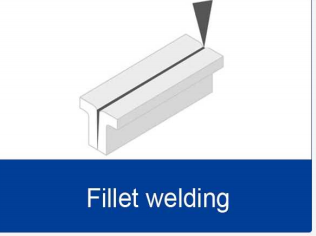
fillet welding
Applications of Groove Welds
Groove welds are widely used in:
Structural Steel Fabrication
- Buildings
- Bridges
- Stadiums
- Towers
Pipeline Manufacturing
- Oil pipelines
- Gas pipelines
- Water pipelines
Shipbuilding
- Hull structures
- Deck assemblies
Heavy Machinery
- Excavators
- Cranes
- Mining equipment
Automotive Manufacturing
- Chassis components
- Battery trays
- Structural reinforcements
Aerospace Industry
- Precision structural components
- Lightweight assemblies
How to Choose the Right Groove for Laser Welding
Several factors should be considered:
Material Thickness
Thin materials:
- I-groove
Medium materials:
- V-groove
- Y-groove
Thick materials:
- U-groove
- K-groove
- X-groove
Material Type
- Stainless steel
- Carbon steel
- Aluminum
- Copper
Each material has different penetration and heat conduction characteristics.
Strength Requirements
If complete joint penetration is required, deeper groove designs may be necessary.
Production Efficiency
Reducing groove volume can significantly lower:
- Welding time
- Filler consumption
- Manufacturing costs
Conclusion
A groove weld is far more than simply preparing an edge before welding. The groove design directly affects weld penetration, strength, distortion, filler metal consumption, and overall manufacturing efficiency.
From simple I-grooves used in modern laser welding to complex U-, K-, X-, and Double-U grooves required for heavy structural fabrication, each groove type serves a specific purpose.
As laser welding technology continues to advance, manufacturers can often reduce groove size, decrease filler wire consumption, and achieve higher productivity than traditional welding methods. However, selecting the proper groove geometry remains critical to achieving reliable weld quality and long-term structural performance.
At ZS Laser, we provide laser welding solutions for sheet metal fabrication, structural welding, robotic welding, and automated production lines. If you are unsure which groove design or laser welding process is best for your application, contact our engineering team for professional recommendations and free welding sample testing.

WhatsApp
Scan the QR Code to start a WhatsApp chat with us.