 ZS Laser Equipment

In metal structure manufacturing, sheet metal processing, and industrial equipment production, fillet weld is one of the most widely used welding joint types. Whether it is steel frames, electrical enclosures, or automated equipment housings, fillet welds are essential for structural joining.
This article systematically explains what a fillet weld is, its common types, traditional welding methods, and how laser welding is applied in fillet weld production, including process steps and key advantages.
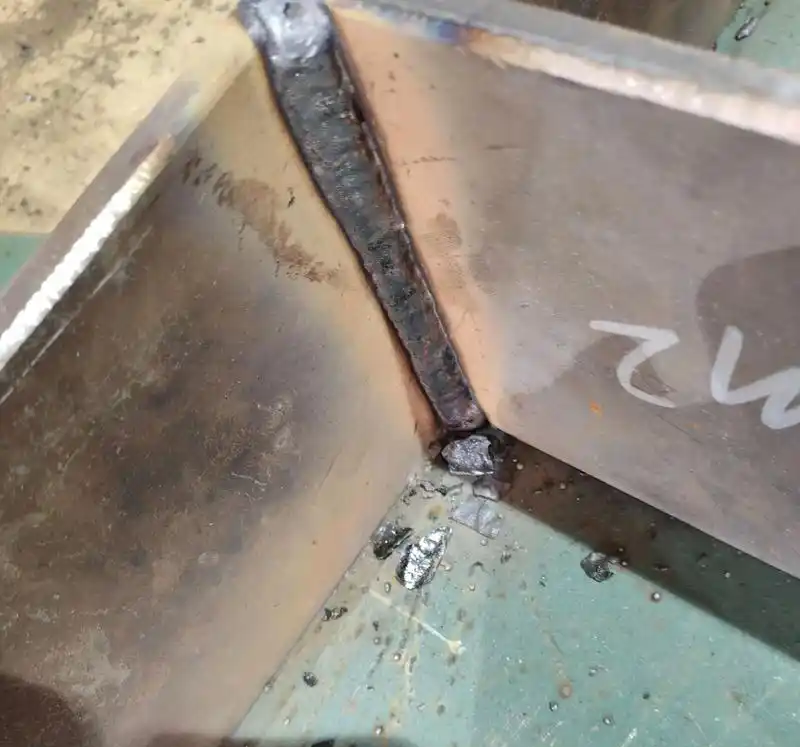
fillet weld
1. What is a Fillet Weld?
A fillet weld refers to a welded joint formed by filling weld metal at the intersection of two metal workpieces that are positioned at a perpendicular or near 90-degree angle.Unlike groove weld,the cross-section of a fillet weld is typically triangular, and it does not require groove preparation. This makes it simple to process and highly efficient, which is why it is one of the most commonly used welding methods in industrial production.
Simply put:It is a weld that fills the “inner corner” between two metal plates to form a strong connection.
The cross-section of a fillet weld is typically triangular, and it does not require groove preparation. This makes it simple to process and highly efficient, which is why it is one of the most commonly used welding methods in industrial production.
2. Common Types of Fillet Welds
Depending on the joint configuration, fillet welds can be mainly divided into three types:
1. T-joint fillet weld
Two plates are joined perpendicular to each other, forming a “T” shape. This is the most common structure used in machine frames and support structures.
2. Lap joint fillet weld
Two plates overlap partially and are welded together. It is commonly used in thin sheet metal applications such as automotive parts.
3. Corner joint fillet weld
Two plates form a right-angle structure at the edges. It is widely used in box structures and enclosures.
3. Traditional Welding Methods for Fillet Welds
In industrial production, fillet welds are commonly produced using the following welding methods:
MIG/MAG Welding (Metal Inert/Active Gas Welding)
MIG/MAG welding is currently the most widely used welding process in industrial manufacturing. It is commonly found in sheet metal fabrication, steel structure manufacturing, and equipment frame assembly. The process works by continuously feeding a consumable wire electrode into the welding zone, where it melts under a shielding gas environment (inert or active gas) to form the weld bead. This results in a relatively stable welding process that is suitable for continuous production.
In fillet weld applications, MIG/MAG welding offers high productivity and is well-suited for medium to thick plate structures, especially T-joints and lap joints. Since the wire feeding is continuous, it is relatively easy to automate or semi-automate, making it widely used in production lines.
However, it also has clear disadvantages. Due to relatively dispersed arc energy, spatter is often generated during welding, requiring post-weld cleaning or grinding. This is particularly problematic for products with strict appearance requirements, increasing additional labor and cost. In addition, the relatively high heat input may also cause some degree of distortion in the workpiece.
TIG Welding (Tungsten Inert Gas Welding)
TIG welding is known for producing high-quality welds. It uses a non-consumable tungsten electrode, with an inert gas (such as argon) providing arc stability. Filler material is typically added manually or through an automated feeding system.
In fillet weld applications, TIG welding provides excellent weld quality with smooth and precise bead formation and almost no spatter. This makes it ideal for products requiring high aesthetic standards, such as stainless steel decorative parts, food-grade equipment, and precision components.
However, TIG welding has limitations. It is relatively slow compared to MIG/MAG welding and is therefore more suitable for small-batch or high-precision applications rather than mass production. It also requires highly skilled operators to control current, torch angle, and filler feeding speed. Otherwise, issues such as uneven welds or burn-through may occur.
Shielded Metal Arc Welding (SMAW)
SMAW is a very traditional welding method that uses a consumable electrode coated with flux. The arc melts the electrode to form the weld. Its biggest advantage is its simplicity—equipment is inexpensive and easy to operate, with minimal auxiliary systems required.
For fillet weld applications, SMAW is suitable for field construction and repair work, such as steel structure installation, outdoor fabrication, and equipment maintenance. It performs well in harsh environments, even in windy or confined spaces.
However, from a manufacturing perspective, its limitations are obvious. Weld appearance is relatively rough, spatter and slag are common, and post-weld cleaning is required. Efficiency is also relatively low, making it unsuitable for high-consistency mass production. Therefore, it is mainly considered an engineering or maintenance welding method rather than a precision manufacturing process.
Submerged Arc Welding (SAW)
SAW is a highly efficient welding process designed for heavy industrial applications. During welding, the arc is covered by granular flux, creating a “submerged” arc environment that ensures stable and high-energy-density welding.
In fillet weld applications, SAW is commonly used for thick plates, large steel structures, or long straight welds, such as bridges, ships, pressure vessels, and large structural frames. It allows continuous long-duration welding, making it highly efficient in heavy industry production.
SAW also offers a high degree of automation and can be integrated into semi-automatic or fully automatic welding systems. However, the equipment is large and requires fixed workstations, making it unsuitable for flexible or small-scale production. Its application is therefore mainly concentrated in heavy industrial sectors.
4. Laser Welding in Fillet Weld Applications
With increasing demands for efficiency and precision in manufacturing, laser welding is becoming an important upgrade solution for fillet weld production.
Laser welding uses a high-energy-density laser beam to rapidly melt the metal surface and form a weld joint, making it suitable for high-precision and high-efficiency industrial production.
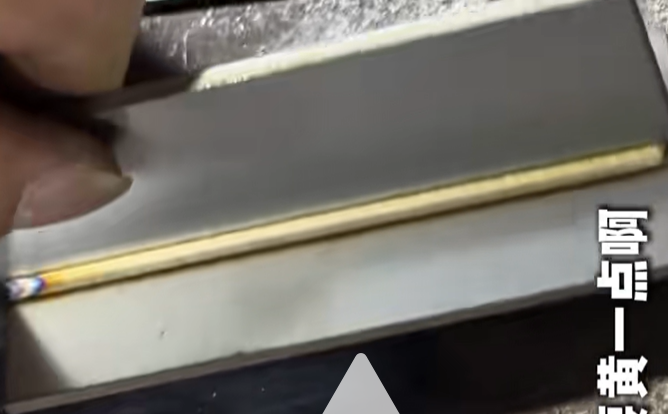
800W laser power welding of 3mm steel plate fillet weld
5. Process Steps of Laser Fillet Welding
Taking automated laser welding as an example, the basic process is as follows:
1. Workpiece positioning and clamping
Fixtures are used to secure T-joint or lap joint structures.
Ensure stable welding gaps.
Automation systems enable repeatable positioning.
2. Weld path programming
Welding paths are set through teaching or programming.
Vision systems can be integrated to automatically detect weld positions.
3. Laser parameter setup
Key parameters include:
- Laser power
- Welding speed
- Focus position
- Shielding gas (e.g., argon)
4. Laser welding execution
The laser beam is focused on the joint area.
The material melts instantly to form a molten pool.
After cooling, a dense and solid weld is formed.
5. Post-weld inspection
Inspect weld formation quality.
No or minimal post-processing is required depending on the material.
6. Advantages of Laser Fillet Welding
Compared with traditional welding methods, laser welding offers significant advantages in fillet weld applications:
1. Low heat distortion
The laser energy is highly concentrated, resulting in a small heat-affected zone and significantly reduced workpiece deformation.
2. High weld quality
The weld is uniform, dense, and aesthetically clean with stable mechanical strength.
3. High speed and efficiency
Welding speed is much higher than TIG/MIG processes, making it suitable for mass production.
4. Easy automation
Can be integrated with robots, vision systems, and conveyor lines for fully automated production.
5. Minimal post-processing
Low spatter and clean welds reduce or eliminate the need for grinding.
6. Wide material compatibility
Suitable for stainless steel, carbon steel, aluminum alloys, and more.
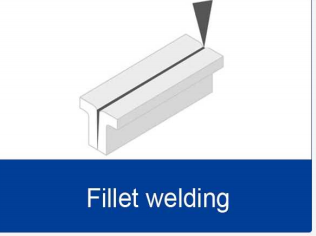
fillet welding
7. Laser Welding vs Traditional Welding (Fillet Weld Comparison)
| Item | MIG/TIG Welding | Laser Welding |
|---|---|---|
| Welding speed | Medium / Slow | Very fast |
| Heat distortion | High | Very low |
| Appearance quality | Average | Excellent |
| Automation level | Low | Very high |
| Post-processing | Required | Minimal |
| Production efficiency | Medium | High |
8. Typical Applications of Laser Fillet Welding
Laser fillet welding is widely used in:
- Sheet metal enclosures and cabinets
- Stainless steel equipment housings
- Automotive components
- Elevator panel structures
- HVAC ventilation systems
- Industrial machine frames
In mass production environments, laser welding is gradually replacing traditional MIG/TIG welding.
9. Conclusion And Call To Action
As one of the most fundamental and widely used welding joint types, fillet weld plays a critical role in industrial manufacturing. Traditional welding methods such as MIG/MAG, TIG, SMAW, and SAW have supported industrial development for decades. However, with increasing demands for efficiency, appearance quality, and consistency, these methods are gradually showing limitations in productivity, stability, and automation capability.
In contrast, laser welding technology is rapidly becoming a key upgrade direction for fillet weld processing due to its high energy density, high welding speed, minimal heat-affected zone, and excellent weld formation quality. It is especially advantageous in thin plate structures, stainless steel equipment, and high-precision sheet metal manufacturing, as it significantly reduces deformation and post-processing requirements while enabling automated production lines for stable, high-efficiency mass manufacturing.
For modern manufacturing companies, adopting laser welding is not only a process upgrade but also an overall production transformation. It reduces labor dependency, improves product consistency, and increases production throughput, ultimately providing stronger delivery capability and cost competitiveness in a highly competitive market.
Call to Action
If your factory is currently using MIG or TIG welding for fillet welds and facing challenges such as low efficiency, high distortion, high labor cost, or inconsistent appearance quality, now is the ideal time to upgrade your welding process.
ZS Laser provides professional industrial laser welding solutions, widely applied in fillet welds, T-joint welding, and sheet metal fabrication, helping manufacturers achieve higher efficiency and more stable welding quality.
Contact us to get:
- Free welding sample testing
- Process evaluation tailored to your products
- Feasibility analysis for replacing traditional welding with laser welding
Let laser welding help your production line move toward higher efficiency and smart manufacturing.

WhatsApp
Scan the QR Code to start a WhatsApp chat with us.