 ZS Laser Equipment

Stud welding is widely used in sheet metal fabrication, automotive manufacturing, and industrial equipment assembly. When selecting a stud welder, many users face a key question:
Should you choose a traditional stud welder, or consider laser stud welding technology?
This article explains the main types of traditional stud welders and provides a practical comparison with laser stud welding, helping you make a more informed decision.
What Is a Traditional Stud Welder?
A traditional stud welder typically uses electrical energy to fuse a stud onto a metal surface. The most common types include:
1.Capacitor Discharge (CD) Stud Welder
This type stores energy in capacitors and releases it in a very short time.
Suitable for thin sheet metal
Common stud size: M3–M6
Very fast welding speed
Minimal backside marking
It is widely used in electrical cabinets, enclosures, and light-duty applications.
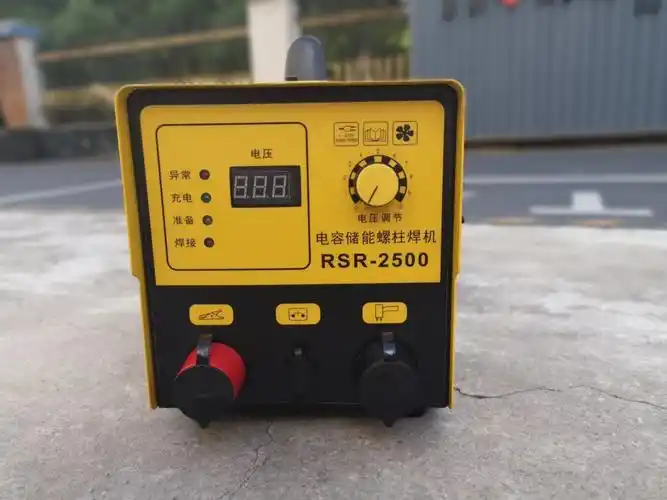
Capacitor Discharge (CD) Stud Welder
2.Drawn Arc Stud Welder
This method creates an arc between the stud and the workpiece, generating heat to complete the weld.
Suitable for thicker materials
Larger studs (M6–M12 or above)
Strong weld strength
Requires ceramic ferrules or shielding gas
It is commonly used in construction, steel structures, and heavy-duty applications.
3.Short Cycle Stud Welding
A hybrid process between CD and drawn arc welding.
Medium thickness materials
Faster than drawn arc
Lower heat input
Often used in automotive and industrial manufacturing.
What Is Laser Stud Welding?
Laser stud welding uses a high-energy laser beam to locally melt the contact area between the stud and the base material. Compared to traditional methods, it is a more precise and controllable process.
It is often integrated into automated systems such as CNC platforms or multi-axis welding machines, enabling high-precision and flexible production.
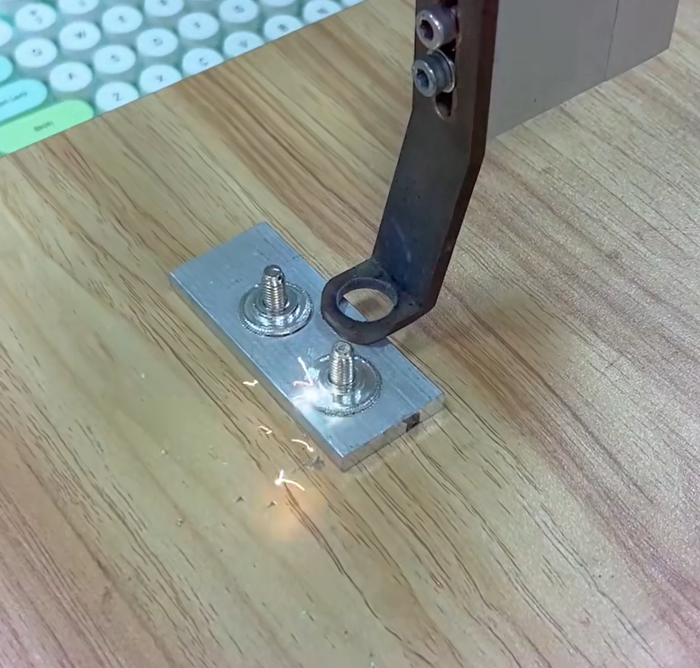
Stud Laser Welding
Advantages of Laser Stud Welding
1.Higher Precision
Laser energy is highly concentrated, allowing precise control of the weld area. This is especially useful for:
Small studs
Precision components
Complex welding layouts
2.Lower Heat Input
Compared to traditional arc-based stud welders, laser welding introduces less heat into the material.
Reduced deformation
Better surface quality
Suitable for thin or sensitive materials
3.Better for Automation
Laser stud welding systems are easy to integrate with:
CNC motion systems
Vision positioning systems
Robotic arms
This makes them ideal for automated production lines with high consistency requirements.
4.Flexible for Complex Structures
With additional axes or fixtures, laser systems can handle:
Inclined surfaces
Curved parts
Complex 3D geometries
Limitations of Laser Stud Welding
1.Higher Initial Cost
Laser systems typically require a higher investment compared to traditional stud welders, especially when combined with automation platforms.
2.Process Sensitivity
Laser welding is more sensitive to:
Surface condition
Material reflectivity (e.g., copper, aluminum)
Parameter settings
Proper testing and parameter optimization are necessary.
3.Not Ideal for Very Thick Materials
For heavy structural applications or very large studs, traditional drawn arc stud welding may still be more suitable due to deeper penetration and higher bonding strength.
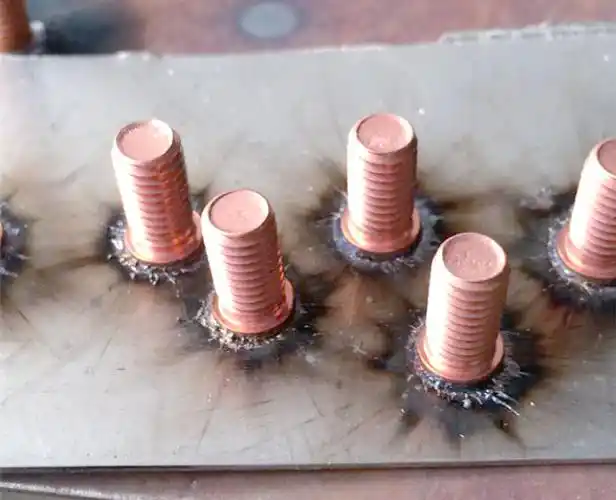
Traditional Stud Welding Sample
Traditional Stud Welder vs Laser Stud Welding
From a practical perspective:
Traditional stud welders are reliable, cost-effective, and widely used in standard applications
Laser stud welding offers higher precision, better automation compatibility, and greater flexibility
Which One Should You Choose?
The best choice depends on your application:
If you are working with thick materials, large studs, or heavy structural components → a traditional stud welder is often the better option
If your application involves precision parts, thin materials, complex layouts, or automated production → laser stud welding is more suitable
Both traditional stud welder systems and laser stud welding technologies have their own advantages.
There is no universal solution. The right choice depends on your product design, material, and production requirements.
If you are unsure which solution fits your application, it is always recommended to test your parts and consult with experienced equipment suppliers.ZS Laser is a experienced laser welding supplier in industry welding,you can cansult us at any time to get your suitable solutions.

WhatsApp
Scan the QR Code to start a WhatsApp chat with us.