 ZS Laser Equipment

No matter how good a weld looks during the welding process, the job is often only half finished. In many fabrication industries, weld finishing is just as important as welding itself.A rough weld with excessive spatter, oxidation, or uneven reinforcement can affect not only the appearance of a product but also its coating quality, corrosion resistance, and assembly accuracy.
For decades, the welding grinder has been the standard tool for post-weld finishing. Welders use angle grinders to remove slag, flatten weld beads, clean oxidation, and prepare metal surfaces for painting or powder coating.However, the rapid development of laser welding technology has changed this workflow. Modern 4-in-1 laser welding machines combine welding, cutting, cleaning, and weld cleaning into one system, dramatically reducing the amount of grinding required after welding.
So, which solution is better?
Should manufacturers continue relying on traditional grinding tools, or is laser weld cleaning becoming the new standard?
This article compares both technologies to help you choose the right weld finishing solution for your production.
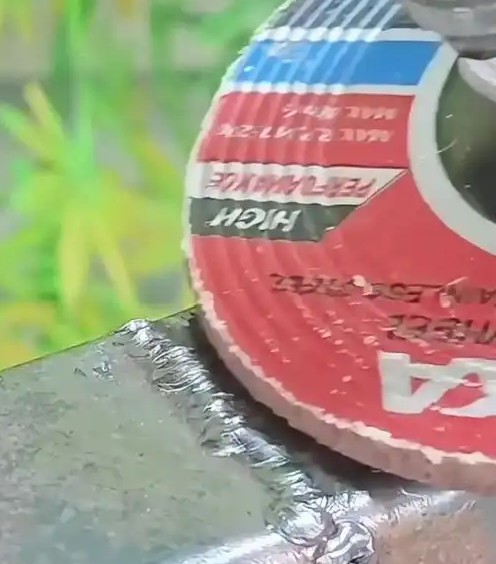
Grinding of square tube welds
Why Is Weld Finishing Important?
Many people assume that once two pieces of metal are joined together, the welding process is complete.In reality, industries such as sheet metal fabrication, cabinet manufacturing, food equipment, medical devices, automotive parts, and stainless steel furniture place extremely high demands on weld appearance.
Poor weld finishing may result in:
- Visible weld reinforcement
- Excessive welding spatter
- Heat discoloration
- Surface oxidation
- Uneven paint or powder coating
- Poor product appearance
Even structurally sound welds may require additional finishing before the product is ready for assembly or shipment.
For this reason, weld finishing has become an essential step in modern metal fabrication.
What Is a Welding Grinder?
Despite the name, a welding grinder is not a specialized welding machine. It generally refers to grinding tools used after welding, most commonly an angle grinder equipped with different abrasive accessories.Common grinding accessories include:
- Grinding wheels
- Flap discs
- Wire brush wheels
- Sanding discs
- Polishing wheels
Depending on the application, these tools perform different finishing operations.Typical grinding tasks include:
- Removing weld reinforcement
- Eliminating welding spatter
- Cleaning slag
- Removing oxidation
- Blending weld seams
- Preparing surfaces for coating
- Creating smoother cosmetic finishes
Because of their versatility and relatively low cost, welding grinders remain standard equipment in almost every fabrication shop.
Why Traditional Welding Requires So Much Grinding
The amount of grinding required depends largely on the welding process.
MIG Welding
MIG welding offers high productivity but often produces:
- Significant spatter
- Raised weld beads
- Heat discoloration
Most welded parts require grinding before painting or powder coating.
Stick Welding (SMAW)
Stick welding creates slag that must be completely removed after welding.Besides slag removal, additional grinding is often necessary to smooth the weld surface.
Flux-Cored Welding
Flux-cored welding generates even more slag and spatter than standard MIG welding.Grinding usually becomes one of the most time-consuming stages of production.
TIG Welding
TIG welding produces cleaner welds than MIG or Stick welding.However, for products requiring decorative finishes, such as stainless steel furniture or food-grade equipment, polishing is still commonly required.In many workshops, welders spend almost as much time grinding as they do welding.This hidden labor cost is often underestimated.
The Hidden Costs of Using a Welding Grinder
Although grinding tools are inexpensive, the overall cost of weld grinding is much higher than many manufacturers realize.
Labor Costs
Grinding is a completely manual process.In many production lines, a welder may spend one minute welding but several minutes grinding and polishing.Over thousands of parts, this significantly increases labor costs.
Material Removal
Grinding removes metal.If too much material is removed, the weld reinforcement may become insufficient, potentially reducing joint strength.Repair work may even become necessary.
Dust and Workplace Safety
Grinding produces large amounts of airborne metal dust.This is especially noticeable when processing:
- Stainless steel
- Carbon steel
- Aluminum
Without proper dust extraction, grinding can negatively affect workplace safety and equipment cleanliness.
Noise
Angle grinders operate at very high speeds and generate considerable noise.Long-term exposure increases operator fatigue and often requires additional hearing protection.
Inconsistent Quality
Manual grinding depends heavily on operator experience.Different workers may produce different surface finishes, making it difficult to maintain consistent product quality in mass production.
How Laser Welding Reduces Weld Finishing
Laser welding changes the situation completely.Compared with traditional arc welding, laser welding produces:
- Narrower weld seams
- Lower heat input
- Minimal spatter
- Smaller heat-affected zones
- Better dimensional accuracy
Because less heat enters the workpiece, deformation is significantly reduced.The cleaner weld profile also means much less grinding is required afterward.For many sheet metal products, laser-welded parts can proceed directly to brushing, powder coating, or assembly without extensive grinding.This is one of the biggest productivity advantages of laser welding.
What Is Laser Weld Cleaning?
Many people mistakenly believe that the cleaning function on a 4-in-1 laser welding machine simply replaces an angle grinder.In reality, they perform very different tasks.Laser weld cleaning uses a laser beam to remove:
- Welding oxidation
- Heat tint
- Smoke residue
- Surface contamination
- Light welding spatter
Unlike grinding, laser cleaning does not remove significant amounts of base metal.Instead, it restores a clean metal surface while preserving the original weld profile.For stainless steel, laser cleaning is especially effective at removing the yellow, blue, and purple heat tint that appears after welding.
Welding Grinder vs Laser Weld Cleaning
| Welding Grinder | Laser Weld Cleaning |
|---|---|
| Contact process | Non-contact process |
| Removes base metal | Removes oxidation and contaminants |
| Produces dust | Almost dust-free |
| High noise | Low noise |
| Consumes grinding discs | Minimal consumables |
| May scratch the surface | Preserves surface quality |
| Operator dependent | Easier to achieve consistent results |
| Higher labor intensity | Faster post-processing |
The biggest difference is simple:
Grinding reshapes the weld.
Laser cleaning restores the weld.
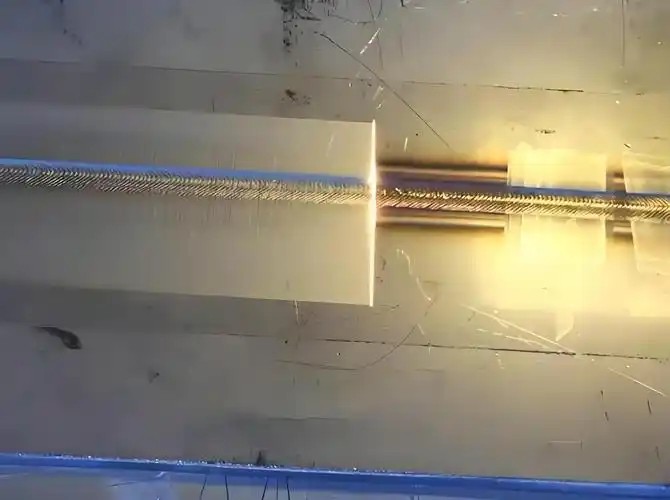
Laser weld cleaning
Can Laser Cleaning Completely Replace Grinding?
The answer is not always.
Laser cleaning is excellent for removing oxidation, discoloration, and light contamination, but it cannot replace grinding in every application.
Grinding is still necessary when:
- Weld reinforcement is intentionally excessive
- Structural welds require blending
- Mirror-finish polishing is required
- Weld geometry must be reshaped
- Surface leveling is needed before machining
Laser cleaning should therefore be viewed as a complementary technology rather than a complete replacement.
When Should You Use a Welding Grinder?
Traditional grinding remains the better choice for:
- Heavy structural steel fabrication
- Thick plate welding
- Large weld reinforcement removal
- Repair welding
- Surface reshaping
- Preparing welds for machining
In these applications, physical material removal is still essential.
When Is Laser Weld Cleaning the Better Choice?
Laser weld cleaning offers clear advantages in industries where appearance, efficiency, and precision matter most.Typical applications include:
- Sheet metal fabrication
- Electrical cabinets
- Stainless steel furniture
- Kitchen equipment
- Medical devices
- Elevator panels
- Automotive components
- Precision metal fabrication
For these products, reducing post-processing time can significantly improve production efficiency while delivering a cleaner and more consistent finish.
Why More Manufacturers Are Choosing 4-in-1 Laser Welding Machines
Modern 4-in-1 laser welding machines combine four functions into one compact system:
- Laser welding
- Laser cutting
- Surface cleaning
- Weld cleaning
Instead of moving workpieces between multiple machines, operators can complete several processes using a single handheld system.
Compared with traditional welding followed by extensive grinding, this integrated workflow reduces:
- Labor costs
- Production time
- Consumable usage
- Dust generation
- Secondary finishing work
For manufacturers producing stainless steel cabinets, sheet metal enclosures, furniture, and precision fabricated parts, this can dramatically improve productivity.
Conclusion
A welding grinder remains an essential tool in many fabrication shops, especially for structural welding, heavy plate fabrication, and applications requiring significant weld reshaping.However, manufacturing is moving toward cleaner, faster, and more automated production methods.
Laser welding already produces smoother welds with far less spatter than traditional welding processes. Combined with laser weld cleaning, manufacturers can dramatically reduce grinding time, lower labor costs, and achieve more consistent product quality.
At ZS Laser, we provide advanced 3-in-1 and 4-in-1 handheld laser welding machines that integrate welding, cutting, and laser cleaning into one intelligent system. Whether you manufacture sheet metal cabinets, stainless steel furniture, automotive components, or precision fabricated parts, our laser welding solutions can help you minimize post-processing, improve efficiency, and produce cleaner, higher-quality welds.
If you’re looking to reduce grinding time and modernize your welding workflow, contact ZS Laser today. Our engineers are ready to recommend the right laser welding solution for your production needs.

WhatsApp
Scan the QR Code to start a WhatsApp chat with us.