 ZS Laser Equipment

Plastic welding is widely used to assemble automotive components, medical devices, electrical housings, consumer products, and thermoplastic composite parts. Among the many available technologies, induction welding and laser welding are both non-contact heating processes, but they generate heat in very different ways.So, when comparing induction welding vs laser welding for plastic, which process is better?
The answer depends on the plastic material, joint design, component geometry, production volume, required weld quality, and process requirements. Neither technology is the best choice for every application.
What Is Induction Welding for Plastic?
Induction welding uses electromagnetic energy to generate heat at or near the welding interface of a thermoplastic component.In many induction welding configurations, a conductive or metallic susceptor is positioned at the joint. An alternating electromagnetic field generated by an induction coil heats the susceptor, which then transfers heat to the surrounding thermoplastic material. Once the polymer at the interface reaches its melting temperature, pressure is applied to form the joint.
The exact heating mechanism depends on the material and system configuration. Thermoplastic composites with sufficient electrical conductivity, for example, may be heated by induction without a separate metallic susceptor.
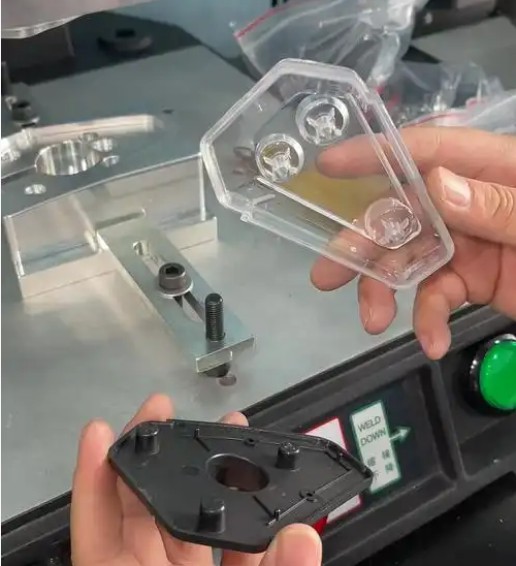
Plastic welding
What Is Laser Welding for Plastic?
Laser welding uses a focused laser beam to generate heat directly in the joint area of thermoplastic components.
One of the most established methods is laser transmission welding. In a typical configuration, the upper plastic component is relatively transmissive to the selected laser wavelength, while the lower component or an interface layer absorbs the laser energy. The absorbed energy is converted into heat, melting the polymer locally at the joint.The two components are normally held together during welding so that the molten polymer can form a strong joint as it cools.
Laser welding can also be performed using other process configurations, including contour, simultaneous, quasi-simultaneous, and hybrid approaches. Therefore, plastic laser welding is not limited to one particular optical arrangement.
Induction Welding vs Laser Welding: Key Differences
Although both processes can provide localized, non-contact heating, their process requirements are quite different.
| Factor | Induction Welding | Laser Welding |
|---|---|---|
| Heat source | Electromagnetic field | Laser beam |
| Heating mechanism | Induced electromagnetic heating | Optical energy absorption |
| Contact with heating tool | Non-contact | Non-contact |
| Susceptor | Often required, depending on material/process | Not normally required |
| Material requirements | Electrical/magnetic response or suitable susceptor may be needed | Optical transmission/absorption must be suitable |
| Joint visibility | Depends on joint design | Can produce very clean and unobtrusive welds |
| Complex geometries | Depends strongly on coil and susceptor design | Highly flexible with beam/path control |
| Automation | Highly suitable | Highly suitable |
| Heat affected area | Localized | Highly localized |
| Process flexibility | Dependent on coil design and heating configuration | High flexibility through beam and motion control |
| Typical applications | Thermoplastic composites and suitable thermoplastic assemblies | Precision plastic components, films, sheets, and molded parts |
Difference In Material Compatibility
Material selection is one of the most important considerations when choosing between induction and laser welding.
Induction Welding
Induction welding requires the material and joint configuration to interact appropriately with the electromagnetic field. In conventional systems, this often means using a suitable susceptor at the interface. Thermoplastic composites containing electrically conductive reinforcement can also be suitable for induction welding under appropriate conditions.
This makes induction welding particularly interesting for thermoplastic composite structures, including applications involving carbon-fiber-reinforced thermoplastics.However, the electrical, thermal, and electromagnetic properties of the material need to be considered during process development.
Laser Welding
Laser welding depends strongly on the optical properties of the polymer at the selected laser wavelength.For conventional transmission laser welding, one component needs to transmit sufficient laser energy while the joint region needs to absorb enough energy to generate melting. Pigments, fillers, additives, material color, and processing history can therefore affect weldability.
This is why two plastics that appear identical visually may not necessarily behave identically during laser welding.
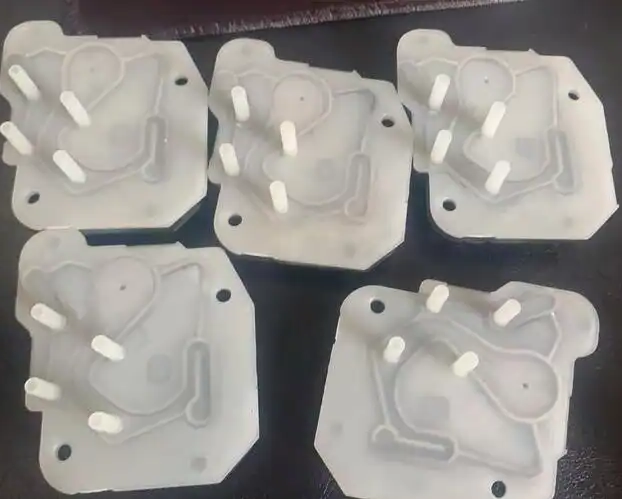
Laser welding effect on white plastic
Which Process Offers Better Precision?
For applications requiring highly localized heat input and precise control of the weld path, laser welding has a significant advantage.The laser beam can be focused and moved along a programmed path, allowing the heat to be concentrated in the intended joint area. This is particularly useful for molded plastic components with detailed geometries, narrow weld paths, and appearance-sensitive surfaces.
Laser welding also does not require a mechanical welding tool to directly contact the joint during heating. This can help reduce mechanical stress on delicate components. Research reviews have highlighted the small localized heat input and suitability of laser welding for complex shapes.
Induction welding can also provide localized heating, but the heating pattern is strongly influenced by the design and position of the induction coil and, where applicable, the susceptor. For complex geometries, designing the induction system can therefore become an important part of the process.
Induction Welding vs Laser Welding for Thermoplastic Composites
Thermoplastic composites are an interesting application because their electrical and thermal properties can make induction welding attractive.
For example, carbon-fiber-reinforced thermoplastics can have sufficient electrical conductivity for induction heating under suitable configurations. Research comparing induction and transmission laser welding has demonstrated that the suitability of each process depends heavily on the material properties of the composite and the specific joint configuration.
Laser welding can also be used for thermoplastic composites, but optical transmission and absorption become important. Carbon fibers, pigments, fillers, and the structure of the composite can significantly influence how laser energy interacts with the material.
Therefore, for composite applications, neither process should be selected simply because it is faster or more advanced. Material characterization and welding trials are often necessary before choosing the production process.
Which Is Better for High-Volume Production?
Both induction welding and laser welding can be integrated into automated production systems.
Induction welding can be highly effective when the joint geometry is consistent and the induction coil can provide a repeatable heating pattern. Once the coil, fixture, frequency, power, pressure, and process parameters have been established, the process can be well suited to repetitive production.
Laser welding is also highly suitable for automation. Laser systems can be integrated with CNC platforms, robotic systems, scanning optics, and automated fixtures. The welding path can be programmed and adjusted for different component geometries.
This gives laser welding an important advantage when manufacturers need production flexibility or frequent changes between different component designs.
Induction Welding vs Laser Welding: Advantages and Limitations
Advantages of Induction Welding
Induction welding can be attractive when:
- The material has suitable electromagnetic or electrical properties
- A suitable susceptor can be incorporated into the joint
- The component geometry is compatible with the induction coil
- Consistent and repeatable heating is required
- Thermoplastic composite structures are being joined
- The production process can justify dedicated tooling
Limitations of Induction Welding
Potential limitations include:
- Coil design can be application-specific
- The heating pattern depends on electromagnetic and material properties
- A susceptor may be required in many configurations
- Changing component geometry may require changes to the induction system
- Process development must consider frequency, power, pressure, heating time, and thermal behavior
Advantages of Laser Welding
Laser welding is particularly attractive when manufacturers need:
- Highly localized heat input
- Precise weld paths
- Low visible marking of the component surface
- Complex or detailed weld geometries
- Flexible automated production
- Non-contact processing
- Clean and repeatable welds
Transmission laser welding can melt the polymer at the interface while leaving the outer surfaces relatively unaffected when the material combination and process are properly designed.
Limitations of Laser Welding
Laser welding also has limitations.
The optical properties of the plastics must be compatible with the selected laser wavelength and welding configuration. Pigments, fillers, additives, and material variations can influence transmission and absorption. Joint fit-up and clamping are also important because the components need to remain in appropriate contact during welding.
For this reason, laser welding should not be selected based only on laser power. Material compatibility, optical properties, joint design, clamping, beam configuration, and process parameters all need to be considered.
Induction Welding or Laser Welding: Which Should You Choose?
There is no universal winner between induction welding and laser welding for plastic.
Induction welding may be a better choice when the material and component are well suited to electromagnetic heating, particularly for thermoplastic composite applications or production systems where a dedicated induction setup is practical.
Laser welding may be a better choice when the application requires precise localized heating, complex weld paths, clean weld appearance, and flexible automation.
The best choice should therefore be based on the complete manufacturing process rather than the heating method alone.
Conclusion
Induction welding and laser welding are both valuable technologies for joining thermoplastic materials, but they rely on different heating mechanisms and have different material and process requirements.
Induction welding is particularly interesting for suitable thermoplastic composite structures and applications where electromagnetic heating can provide efficient localized heating. Laser welding offers highly controlled energy delivery and is particularly attractive for precision components, complex weld paths, and automated manufacturing.
For manufacturers considering plastic laser welding, ZS Laser provides laser welding solutions for thermoplastic components and customized production applications. Depending on the component and material, ZS Laser can help evaluate the welding process, laser configuration, fixtures, and automation requirements, with sample testing available for applications that require process validation.
Contact us now to get your own plastic welding solutions.

WhatsApp
Scan the QR Code to start a WhatsApp chat with us.