 ZS Laser Equipment

Handheld laser welders have become an increasingly popular choice for metal fabrication because they combine flexible operation with the advantages of laser welding. They are widely used for welding stainless steel, carbon steel, aluminum, and other suitable metal materials in industries such as sheet metal fabrication, kitchen equipment manufacturing, metal furniture production, and industrial enclosure manufacturing.
However, not all handheld laser welders are the same. Some are designed primarily for welding, while others combine welding with additional functions such as laser cleaning and cutting. Machines also differ in cooling methods, laser power, wire-feeding configurations, and overall system design.
Understanding these differences is important when selecting equipment for a particular application.
In this guide, we explain the main types of handheld laser welders, compare their features, discuss common applications, and help you choose a suitable machine for your production needs.
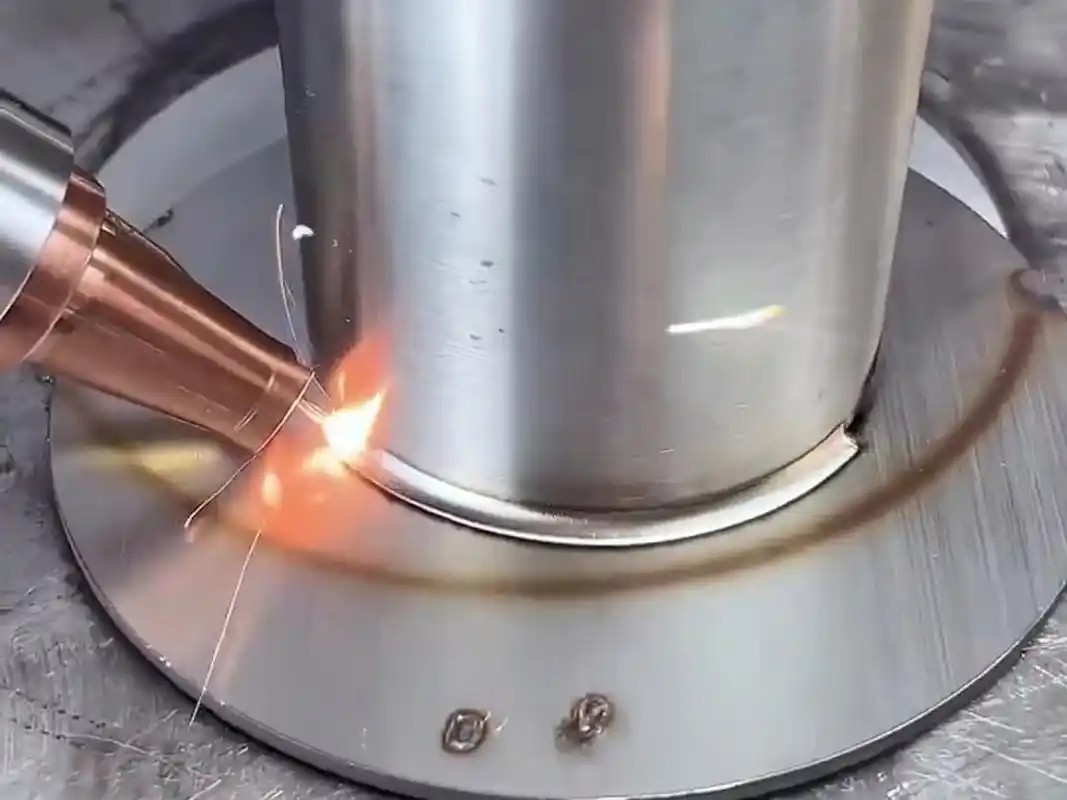
Tube flange laser welding
What Are Handheld Laser Welders?
A handheld laser welder is a laser welding system in which the operator manually guides a welding gun along the joint between two workpieces. The machine delivers a focused laser beam to the welding area, where the material is heated and melted locally. As the molten metal cools and solidifies, it forms a joint between the workpieces.
Most industrial handheld laser welders use fiber laser sources for metal welding. A typical system includes a laser source, handheld welding gun, control system, and cooling system. Depending on the model and application, it may also include a wire feeder and additional processing functions.
Unlike a conventional welding torch, a laser welding gun delivers a focused beam of light rather than using an electrical arc as the primary heat source. This concentrated energy can provide high welding speed potential and help control heat input when the material, joint design, and process parameters are suitable.
Handheld laser welding machines are particularly useful when manufacturers need to weld different products without developing a dedicated automated system for every workpiece.
Types of Handheld Laser Welders
Handheld laser welders can be classified in several ways, including cooling method, available functions, laser power, and auxiliary equipment.These categories are not mutually exclusive. For example, a machine may be a 2000W water-cooled 4-in-1 laser welder with a wire-feeding system.Understanding each classification helps buyers compare machines more accurately.
1. Standard Handheld Laser Welders
A standard handheld laser welder is primarily designed for metal welding. It is a practical option for manufacturers that need a flexible welding solution for general fabrication work.The operator guides the welding gun along the joint, while the control system manages the relevant welding functions.
Main Features
Flexible operation: The operator can move around the workpiece and weld accessible joints in different positions.
Suitable for varied products: The machine can be used for different components without requiring a dedicated CNC platform for every product.
Concentrated heat input: Under suitable conditions, laser welding can help reduce the size of the heat-affected area and limit distortion compared with some conventional welding processes.
Optional filler wire: A wire feeder can be added when the joint gap, weld profile, or application requirements call for additional material.
Typical Applications
Standard handheld laser welders are commonly used for stainless steel cabinets, metal enclosures, kitchen equipment, sheet metal components, and general metal fabrication.
They are especially useful for workshops producing different products in relatively small batches.
However, handheld welding relies on the operator’s ability to maintain a suitable welding path. For applications requiring highly repeatable movement or complex programmed paths, CNC or robotic welding equipment may be more appropriate.
2. Air-Cooled Handheld Laser Welders
Air-cooled handheld laser welders use an air-based cooling arrangement rather than a conventional circulating-water chiller for the relevant cooling functions.Their compact system design can be attractive for applications where portability, equipment layout, and reduced cooling-system complexity are important.
Advantages of Air-Cooled Laser Welders
Compact equipment design: Some air-cooled models combine the laser source and cooling components in a relatively compact unit.
Simplified cooling arrangement: Depending on the design, the machine may not require a separate water chiller.
Convenient installation: A simpler cooling arrangement may make installation and relocation more convenient.
Suitable for specified operating conditions: Air-cooled models can be effective when the machine’s rated power, duty cycle, and environmental requirements match the application.
What Should You Consider?
Air cooling does not automatically mean that a machine is lighter, cheaper, or more suitable for every workshop. These characteristics depend on the specific design.When selecting an air-cooled handheld laser welder, check the rated laser power, continuous operating capability, ambient temperature limits, cooling requirements, and manufacturer’s operating specifications.
For applications involving extended production runs, confirm that the selected model can maintain stable operation under the expected workload.Air-cooled equipment is worth considering when its cooling design matches the production requirements, but it should not be selected based on portability alone.
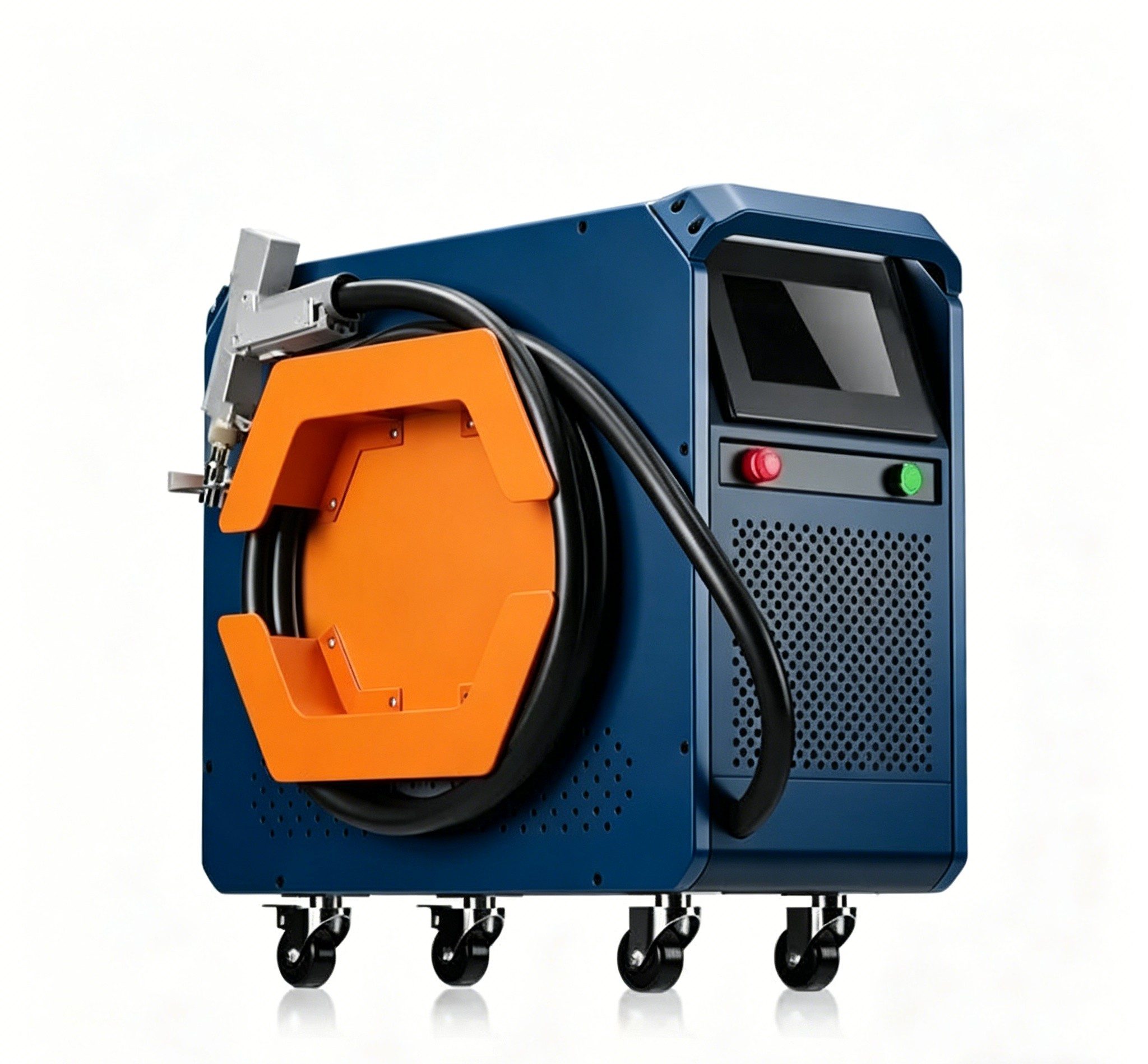
3 in 1 Laser Welder
3. Water-Cooled Handheld Laser Welders
Water-cooled handheld laser welders use a circulating cooling system to remove heat from components that require liquid cooling.
This configuration is common in industrial laser welding systems, including many higher-power machines. The exact cooling arrangement depends on the laser source and equipment design.
Advantages of Water-Cooled Laser Welders
Effective heat management: A properly designed cooling system helps maintain suitable operating temperatures during production.
Suitable for many industrial configurations: Water-cooled systems are widely used in machines designed for demanding welding applications.
Flexible power options: Water cooling is available across different equipment configurations, depending on the manufacturer’s product range.
Support for production workloads: When the cooling capacity matches the machine and operating conditions, the system can support the specified production duty cycle.
What Should You Consider?
Water-cooled machines require attention to the cooling system, including coolant condition, circulation, temperature, and maintenance.The cooling capacity must match the laser source and other components specified by the manufacturer. An unsuitable cooling system can affect reliability and operating stability.
When comparing air-cooled and water-cooled machines, evaluate the complete equipment configuration rather than assuming that one cooling method is always better.For applications requiring a particular power level or extended operating periods, the manufacturer’s rated operating conditions should guide the decision.
4. 4-in-1 Handheld Laser Welders
A 4-in-1 handheld laser welding machine combines several processing functions in one system. A common configuration includes welding, laser cleaning, laser cutting, and weld-seam cleaning.This type of equipment is designed for users who want to perform multiple suitable metal-processing tasks without purchasing separate machines for every function.
Laser Welding
The primary function is joining compatible metal components. Depending on the material and joint, the process may be used for sheet metal, enclosures, metal furniture, and other fabricated parts.
Laser Cleaning
Laser cleaning can be used for selected surface-treatment applications, including the removal of certain oxides or surface contaminants.Its effectiveness depends on the material, contaminant, laser parameters, and cleaning-head configuration. It should not be assumed that every surface or coating can be removed safely or effectively using the same settings.
Laser Cutting
Some multifunction systems support cutting thin metal materials within the limits of their rated power and cutting configuration.However, the cutting performance of a multifunction handheld machine is not necessarily equivalent to that of a dedicated industrial laser cutting machine.
Before purchasing a 4-in-1 system for cutting applications, confirm the supported materials, thickness range, cutting quality, and intended duty cycle.
Weld-Seam Cleaning
Weld-seam cleaning is used for selected post-weld surface-treatment tasks. It may help improve the appearance of suitable welds by removing certain surface residues or discoloration.
The result depends on the material, weld condition, and cleaning parameters. Some stainless steel applications may still require additional cleaning or passivation to meet the required corrosion-resistance specifications.
Is a 4-in-1 Laser Welder Worth Buying?
A multifunction system may be attractive to workshops that need welding and occasional cleaning or cutting operations.It can reduce the need to purchase several separate machines, but buyers should compare the performance of each function against their actual requirements.
If the main task is high-volume metal cutting, for example, a dedicated cutting machine may be more appropriate. If welding is the primary application and the additional functions are used occasionally, a 4-in-1 system may provide a practical balance of flexibility and equipment cost.
Handheld Laser Welders by Power
Laser power is one of the first specifications buyers compare. However, rated power alone does not determine whether a machine can weld a particular material thickness.Material type, joint geometry, required penetration, welding speed, focus position, and filler wire all affect the result.The following sections explain how to approach three commonly considered power levels.
1500W Handheld Laser Welder
A 1500W handheld laser welder can be suitable for a range of metal fabrication applications, depending on the material and joint requirements.Potential applications include stainless steel sheet metal, carbon steel components, metal enclosures, and other suitable workpieces.
When evaluating a 1500W machine, consider:
- The material grade and thickness
- The required penetration
- The joint type and gap
- Whether filler wire is needed
- The expected production workload
For relatively thin materials, controlling heat input is important to prevent burn-through and excessive distortion.
The actual thickness range should be confirmed through the machine manufacturer’s specifications and representative sample testing.
2000W Handheld Laser Welder
A 2000W handheld laser welder provides a higher rated laser output than a 1500W model and may offer additional process capability for suitable applications.It can be considered for a variety of stainless steel, carbon steel, and aluminum welding tasks, subject to the specific material, thickness, and joint configuration.
Higher power can provide more energy for a given welding process, but it does not automatically guarantee better weld quality or higher productivity.
The welding speed, beam configuration, focus position, and joint preparation must still be optimized. For thin sheets, excessive heat input can increase the risk of burn-through.
3000W Handheld Laser Welder
A 3000W handheld laser welder is a higher-power option for applications that require greater laser output.Depending on the machine configuration and process conditions, it may be suitable for more demanding welding applications involving appropriate material thicknesses and joint designs.
Before choosing a 3000W machine, consider whether the application genuinely requires the additional power.
Also verify the cooling system, welding-head specifications, wire-feeding configuration if required, safety arrangements, and rated operating conditions.Higher power does not eliminate the need for suitable joint fit-up or process development.
How Do You Choose the Right Laser Power?
The best way to select power is to start with the workpiece rather than the machine specification.
Identify the material, thickness, joint design, required penetration, and production target. Then compare equipment configurations and validate the process with representative samples.
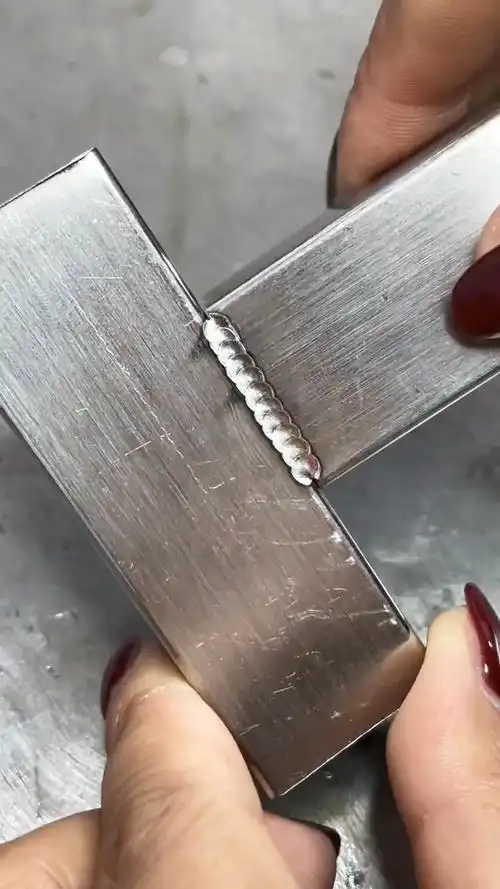
Stainless steel welding
For critical applications, assess more than the appearance of the weld. Penetration, mechanical performance, distortion, and any application-specific inspection requirements should also be considered.
What Materials Can Handheld Laser Welders Weld?
Handheld laser welders are primarily used for metal welding. However, the suitability of each material depends on its physical properties and the requirements of the joint.
Stainless Steel
Stainless steel is widely used in sheet metal fabrication, kitchen equipment, cabinets, enclosures, and industrial components.
Many common grades, including 304 and 316L, can be laser welded with suitable parameters. Surface preparation, joint fit-up, and shielding gas can affect the final result.
Carbon Steel
Carbon steel is commonly used in general metal fabrication, machinery, frames, and industrial equipment.
The required power and welding procedure depend on the steel grade, thickness, joint design, and penetration requirements.
Aluminum and Aluminum Alloys
Aluminum can be welded using suitable laser systems, but its high thermal conductivity, oxide layer, and reflectivity at common fiber-laser wavelengths can make the process more demanding.
The correct power, parameters, and filler material, if required, should be determined according to the alloy and joint.
Galvanized Steel
Galvanized steel has a zinc coating that can vaporize during welding. This may contribute to spatter, porosity, and unstable weld formation.
Laser welding is possible under suitable conditions, but the process may require careful control of shielding gas, joint fit-up, welding parameters, and surface preparation.
Effective fume extraction is also essential when welding galvanized materials.
Other Metal Materials
Selected copper alloys and other metals may be weldable using appropriate equipment and process development.
However, not every material is suitable for every handheld laser welder. Testing is recommended when the material has unusual thermal properties, high reflectivity, or demanding quality requirements.
Advantages and Limitations of Handheld Laser Welders
Handheld laser welding offers several practical advantages, but it is important to understand its limitations before selecting a machine.
Advantages
Flexible operation: Operators can move the welding gun around suitable workpieces and handle different joint positions.
High welding speed potential: On suitable joints, laser welding can offer high welding speeds.
Concentrated heat input: Properly developed welding parameters can help limit the heat-affected area and reduce distortion.
Adaptability: Handheld equipment can be used for different products without requiring a dedicated automated fixture for every component.
Optional multifunction capability: Some systems combine welding with cleaning or cutting functions.
Filler-wire options: A compatible wire feeder can be added when the application requires filler material.
Limitations
Operator technique matters: The consistency of a handheld weld depends partly on the operator’s control of the welding gun.
Joint preparation remains important: Excessive gaps, contamination, or poor alignment can cause defects.
Not every thickness is suitable: The machine must have sufficient capability for the material and required penetration.
Laser safety is essential: Appropriate laser protection, access control, equipment safeguards, and training are required.
Automation may be better for repetitive work: CNC platforms or robots may offer better repeatability for high-volume production or complex welding paths.
Understanding these limitations helps buyers select equipment that matches the actual production task rather than choosing a machine based on advertised features alone.
How to Choose the Right Handheld Laser Welder
Before purchasing a handheld laser welder, consider the following factors.
1. Material and Thickness
Identify the material grade and thickness of the workpiece.
Stainless steel, carbon steel, aluminum, and galvanized steel have different welding characteristics. The selected machine must be suitable for the intended material and joint.
2. Cooling Method
Choose air-cooled or water-cooled equipment according to the machine design, power requirements, expected workload, and operating environment.
Check the manufacturer’s rated operating conditions instead of assuming that one cooling method is universally better.
3. Required Functions
If welding is the main task, a standard handheld laser welder may be sufficient.
If the workshop also needs suitable cleaning or cutting functions, a multifunction system may be worth considering.
Confirm that each additional function can meet the actual requirements of the application.
4. Laser Power
Select power according to the material, thickness, joint geometry, and required penetration.
Avoid choosing a machine based only on the highest available power. An appropriately configured machine can be a better choice than a more powerful system that does not match the application.
5. Filler Wire Requirements
Determine whether the joint can be welded without filler wire or whether a wire feeder is required.
If filler material is needed, confirm the suitable wire type, diameter, and feeding configuration.
6. Safety and Fume Extraction
Laser welding requires appropriate protective measures. The equipment should be installed and operated according to the manufacturer’s instructions and applicable safety requirements.
Fume extraction should be selected according to the material, surface coatings, welding conditions, and workplace exposure-control requirements.
7. After-Sales Support
Equipment selection should also consider technical support, maintenance requirements, spare parts, operator training, and the availability of assistance when process problems occur.
For customized applications, sample testing before purchase can help verify whether the proposed machine and process can achieve the required result.
Handheld Laser Welder Price: What Affects the Cost?
The price of a handheld laser welder depends on its configuration and intended use. Comparing machines based only on laser power may overlook important differences.
Key factors include:
- Laser power and source specification
- Laser welding gun and control system
- Air-cooled or water-cooled configuration
- Wire-feeding system
- Multifunction welding, cleaning, or cutting capabilities
- Safety accessories and protective equipment
- Technical support and after-sales service
A standard welding machine and a 4-in-1 multifunction system may have different costs because they provide different capabilities.Similarly, machines with the same rated power may differ in their laser sources, welding heads, cooling arrangements, and overall build quality.
When requesting a quotation, provide details about the material, thickness, joint type, expected production workload, and any additional functions you need. This information helps the supplier recommend a more suitable configuration.
Frequently Asked Questions
What Is the Difference Between Air-Cooled and Water-Cooled Handheld Laser Welders?
Air-cooled machines use an air-based cooling arrangement, while water-cooled machines use circulating coolant to remove heat from components designed for liquid cooling.
The best choice depends on the equipment design, rated power, operating conditions, and expected workload. Neither cooling method is automatically better for every application.
Is a 4-in-1 Laser Welder Worth Buying?
A 4-in-1 laser welder may be worthwhile if you need welding and occasional cleaning or cutting functions in one system.
However, the performance of each function should be checked against your actual requirements. For specialized, high-volume cutting or cleaning, dedicated equipment may be more appropriate.
Can a Handheld Laser Welder Weld Aluminum?
Yes, suitable handheld laser welding systems can weld many aluminum alloys. However, aluminum welding requires careful control because of the material’s thermal conductivity, oxide layer, and reflectivity.
The correct machine configuration and process parameters depend on the alloy, thickness, and joint design.
What Power Handheld Laser Welder Should I Choose?
The correct power depends on the material, thickness, joint geometry, required penetration, and production conditions.
A 1500W, 2000W, or 3000W machine may be suitable for different applications, but the rated power alone does not determine the result. Sample testing is recommended when the application has demanding quality requirements.
Does a Handheld Laser Welder Need Filler Wire?
Not always. Some well-fitted joints can be welded without filler material. Other joints may require filler wire to bridge gaps or achieve the specified weld profile.
The decision depends on the joint design, material, and required weld quality.
Can Handheld Laser Welders Replace TIG or MIG Welding?
Handheld laser welders can replace conventional welding processes in some suitable applications, but they are not universal replacements.
TIG and MIG welding remain useful for many materials, joints, and production conditions. The best process depends on the application, quality requirements, equipment cost, and operator capabilities.
Conclusion
Handheld laser welders provide a flexible solution for many metal fabrication applications. However, the right machine depends on more than its rated power.
Standard handheld laser welders are suitable for many general welding tasks. Air-cooled and water-cooled models offer different cooling arrangements, while 4-in-1 systems can combine several processing functions. Machines can also be configured with wire feeders when the application requires filler material.
When choosing a handheld laser welder, consider the material, thickness, joint design, required functions, cooling method, and expected production workload. For repetitive or complex components, CNC platform or robotic laser welding may be a better option.
ZS Laser provides handheld laser welding machines with different power levels and configuration options, including multifunction systems for suitable metal-processing applications. If you are unsure which machine fits your workpieces, sharing material specifications, thickness, and sample photos can help determine an appropriate solution.
Contact ZS Laser to discuss your application and explore a suitable handheld laser welding system for your production needs.

WhatsApp
Scan the QR Code to start a WhatsApp chat with us.