 ZS Laser Equipment

A fiber laser welding machine is widely used in modern metal fabrication because it can deliver concentrated laser energy, produce precise welds, and integrate with automated production systems. From handheld welding equipment for sheet metal fabrication to CNC laser welding platforms and robotic welding cells, fiber laser technology offers different solutions for manufacturers with different production requirements.
However, not every laser welding machine has the same structure or capabilities. Some are designed for flexible manual operation, while others use programmed motion systems, dedicated fixtures, or industrial robots to weld complex components repeatedly. The right machine depends on the material, workpiece geometry, required weld quality, production volume, and level of automation.
In this guide, we explain what a fiber laser welding machine is, which materials it can weld, the main types of equipment available, and how to choose a suitable system for your application.
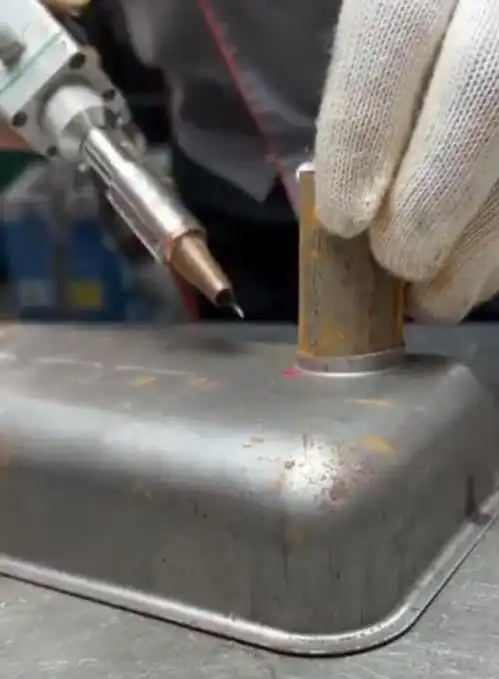
Handheld Laser Welding
What Is a Fiber Laser Welding Machine?
A fiber laser welding machine is an industrial welding system that uses a fiber laser source to generate a concentrated beam of light for joining materials. In most common industrial applications, the machine is used to weld metals such as stainless steel, carbon steel, aluminum, and selected copper alloys.
During welding, the laser beam is focused onto the joint between two workpieces. The absorbed energy heats the material and melts the metal locally. As the molten metal cools and solidifies, it forms a weld that joins the components.
Depending on the material, thickness, joint design, and laser parameters, the process may use conduction welding or deeper-penetration keyhole welding.
Main Components of a Fiber Laser Welding Machine
A typical fiber laser welding system includes several essential components.
Fiber laser source: Generates the laser beam. Laser power and source characteristics affect the available process range and must be selected according to the application.
Laser welding head: Directs and focuses the beam onto the workpiece. Some welding heads support beam oscillation, commonly called wobble welding, to help accommodate particular joint geometries and improve weld formation.
Control system: Controls laser output and coordinates the relevant welding functions. Automatic systems may also control the programmed movement of the welding head or workpiece.
Cooling system: Maintains suitable operating temperatures for the laser source and other components that require cooling. The cooling configuration depends on the equipment design.
Auxiliary equipment: Depending on the application, the machine may include a wire feeder, protective enclosure, workholding fixture, rotary axis, CNC motion platform, or industrial robot.
Not every machine includes all these components. A handheld welder, a CNC welding platform, and a robotic welding cell have different configurations because they are designed for different production tasks.
What Materials Can a Fiber Laser Welding Machine Weld?
Fiber laser welding is primarily associated with metal joining. It can be used for a wide range of metal materials, but the process parameters and equipment configuration must be matched to the material and workpiece.
Stainless Steel
Stainless steel is one of the common materials used in fiber laser welding applications. Typical products include metal enclosures, kitchen equipment, sheet metal components, pipes, fittings, and industrial parts.
The concentrated heat input can help limit the size of the heat-affected area compared with some conventional welding processes. With suitable parameters and joint preparation, fiber laser welding can produce clean welds with controlled distortion.
However, weld appearance, penetration, and mechanical properties still depend on the stainless steel grade, thickness, joint fit-up, and welding conditions.
Carbon Steel
Fiber laser welding is widely used for carbon steel components in machinery manufacturing, metal fabrication, equipment enclosures, structural components, and general industrial production.
The required laser power depends on material thickness, joint type, welding speed, and penetration requirements. Surface condition and joint accuracy also influence process stability.
For thicker sections or joints with larger gaps, filler wire or a different welding configuration may be necessary.
Aluminum and Aluminum Alloys
Aluminum is used in transportation equipment, battery housings, electronic enclosures, and lightweight structures. However, its high thermal conductivity, surface oxide layer, and relatively high reflectivity at common fiber laser wavelengths can make welding more challenging.
A suitable process must account for the specific alloy, material thickness, joint geometry, and required weld quality. Laser power alone does not determine whether an aluminum part can be welded successfully.
Sample testing is recommended for applications involving critical aluminum joints.
Galvanized Steel
Galvanized steel has a zinc coating that protects the underlying steel from corrosion. During laser welding, the zinc can vaporize rapidly and contribute to spatter, porosity, and unstable weld formation.
Galvanized steel can be laser welded under suitable conditions, but it requires more careful process development than uncoated carbon steel. Depending on the joint design and quality requirements, local coating removal and optimized shielding gas and welding parameters may be necessary.
Effective fume extraction is also important because welding galvanized steel can generate hazardous fumes.
Copper and Other Metals
Copper and selected copper alloys can be laser welded for electrical components, connectors, busbars, and other specialized applications. However, copper’s high reflectivity and thermal conductivity can make the process more demanding.
The suitability of fiber laser welding depends on the copper alloy, thickness, laser source characteristics, joint design, and required weld properties. Other metals and alloys may also be weldable, but each application should be evaluated individually.
Three Main Types of Fiber Laser Welding Machines
Fiber laser welding machines can be divided into three broad equipment categories: handheld laser welding machines, CNC platform laser welding machines, and robotic laser welding systems.
These categories are not simply different power levels. They represent different approaches to positioning the welding head, controlling the weld path, holding the workpiece, and organizing production.
1. Handheld Fiber Laser Welding Machine
A handheld fiber laser welding machine is designed for flexible welding by an operator. The operator holds a laser welding gun and guides it along the joint while the system controls the welding process.
Handheld systems are commonly used in sheet metal fabrication, metal enclosures, kitchen equipment, doors, cabinets, and other products with accessible weld seams.
Key Features of Handheld Laser Welders
Flexible operation: Operators can move around the workpiece and reach different welding positions without programming a complete motion path.
Suitable for varied workpieces: Handheld welding is useful when products have different shapes, dimensions, or joint locations and production does not justify a dedicated automated fixture.
Compact system configuration: A typical system combines a fiber laser source, handheld welding gun, control system, and cooling equipment. Depending on the model, it may also include a wire feeder.
Potential for fast welding: On suitable joints, handheld laser welding can offer high welding speeds and concentrated heat input. Actual productivity depends on the material, thickness, joint preparation, and operator technique.
Some handheld systems also offer additional functions, such as laser cleaning or cutting. These capabilities depend on the machine design and supported configuration; they should not be assumed to be available on every model.
Limitations of Handheld Laser Welding
Handheld welding depends on the operator’s ability to guide the gun consistently. It may be less suitable for applications requiring highly repeatable three-dimensional paths, tightly controlled positioning, or high-volume automated production.
Laser safety is another important consideration. The equipment must be used with appropriate laser protection, controlled access, and suitable fume extraction.
A handheld fiber laser welder is often a practical choice for flexible metal fabrication, but automated equipment may be more appropriate for complex or repetitive production.
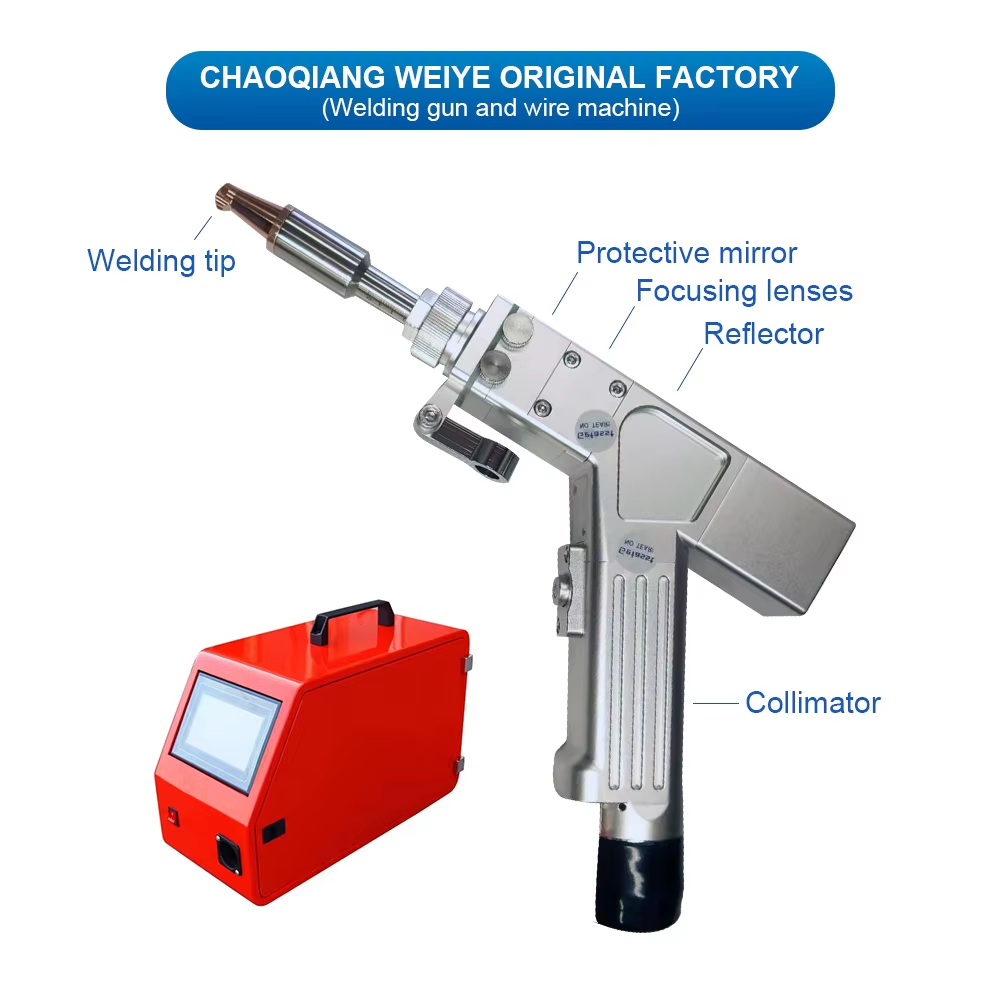
Laser Welding Gun Used By ZS Laser
2. CNC Platform Fiber Laser Welding Machine
A CNC platform fiber laser welding machine uses a programmed motion system to control the welding head, workpiece, or both. Compared with handheld welding, it provides more repeatable motion and can reduce the variation associated with manually guiding the welding gun.
CNC laser welding systems are particularly useful when components have consistent dimensions and require the same welding path across multiple production cycles.
Common CNC Laser Welding Configurations
Three-axis CNC laser welding machine: An XYZ platform moves the welding head or workpiece along three linear axes. It is suitable for many programmed welding tasks involving flat parts and accessible three-dimensional joints within the machine’s working range.
Four-axis CNC laser welding machine: A common configuration combines XYZ linear movement with a rotary axis. Depending on the design, the rotary axis may be horizontal or vertical. A chuck or dedicated fixture can hold and rotate pipes, tubes, shafts, rings, and other cylindrical components.
Customized automatic welding platform: Some applications require specialized fixtures, pneumatic cylinders, positioners, wire feeders, or automated loading and unloading. These systems are designed around the workpiece and the required welding sequence.
The number of axes alone does not fully describe the capabilities of a machine. Working range, axis arrangement, fixture design, control functions, and welding-head configuration all affect what it can produce.
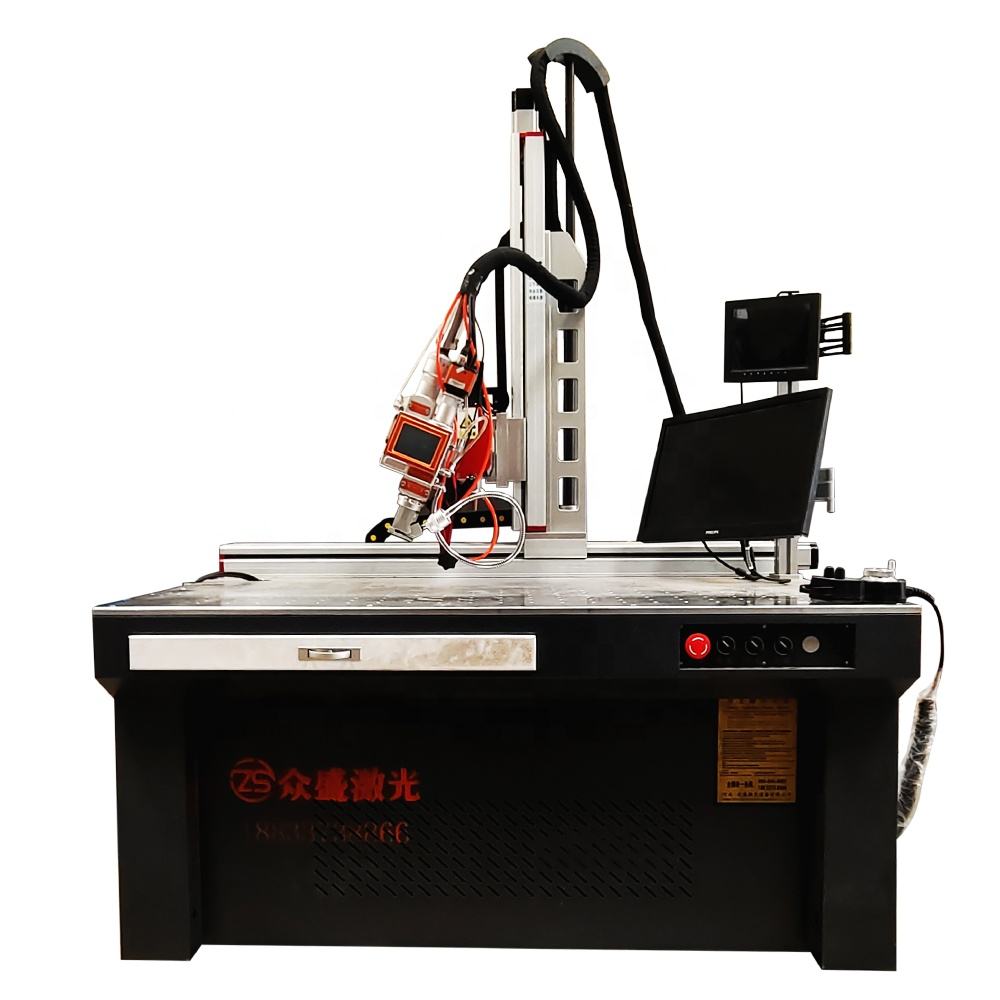
1500W Automatic Laser Welding Machine
Applications of CNC Laser Welding Machines
CNC platform systems can be used for:
- Stainless steel tubes, pipes, and fittings
- Circular rings and cylindrical components
- Metal enclosures and sheet metal assemblies
- Repetitive industrial components
- Parts that require accurate positioning and a programmed weld path
- Customized products requiring pneumatic clamping or dedicated tooling
For example, a stainless steel ring with an open joint may require a dedicated fixture to position the two ends, close the gap, and hold the component during welding. A customized CNC system can coordinate the workpiece position and programmed welding path to improve repeatability.
The fixture is often just as important as the laser source in these applications. Accurate positioning and stable clamping help ensure that the joint remains within the process’s acceptable fit-up range.
Advantages of CNC Platform Welding
CNC laser welding is useful when the same welding sequence must be repeated across many parts. Programmed movement can improve consistency, while dedicated fixtures can reduce setup variation and manual handling.
It also allows manufacturers to build a more standardized production process. Once the machine, fixture, and welding parameters have been validated, the same setup can be used to produce repeated components.
However, the system must be designed around the actual part. A standard three-axis platform may not be suitable for every curved surface or complex joint, and additional rotary axes or customized tooling may be required.
3. Robotic Fiber Laser Welding Machine
A robotic fiber laser welding machine uses an industrial robot to move the welding head along programmed paths. Compared with a conventional fixed CNC platform, a robot can offer a larger or more flexible motion envelope for many applications, depending on the robot model and system layout.
Robotic laser welding is especially useful for larger workpieces, complex spatial welds, and production lines that require a high degree of automation.
Key Features of Robotic Laser Welding
Flexible motion: A multi-axis robot can approach a component from different directions and follow complex welding paths within its working envelope.
Larger workpiece capability: With an appropriate robot reach, fixture arrangement, and cell design, robotic systems can handle components that are difficult to accommodate on a compact CNC platform.
Automation integration: A robotic welding cell can be integrated with fixtures, rotary positioners, part transfer systems, sensors, vision systems, and other production equipment when required.
Repeatable production: Once the welding program and process have been validated, robotic motion can help maintain consistent path execution across repeated parts.
Typical Applications
Robotic fiber laser welding systems are used in applications such as:
- Automotive components
- Machinery and equipment assemblies
- Complex metal structures
- Large or irregularly shaped workpieces
- High-volume manufacturing
- Production lines requiring coordinated welding and material handling
Robotic welding is not automatically better than CNC welding for every application. A robot may be unnecessary for a simple, repetitive flat weld, while a fixed CNC platform may not provide sufficient reach or flexibility for a large component with multiple complex seams.
The best solution depends on the geometry of the part, production volume, required accuracy, cycle time, and overall automation plan.
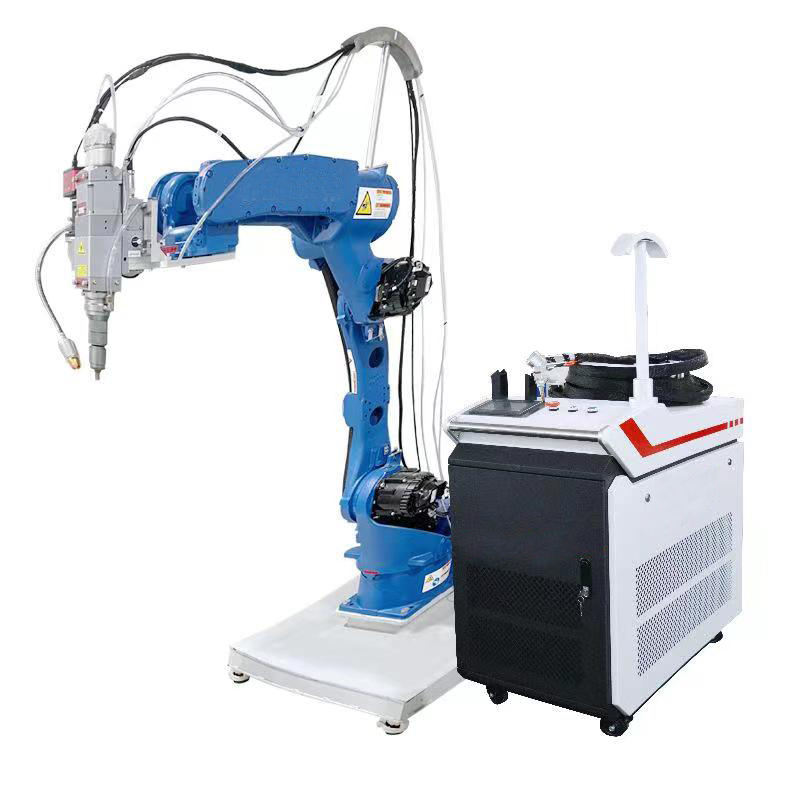
Robot Welding Machine
Fiber Laser Welding vs. Other Laser Welding Technologies
Not every application called “laser welding” uses a fiber laser source. Different materials and processes may require different wavelengths, optical configurations, and energy-delivery systems.
Understanding these differences helps manufacturers avoid selecting equipment based only on the general term “laser welding machine.”
Fiber Laser Welding for Metal Joining
Fiber laser welding is widely used for industrial metal joining because it can deliver concentrated energy to a small area and can be integrated with handheld equipment, CNC platforms, or industrial robots.
It is suitable for many stainless steel, carbon steel, aluminum, and other metal applications when the material and joint configuration are compatible with the process.
Plastic Laser Welding Machines
Plastic laser welding joins compatible thermoplastic components by generating heat at or near the interface between the parts. The process often relies on one component transmitting the laser wavelength while another absorbs enough energy to create a weld.
Laser diode systems at suitable wavelengths are commonly used for plastic welding applications. The correct laser source depends on the plastic type, pigments or additives, part thickness, optical properties, and joint design.
A conventional metal-welding fiber laser is not automatically suitable for plastic welding. The wavelength and optical arrangement must match the material system and the intended welding mechanism.
Plastic laser welding is used in applications such as automotive lighting components, electronic housings, fluid-handling components, and selected medical plastic assemblies. Some applications require dedicated fixtures, enclosed workstations, and controlled production environments.
Laser Cladding Equipment
Laser cladding is a different laser process from conventional fusion welding between two components. It deposits material onto a surface to create a coating or rebuild a worn area, often to improve wear resistance, corrosion resistance, or component service life.
The process may involve feeding metal powder or wire into a laser-generated melt pool. As the material solidifies, it forms a metallurgically bonded layer on the substrate.
Laser cladding systems can use fiber lasers, among other suitable laser sources. The correct configuration depends on the deposited material, substrate, coating thickness, processing speed, and required surface properties.
Typical applications include repairing worn components, restoring dimensions, and applying functional surface layers to industrial parts.
Although both processes use laser energy, laser cladding equipment and conventional laser welding machines have different process requirements and should not be treated as interchangeable without evaluating the application.
Advantages of Fiber Laser Welding
Fiber laser welding offers several potential benefits for metal fabrication and industrial production.
Concentrated Heat Input
The laser beam delivers energy to a localized area. With suitable parameters, this can help limit the size of the heat-affected area and reduce distortion compared with some conventional welding processes.
The actual result depends on material thickness, welding speed, joint design, and the energy required to achieve the specified penetration.
High Welding Speed Potential
On suitable materials and joints, fiber laser welding can achieve high welding speeds. This can improve production efficiency, particularly for repeatable seams and automated manufacturing.
However, welding speed should always be considered together with penetration, weld quality, fixture time, and any required post-weld processing.
Consistent Weld Formation
When laser output, joint fit-up, movement, and shielding are properly controlled, fiber laser welding can produce consistent results across repeated parts.
Automation can improve path repeatability, while fixtures help maintain the position of the workpiece. Both are important when production requires consistent weld dimensions and appearance.
Integration with Automation
Fiber laser sources can be integrated with CNC motion systems and industrial robots. This flexibility allows manufacturers to choose between manual operation, programmed platform welding, and more comprehensive automated production cells.
The equipment can also be combined with wire feeding, positioners, sensors, or part-handling systems when the application requires them.
Potential for Reduced Post-Weld Finishing
Some applications can achieve an acceptable weld appearance with limited post-weld finishing. The result depends on the material, joint design, filler material, welding parameters, and appearance requirements.
A good-looking weld should not automatically be considered defect-free. Applications with structural, pressure, or leak-tightness requirements may need additional inspection or testing.
How to Choose the Right Fiber Laser Welding Machine
Selecting the right machine begins with the welding application, not simply the laser power.
1. Identify the Material and Thickness
Confirm the material grade, thickness, surface condition, and required penetration. Stainless steel, carbon steel, aluminum, and galvanized steel have different welding characteristics.
A representative sample test can help determine whether the proposed process can meet the required quality standard.
2. Consider the Workpiece Geometry
For accessible seams on varied parts, a handheld laser welder may offer the flexibility needed for production.
For repeatable welds on fixed workpieces, a CNC platform with a dedicated fixture may be more appropriate.
For large components or complex spatial weld paths, a robotic system may offer a more suitable working range and approach flexibility.
3. Evaluate Production Volume
Low-volume or high-mix production often benefits from flexible equipment and simpler changeovers.
When the same components are welded repeatedly, CNC or robotic automation may reduce manual handling and improve consistency. The business case should consider not only welding speed but also loading time, fixture changes, programming, maintenance, and labor requirements.
4. Determine the Required Automation Level
Decide whether the process needs manual welding, programmed motion, or a complete automated cell.
Additional equipment may include rotary axes, pneumatic fixtures, wire feeders, safety enclosures, part-positioning devices, and automatic loading systems. These options should be selected according to the actual production workflow.
5. Check Weld Quality Requirements
Define the required weld appearance, penetration, strength, dimensional accuracy, and inspection method.
For critical joints, sample welding and appropriate testing should be completed before committing to full production. If the application requires leak-tightness, for example, visual inspection alone is not sufficient to verify sealing performance.
6. Compare the Total System Cost
The cost of a fiber laser welding machine depends on more than laser power. Important factors include the laser source, welding head, cooling system, motion platform, robot, fixtures, safety equipment, and automation level.
A handheld machine may have a lower initial cost for a simple application, while a customized CNC or robotic system may offer better repeatability or labor efficiency for a suitable production task.
The most economical choice is the system that meets the required quality and output with an appropriate balance of equipment investment, operating cost, and production efficiency.
Fiber Laser Welding Machine Price
There is no single price that applies to every fiber laser welding machine. A handheld system, a CNC automatic welding platform, and a robotic welding cell can have substantially different costs because their configurations and capabilities are different.
When comparing quotations, consider the following:
- Laser power and laser source specification
- Handheld or automatic welding-head configuration
- CNC axis arrangement or robot model
- Working range and positioning requirements
- Fixture design and workpiece clamping
- Wire feeding and other auxiliary equipment
- Safety enclosure and fume extraction requirements
- Installation, training, and technical support
For customized automatic welding equipment, providing workpiece drawings, material specifications, sample photos, required weld locations, and expected production volume can help suppliers evaluate the application and propose a more appropriate solution.
Frequently Asked Questions
Can a Fiber Laser Welding Machine Weld Aluminum?
Yes, fiber laser welding can be used for many aluminum alloys. However, aluminum can be challenging because of its high thermal conductivity, surface oxide layer, and reflectivity. The suitable laser configuration and welding parameters depend on the alloy, thickness, joint geometry, and required weld quality.
What Is the Difference Between Handheld and Automatic Laser Welding Machines?
A handheld laser welding machine is operated manually and offers flexibility for varied workpieces and accessible weld seams. An automatic laser welding machine uses a CNC platform, robot, or another motion system to execute a programmed welding path. Automatic systems are often more suitable when repeatability, positioning control, and production consistency are important.
Is a Fiber Laser Welding Machine Suitable for Every Metal?
No. Fiber laser welding is suitable for many metals, but the results depend on the material’s optical and thermal properties, its thickness, and the joint design. Highly reflective materials and specialized alloys may require more careful process development. Testing the actual workpiece is recommended for demanding applications.
What Is the Difference Between CNC and Robotic Laser Welding?
A CNC platform typically moves the welding head or workpiece along a defined set of linear and, where equipped, rotary axes. A robotic system uses an industrial robot to provide multi-axis motion and flexible approach directions. CNC platforms are often practical for repeatable parts within a defined working area, while robots can be advantageous for larger components and complex spatial weld paths. The best option depends on the application and system configuration.
Can One Laser Machine Be Used for Welding, Cleaning, and Cutting?
Some handheld fiber laser systems are designed with multiple functions, such as welding, cleaning, and cutting. However, the available functions, performance, and compatible materials depend on the specific equipment and configuration. A multifunction system should be evaluated against the actual requirements of each process.
How Do I Choose the Correct Laser Power?
Laser power should be selected according to material type, thickness, joint geometry, welding speed, and required penetration. Higher power does not automatically guarantee better weld quality. Sample testing is a practical way to determine whether the selected machine and parameters can achieve the required result.
Conclusion
A fiber laser welding machine is a versatile solution for many industrial metal joining applications, but the right equipment depends on more than the laser source or its rated power.
Handheld fiber laser welders offer flexibility for general metal fabrication. CNC platform welding machines provide programmed motion and repeatable positioning for specific components. Robotic laser welding systems offer flexible multi-axis motion and can be integrated into more extensive automated production lines.
Plastic laser welding and laser cladding serve different processing purposes and may require different system configurations. Understanding these distinctions helps manufacturers select equipment that matches their materials, workpiece geometry, production volume, and quality requirements.
ZS Laser provides fiber laser welding equipment and customized welding solutions, including handheld machines, CNC automatic welding platforms, and robotic welding systems. For applications involving special workpiece shapes, dedicated fixtures, rotary positioning, or automated production, evaluating the actual part and welding requirements is an important first step toward choosing the right solution.
Contact ZS Laser to discuss your application and explore a suitable laser welding system for your production needs.

WhatsApp
Scan the QR Code to start a WhatsApp chat with us.