 ZS Laser Equipment

Galvanized steel pipe is widely used in construction, plumbing, agricultural equipment, metal structures, and industrial applications because its zinc coating helps protect the steel from corrosion.However, welding galvanized pipe is more challenging than welding ordinary carbon steel pipe. When exposed to the concentrated heat of a laser, the zinc coating can vaporize rapidly, making the molten pool unstable and increasing the risk of spatter, porosity, and weld defects.
So, can you use a handheld laser welder for galvanized pipe?
Yes, laser welding galvanized pipe is possible, but the process requires careful control. Shielding gas flow, welding parameters, surface preparation, and joint design all affect the result. For many handheld laser welding applications, increasing the shielding gas flow appropriately is one of the practical adjustments that can help improve weld stability and reduce spatter.
This guide explains the main challenges of laser welding galvanized pipe and how to improve the process.
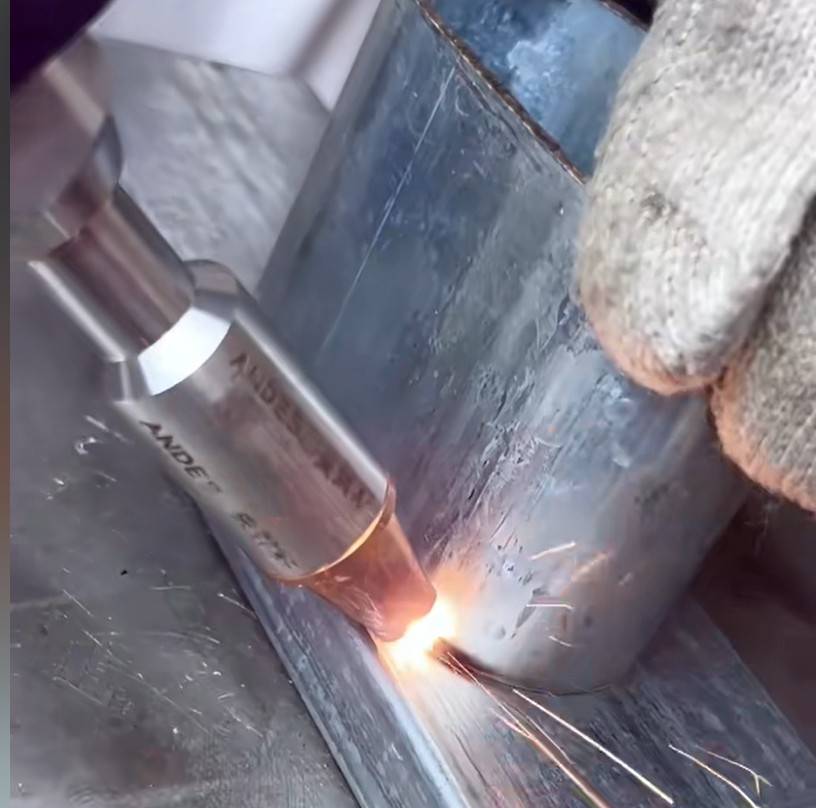
Laser Welding Galvanized Pipe
1. Why Is Galvanized Pipe Difficult to Laser Weld?
The main challenge comes from the zinc coating rather than the steel itself.Galvanized pipe is usually made from carbon steel with a protective zinc layer on its surface. Zinc has a much lower boiling point than steel, so it can vaporize before the base metal has fully melted.
During laser welding, this rapid vaporization can interfere with the molten metal and make the welding process unstable.
Zinc Vapor and Weld Spatter
When the laser heats the galvanized surface, zinc vapor may form rapidly near the welding zone. If the vapor cannot escape smoothly, pressure can build up around the molten pool or keyhole.
This may lead to:
- Metal spatter around the weld seam
- An uneven or unstable molten pool
- Porosity inside the weld
- Irregular weld appearance
- Additional cleaning and rework
Research on laser welding of galvanized steel has identified zinc vapor behavior as an important factor in spatter formation and weld instability. The exact result depends on the joint configuration and welding conditions.
The Zinc Coating Can Affect Weld Quality
The zinc coating is designed to protect steel from corrosion, but it creates an additional variable during welding.
Depending on the coating thickness and joint design, zinc vapor may become trapped near the joint. Overlapping joints with little or no gap can be particularly challenging because the vapor may have limited space to escape.
For this reason, welding galvanized pipe requires more attention to process setup than welding uncoated carbon steel pipe.
2. Can a Handheld Laser Welder Weld Galvanized Pipe?
A handheld laser welder can be used for certain galvanized pipe applications, but it is not automatically the best choice for every job.
The suitability depends on several factors:
- Pipe wall thickness
- Zinc coating thickness and condition
- Pipe diameter and joint geometry
- Required penetration and weld strength
- Whether the weld must meet leak-tightness requirements
- Appearance requirements and acceptable spatter levels
For relatively thin galvanized pipe and suitable joint configurations, handheld laser welding may provide fast welding and a concentrated heat input.
However, if the coating is thick, the joint traps zinc vapor, or the application requires highly consistent, defect-free welds, the process may need more extensive testing and parameter development.
A successful weld on uncoated carbon steel does not necessarily mean the same settings will work well on galvanized pipe.
3. How to Reduce Spatter When Laser Welding Galvanized Pipe
Spatter control is one of the most important considerations when using a handheld laser welder on galvanized steel.No single adjustment can eliminate every defect, but several practical measures can improve the process.
3.1 Increase the Shielding Gas Flow Appropriately
For handheld laser welding of galvanized pipe, increasing the shielding gas flow from the initial setting may help reduce spatter and improve protection around the molten pool.Shielding gas helps protect the hot metal from atmospheric contamination and can influence the behavior of the welding zone. The appropriate flow rate depends on the welding torch, nozzle design, gas type, working distance, and welding parameters.
When adjusting the gas flow:
- Increase the flow gradually and observe the welding result.
- Keep the gas nozzle properly positioned relative to the weld seam.
- Check that the gas stream covers the molten pool effectively.
- Avoid excessive flow that creates turbulence or disrupts the molten metal.
- Confirm that the gas supply and nozzle are working properly.
It is important to understand that shielding gas does not remove the zinc coating or prevent all zinc vapor from forming. If spatter is caused mainly by rapid zinc vaporization or trapped vapor, gas adjustment alone may not solve the problem.
The best approach is to test different gas flow settings together with laser power, welding speed, and other relevant parameters.
3.2 Optimize Laser Power and Welding Speed
Excessive or poorly distributed heat input can increase zinc vaporization and destabilize the molten pool. On the other hand, insufficient energy may result in incomplete fusion or inadequate penetration.
The goal is to find a suitable balance between penetration, welding speed, and process stability.
During testing, adjust the power and speed in a controlled manner. Evaluate the weld appearance, spatter level, penetration, and internal defects rather than judging the result by appearance alone.
There is no universal parameter setting for every galvanized pipe because pipe thickness, coating condition, and joint geometry vary.
3.3 Consider Removing the Zinc Coating Locally
For applications with strict weld quality requirements, removing the zinc coating from the immediate welding area may be worth considering.
Local coating removal can reduce the amount of zinc entering the welding zone and may help make the process more stable. However, it adds a preparation step and exposes the underlying steel, so the corrosion protection must be restored after welding when required.
The method and width of coating removal should be determined according to the pipe specification and the joint design. The prepared surface should also be clean and dry before welding.
For production work, compare the cost of surface preparation and post-weld treatment with the benefits of reduced defects and rework.
3.4 Check the Joint Fit-Up
Joint geometry can strongly affect how zinc vapor escapes.
If two pipe edges or overlapping surfaces fit tightly together, vapor may become trapped near the molten pool. Depending on the joint design, an appropriate gap or an alternative joint configuration may help provide an escape path.
However, the gap must remain compatible with the required joint strength and welding process. An excessive gap can create other problems, including poor bridging or incomplete fusion.
The joint should therefore be designed and tested as part of the overall welding process.
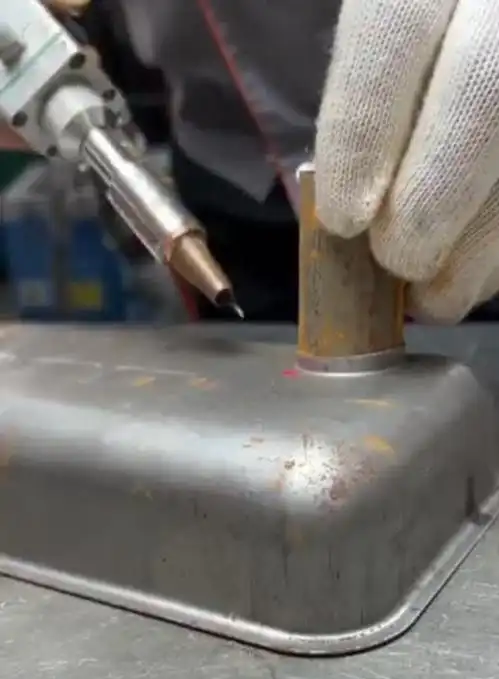
Handheld Laser Welding
4. Which Shielding Gas Should Be Used?
The choice of shielding gas depends on the material, joint configuration, welding process, and desired weld quality.
Argon and nitrogen are used in different laser welding applications, but they should not be treated as interchangeable in every situation. Their suitability should be confirmed through application testing and the welding equipment manufacturer’s recommendations.
For galvanized pipe, gas selection should be evaluated together with flow rate, nozzle geometry, and torch position.
Simply increasing the gas flow without checking the actual gas coverage may not improve the result. A stable, correctly directed gas stream is more useful than an arbitrarily high flow rate.
5. Safety Considerations When Welding Galvanized Pipe
Welding galvanized steel produces fumes that may contain zinc oxide. These fumes can be harmful if inhaled, so ventilation and exposure control are essential.
When laser welding galvanized pipe:
- Use suitable local exhaust ventilation close to the welding area.
- Keep the operator’s breathing zone away from the fume plume.
- Follow applicable workplace exposure controls and respiratory protection requirements.
- Use the required laser safety enclosure or protective measures for the laser system.
- Follow the machine manufacturer’s operating and maintenance instructions.
Increasing shielding gas flow is a welding process adjustment, not a substitute for fume extraction or personal protection.
For additional guidance, see the OSHA welding ventilation requirements.
6. Is Laser Welding the Best Method for Galvanized Pipe?
Not necessarily. The best welding method depends on the pipe dimensions, production requirements, joint design, and quality standards.
Handheld laser welding may be attractive when high welding speed, a concentrated heat input, and convenient operation are important. However, galvanized steel can still produce spatter and porosity if zinc vapor is not managed effectively.
For applications with strict quality requirements, compare laser welding with other suitable welding processes and consider the complete workflow, including surface preparation, fume extraction, post-weld corrosion protection, and inspection.
Before choosing equipment for production, test representative samples using the actual galvanized pipe and joint configuration.
7. Practical Checklist for Handheld Laser Welding Galvanized Pipe
Before starting production, review the following points:
- Identify the material: Confirm the steel grade, pipe thickness, and zinc coating condition.
- Prepare the joint: Check alignment, fit-up, cleanliness, and whether local coating removal is necessary.
- Set the shielding gas: Verify the gas type, nozzle position, and initial flow rate.
- Test the welding parameters: Adjust power, speed, and other available process settings systematically.
- Evaluate spatter and penetration: Inspect both the weld surface and the weld cross-section when appropriate.
- Verify the application requirements: Perform leak testing or other specified inspections if the pipe is used in a pressure or fluid-handling system.
- Restore corrosion protection: Apply an appropriate post-weld treatment when required.
- Control fumes: Provide effective local exhaust ventilation and follow applicable safety procedures.
Conclusion
Laser welding galvanized pipe is possible, but it requires more process control than welding uncoated carbon steel. Zinc vapor can destabilize the molten pool and cause spatter, porosity, and inconsistent weld quality.
For handheld laser welding, appropriately increasing the shielding gas flow can be a useful adjustment, but it should be combined with optimized welding parameters, suitable joint preparation, and proper fume extraction. For demanding applications, sample testing is the most reliable way to determine whether the process can meet the required quality standards.
ZS Laser provides handheld laser welding machines and customized welding solutions for different metal fabrication applications. If you are planning to weld galvanized pipe, testing your actual material and joint design can help identify a suitable machine configuration and welding process before production.

WhatsApp
Scan the QR Code to start a WhatsApp chat with us.