 ZS Laser Equipment

Stainless steel sealing rings are used in applications where sealing performance and dimensional consistency are important. During manufacturing, some sealing rings are formed into a C-shaped profile, leaving an opening that must be joined to create a complete circular component.
Recently, we delivered a custom five-axis automatic laser welding machine for stainless steel C-ring seals. The system was designed to weld the joint of the C-shaped ring after the workpiece is positioned and clamped by a dedicated fixture.
This project demonstrates how customized laser welding equipment can combine multi-axis motion, pneumatic clamping, and precise workpiece positioning to meet the requirements of specialized metal component manufacturing.
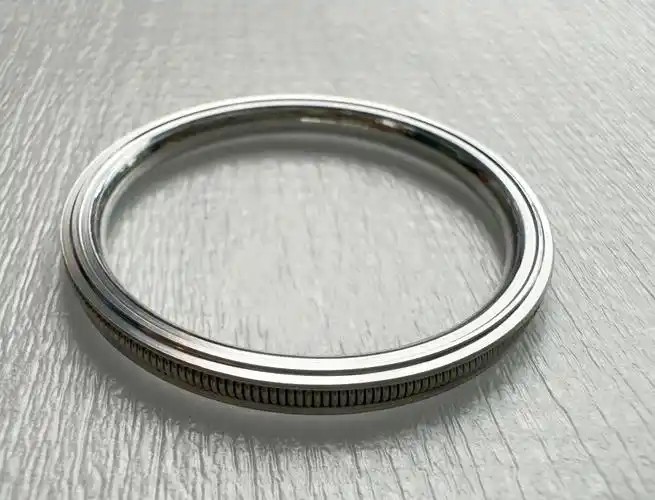
Stainless steel sealing ring
Why Does a Stainless Steel C-Ring Need Automatic Welding?
A C-shaped sealing ring has an opening at its joint. To manufacture a complete ring, the two ends must be brought together and welded.
Because the component is used for sealing, the welding process needs to consider more than simply joining two pieces of metal. Joint alignment, clamping stability, weld consistency, and the final geometry of the ring are also important.
If the two ends are not properly aligned before welding, the resulting joint may have dimensional deviations or inconsistent weld formation. For this reason, a dedicated fixture is essential for controlling the workpiece position throughout the welding process.
Automating the process helps establish a repeatable sequence for positioning, clamping, and welding each ring.
Five-Axis Automatic Laser Welding Machine
The machine delivered for this project uses a five-axis configuration and a customized workholding fixture.
The multi-axis system provides motion flexibility for positioning the welding head and workpiece according to the programmed welding path. This is particularly useful for specialized components whose geometry and welding positions cannot be handled efficiently by a simple fixed welding arrangement.
The machine is equipped with a dedicated fixture designed specifically for the stainless steel C-ring. Rather than relying entirely on manual positioning, the fixture uses three groups of pneumatic cylinders to perform different functions.
Three Groups of Pneumatic Cylinders for Positioning and Clamping
The customized fixture is a key part of this automatic welding solution. Its three groups of cylinders perform three separate functions.
1. Downward Pressing
The first group of cylinders presses the workpiece downward to hold it in the required position.
This helps keep the ring stable during the subsequent clamping and welding operations.
2. Closing and Squeezing the Joint
The second group of cylinders brings the two ends of the C-shaped ring together and applies clamping force.
This operation helps close the opening and maintain the required joint condition before welding. Consistent positioning of the two ends is important for producing a uniform welded connection.
3. Workpiece Positioning
The third group of cylinders performs the positioning function, helping locate the ring accurately in the fixture.
Together, these three pneumatic functions establish a controlled workholding sequence before the laser welding process begins.
The exact cylinder movements and clamping forces are configured according to the workpiece geometry and production requirements.
Laser Welding the Stainless Steel C-Ring Joint
Once the workpiece has been positioned and clamped, the laser welding system joins the interface to form a complete circular ring.
Laser welding is attractive for this type of component because it concentrates energy in a relatively small area. With suitable welding parameters, it can produce a localized weld while limiting unnecessary heat input to the surrounding material.
For stainless steel sealing components, the welding procedure needs to be matched to the material grade, ring dimensions, joint geometry, and required sealing performance.
The fixture helps maintain the joint position during welding, while the programmed motion system provides a repeatable welding path.
It is important to note that a visually complete weld does not automatically guarantee leak-tight sealing performance. If the C-ring is used in a demanding sealing application, the finished component should be evaluated using the inspection and leak-testing methods required by the customer’s application.
Why Use a Customized Automatic Welding System?
Compared with manually positioning and welding each ring, a dedicated automatic system can provide several production advantages.
- Repeatable positioning: The fixture helps locate the C-ring consistently before welding.
- Controlled joint closure: Pneumatic clamping brings the two ends together before the laser operates.
- Consistent welding path: The five-axis system follows the programmed path for the joint.
- Reduced manual handling: Positioning and clamping functions are integrated into the equipment.
- Application-specific design: The fixture and motion system are configured around the actual workpiece rather than forcing the component to fit a standard machine.
These benefits are particularly valuable when manufacturers need to produce specialized sealing components with consistent dimensions and repeatable welding operations.
Customized Laser Welding Solutions from ZS Laser
The stainless steel C-ring project is an example of how ZS Laser develops automatic laser welding equipment around a customer’s actual production needs.
From multi-axis motion systems to dedicated fixtures and pneumatic clamping mechanisms, each part of the machine is designed to support the required welding process.
ZS Laser provides customized automatic laser welding solutions for specialized metal components. If you need to automate the welding of sealing rings or other precision parts, contact our team to discuss your workpiece, joint design, and production requirements.

WhatsApp
Scan the QR Code to start a WhatsApp chat with us.