 ZS Laser Equipment

Laser cladding is a surface engineering process that uses a concentrated laser beam to melt a coating material and form a metallurgically bonded layer on the surface of a substrate. Compared with conventional hardfacing and overlay welding, laser cladding offers precise heat input, strong control over material deposition, low dilution, and the ability to repair or enhance specific areas of a component.
However, laser cladding is not a single process. Different laser cladding systems use different methods to deliver powder or wire into the laser-generated melt pool, and the way the laser beam interacts with the cladding material has a major influence on deposition efficiency, cladding speed, material utilization, surface quality, and suitable applications.
Based on the material delivery method and the coupling relationship between the laser beam and cladding material, common laser cladding technologies can be divided into four main categories:
1.Coaxial powder-fed laser cladding
2.Off-axis powder-fed laser cladding
3.High-speed or ultra-high-speed laser cladding
4.High-speed wire laser cladding
Although all four processes use laser energy to create a metallurgically bonded cladding layer, their equipment configurations and operating principles are quite different.
1. Coaxial Powder-Fed Laser Cladding
Coaxial powder-fed laser cladding is one of the most flexible laser cladding technologies and is widely used in automated cladding systems.
A typical system uses a semiconductor or fiber-delivered laser, a powder feeder, and a specially designed cladding head. The laser beam is generally delivered through the center of the cladding head, while metal powder is delivered around the laser beam through an annular or multi-channel powder nozzle. A separate shielding-gas channel protects the processing area.
The laser beam, powder flow, and shielding gas are designed to converge around the same processing point. At this location, the laser melts the substrate surface and powder to form a melt pool. As the cladding head and workpiece move relative to each other, the melt pool travels along the programmed path and solidifies to form the cladding layer.
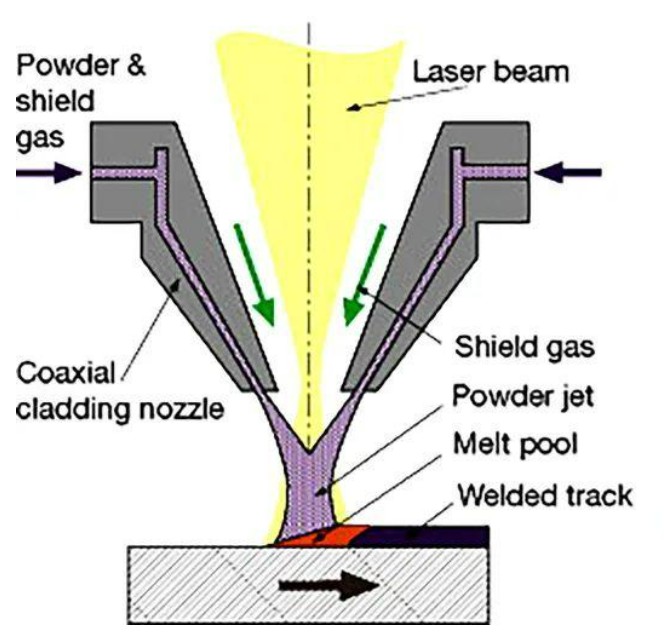
Coaxial Powder-Fed Laser Cladding
Key Characteristics of Coaxial Powder-Fed Laser Cladding
High Flexibility and Easy Automation
One of the biggest advantages of coaxial powder feeding is its directional flexibility. Because the powder is delivered around the laser beam, the cladding head can move in different directions while maintaining relatively consistent material deposition.This makes coaxial laser cladding particularly suitable for industrial robots and multi-axis machine tools. The system can follow complex paths and process components with complicated three-dimensional geometries.
The same principle can also be used for laser metal deposition and laser-based 3D printing, where the coaxial powder head functions as an additive manufacturing tool.
Effective Inert Gas Protection
Coaxial powder-fed systems normally incorporate a dedicated shielding-gas passage into the cladding head. During processing, the melt pool is protected by a localized inert-gas atmosphere, helping reduce oxidation and contamination.This is particularly important when processing reactive alloys or materials that are sensitive to oxidation at elevated temperatures.
Small Melt Pool and Good Process Control
Coaxial laser cladding typically uses a relatively small laser spot, often in the range of approximately 1–5 mm depending on the system and application. The powder interacts with the laser beam in a controlled region before entering the melt pool.This concentrated process helps provide relatively uniform heating and precise deposition. With appropriate material and parameter selection, it can also contribute to good cladding-layer quality and crack resistance.
Typical Applications Of Coaxial Powder-Fed Laser Cladding
Coaxial powder-fed laser cladding is suitable for applications requiring flexible tool movement, complex geometries, and localized material deposition.Typical applications include:
- Shaft repair
- Valve sealing surfaces
- Wear-resistant surfaces
- Corrosion-resistant coatings
- Precision component repair
- Internal and external surface cladding
- Robotic laser cladding
- Multi-axis laser cladding
- Laser metal deposition
2. Off-Axis Powder-Fed Laser Cladding
Off-axis powder-fed laser cladding, also known as side powder feeding laser cladding, uses a different material delivery principle.A typical system uses a semiconductor laser or fiber-delivered semiconductor laser together with a gravity-fed powder delivery system. Instead of feeding powder coaxially around the laser beam, the powder is delivered from the side of the cladding head.
The cladding head generally uses a rectangular laser spot combined with a relatively wide side powder delivery system. During operation, the alloy powder is first deposited or pre-placed on the surface of the workpiece. The rectangular laser beam then scans across the pre-placed powder, melting it together with the surface of the substrate to form a metallurgically bonded cladding layer.
Key Characteristics of Off-Axis Powder-Fed Laser Cladding
High Material Utilization
Because the powder is pre-placed directly on the workpiece surface before laser melting, relatively little powder is lost during the deposition process.Under suitable process conditions, material utilization can exceed 95%.This can significantly reduce powder consumption, which is particularly valuable when expensive alloy powders are being used.
High Cladding Productivity
The rectangular laser spot provides another important advantage.By increasing the laser power and expanding the width of the laser spot while maintaining an appropriate energy density in the cladding direction, the processing width and deposition rate can be increased.This allows off-axis powder-fed laser cladding to achieve relatively high cladding productivity for suitable surface geometries.
No Continuous Inert Gas Consumption for Powder Delivery
Unlike many coaxial powder-fed systems, gravity-fed powder delivery does not require carrier gas to transport the powder.This can simplify the powder delivery system and reduce inert-gas consumption.However, because the powder is not continuously surrounded and transported by a shielding gas, the oxidation resistance of the powder becomes more important. This characteristic can limit the range of materials and applications for which the process is suitable.
Typical Applications
Off-axis powder-fed laser cladding can be attractive for relatively large and accessible surfaces where high material utilization and productivity are important.Potential applications include:
- Large surface cladding
- Wear-resistant coatings
- Corrosion-resistant coatings
- Flat or relatively accessible surfaces
- Components requiring high powder utilization
The actual suitability depends strongly on component geometry and the properties of the cladding material.
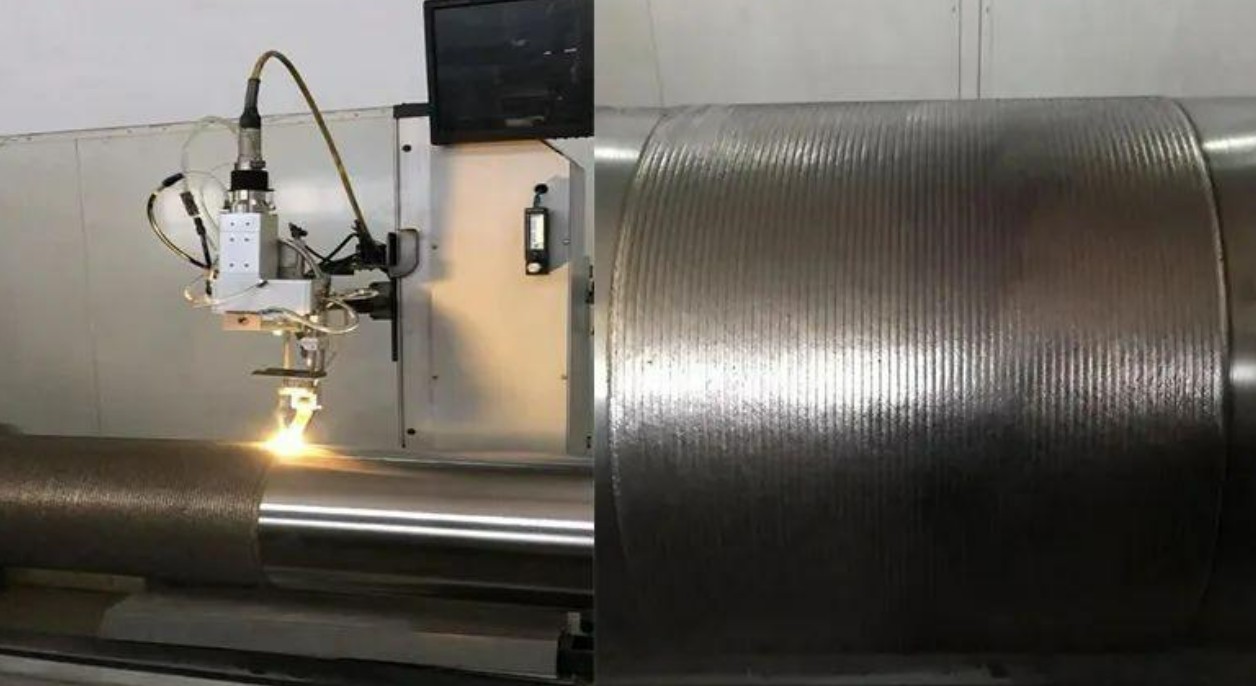
Off-Axis Powder-Fed Laser Cladding
3. High-Speed and Ultra-High-Speed Laser Cladding
High-speed laser cladding, often referred to as ultra-high-speed laser cladding, is designed to significantly increase the cladding deposition speed compared with conventional laser cladding.This technology uses a high-quality semiconductor or fiber laser, a specially designed high-speed cladding head, and a high-speed motion system. The coupling between the laser beam, powder stream, and shielding gas is carefully engineered.
One of the most important differences is how the laser energy interacts with the powder before the powder enters the melt pool.During the process, part of the laser energy interacts with the powder stream, while another portion passes through the powder and heats the substrate. The powder can therefore be heated or partially melted before it reaches the melt pool.This reduces the time required to melt the powder after it reaches the substrate and allows the system to operate at extremely high cladding speeds.
Under suitable conditions, ultra-high-speed laser cladding systems can achieve line speeds of up to approximately 200 m/min, while conventional laser cladding may typically operate at much lower speeds, depending on the process and application.
Key Characteristics of Ultra-High-Speed Laser Cladding
High Laser Energy Utilization
The laser beam passes through the powder stream before reaching the processing zone. A large portion of the laser energy interacts with the powder and substrate, helping reduce energy losses caused by reflection and scattering.Under appropriate system designs and process conditions, laser energy utilization can reach approximately 65%.
Very High Cladding Productivity
The combination of high energy utilization, extremely high cladding speed, and relatively thin deposited layers allows ultra-high-speed laser cladding to achieve very high surface processing productivity.This makes the technology particularly attractive for applications where a large surface area needs to be processed within a relatively short production cycle.
Low Dilution
The extremely high travel speed also reduces the time that the melt pool remains in contact with the substrate.As a result, the amount of substrate material mixed into the cladding layer can be kept very low under properly controlled conditions.Low dilution is important when the chemical composition of the deposited alloy needs to remain close to the original powder composition.
Good Surface Quality and Low Distortion
Ultra-high-speed laser cladding can produce relatively smooth cladding surfaces while maintaining low heat input per unit length.The reduced thermal influence can help minimize component deformation, which is particularly useful when processing precision or dimensionally sensitive components.The process can also provide good cladding-layer quality and crack resistance when the material combination and process parameters are properly developed.
Typical Applications
Ultra-high-speed laser cladding is particularly attractive for applications involving relatively large surface areas and thin protective layers.Potential applications include:
- Wear-resistant coatings
- Corrosion-resistant coatings
- Shafts and cylindrical components
- Hydraulic rods
- Large-volume surface treatment
- High-throughput industrial cladding
- High-value component surface enhancement
However, the very high speed should not be interpreted as meaning that ultra-high-speed laser cladding is suitable for every cladding application. Required layer thickness, substrate material, coating material, geometry, and surface quality requirements must all be considered.
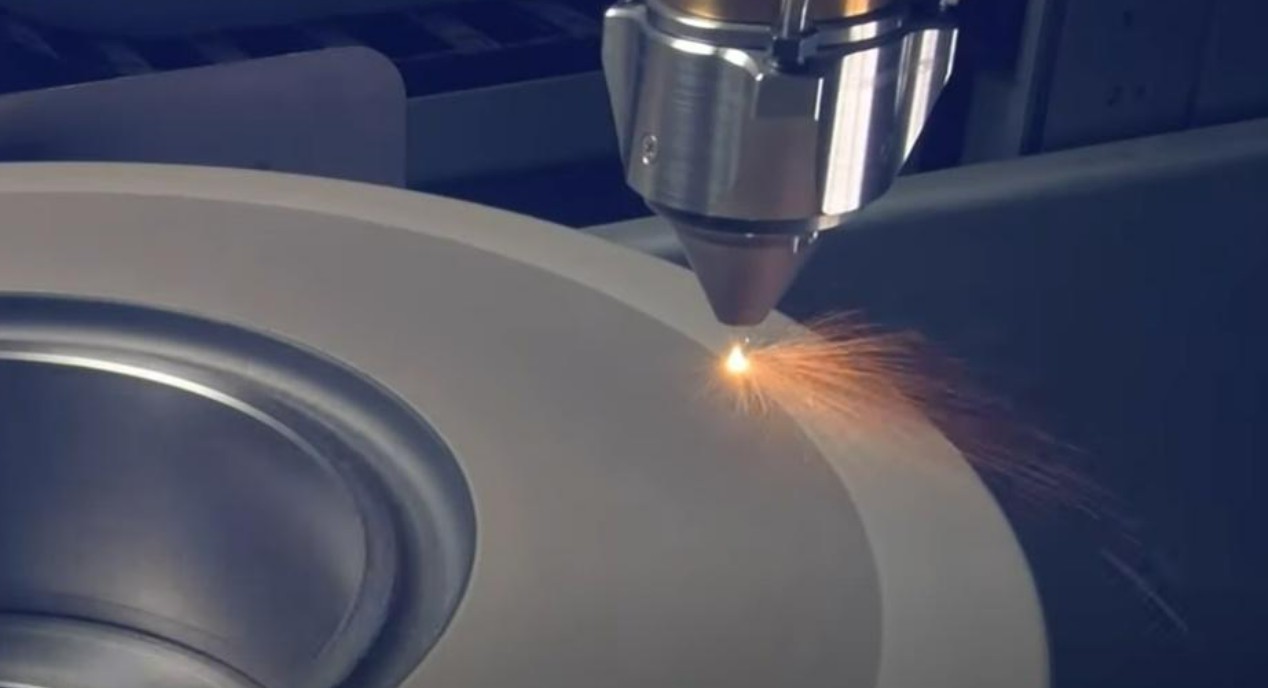
High-Speed and Ultra-High-Speed Laser Cladding
4. High-Speed Wire Laser Cladding
Unlike powder-based laser cladding, high-speed wire laser cladding uses metal wire as the cladding material.The system typically consists of a semiconductor fiber-delivered laser, a high-precision wire feeding system, and a specially designed cladding head.During operation, the metal wire is fed from the side into the laser beam. The laser heats and melts the wire while simultaneously forming a melt pool on the substrate. As the cladding head and workpiece move relative to each other, the molten wire solidifies and forms the cladding layer.Using wire instead of powder changes several important characteristics of the process.
Key Characteristics of High-Speed Wire Laser Cladding
Excellent Material Utilization
One of the biggest advantages of wire is its high material utilization.Unlike powder, which may be lost through overspray or incomplete capture, the wire is directly fed into the laser processing zone. With an appropriate wire and cladding-head design, the wire can be almost completely melted into the cladding layer.Material utilization can reach approximately 99% under suitable conditions.This is particularly valuable when expensive alloy materials are required.
Cleaner and More Environmentally Friendly
Metal powder can create airborne particles during handling and processing. Wire does not have the same powder-dispersion issue.During high-speed wire laser cladding, the rigid wire is delivered directly into the processing zone and melted into the cladding layer. With appropriate process control, there is little material loss caused by powder overspray or airborne powder.This makes wire-based laser cladding an attractive option when a cleaner production environment is important.
High Cladding Efficiency
High-speed wire laser cladding can use a specially designed energy-delivery system to preheat the wire before it enters the melt pool.As a result, the wire can reach a partially molten or highly heated state before entering the melt pool. Only a relatively small amount of additional energy is then required to complete the melting process.This can increase the deposition efficiency compared with conventional powder-based laser cladding.
Low Heat Input and Low Distortion
The process combines controlled energy input with relatively high cladding speed.This can result in low heat input per unit length and reduce thermal influence on the substrate. Under appropriate conditions, line energy can be as low as approximately 0.29 kJ/cm.Lower thermal input is particularly valuable when processing components where excessive heat could cause distortion or dimensional changes.
Dense Cladding Layers and Low Defect Rates
High-speed wire laser cladding can produce dense metallurgically bonded layers when the wire material, laser parameters, feeding speed, and motion system are properly matched.The controlled wire delivery also helps reduce material loss and can contribute to a low defect rate and low dilution.
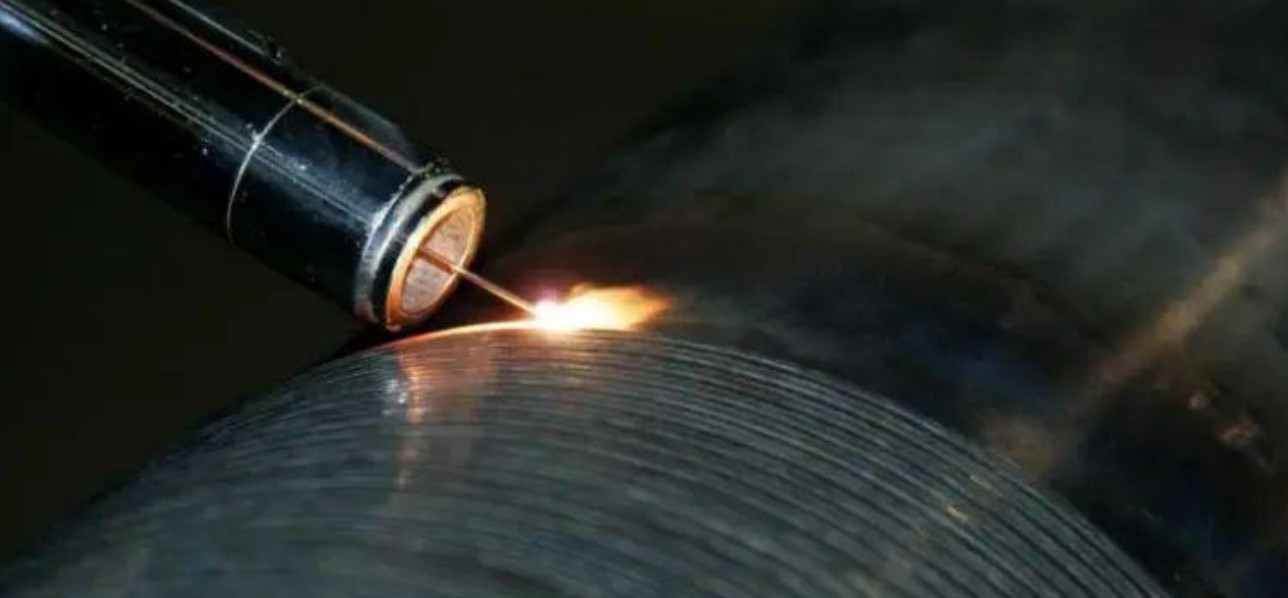
High-Speed Wire Laser Cladding
Laser Cladding Technologies Compared
Although all four technologies are based on laser cladding, their strengths are different.
| Laser Cladding Technology | Material Delivery | Main Advantage | Typical Strength |
|---|---|---|---|
| Coaxial powder-fed | Coaxial powder | High flexibility | Complex geometry and robotic cladding |
| Off-axis powder-fed | Side/pre-placed powder | High material utilization | Large and accessible surfaces |
| Ultra-high-speed laser cladding | High-speed powder delivery | Extremely high processing speed | High-throughput thin coatings |
| High-speed wire laser cladding | Metal wire | Very high material utilization | Clean, efficient wire deposition |
The choice should therefore not be based simply on which process has the highest speed or material utilization. A process that is excellent for a thin coating on a large cylindrical surface may not be appropriate for repairing a complicated valve or rebuilding a damaged shaft.
How to Choose the Right Laser Cladding Technology?
The correct laser cladding process depends on several factors.
Component Geometry
For complex three-dimensional components, internal surfaces, or parts requiring multi-axis movement, coaxial powder feeding provides significant flexibility.For relatively large and accessible surfaces, off-axis powder feeding may provide better productivity and material utilization.
Required Cladding Thickness
The required coating thickness is another important consideration.Ultra-high-speed laser cladding is particularly attractive for relatively thin protective layers and high-throughput surface treatment. If a much thicker layer is required, other deposition technologies may become more suitable depending on the material and production requirements.
Cladding Material
The material itself also affects process selection.Powder and wire have different material availability, feeding characteristics, storage requirements, and processing behavior. Powder can provide considerable flexibility in alloy selection and is widely used in laser metal deposition, while wire offers very high material utilization and cleaner handling.
Production Volume
For high-volume production, deposition speed and material utilization can have a major influence on the economics of the process.Ultra-high-speed laser cladding and high-speed wire laser cladding can be attractive when high throughput is required. For customized repair or complex geometries, however, flexibility may be more important than maximum deposition speed.
Required Surface Quality and Dimensional Accuracy
The required surface roughness, machining allowance, dimensional tolerance, and distortion limit should also be considered.Laser cladding is generally valued for its precise material deposition and relatively low heat input, but the final surface condition still depends on the specific process and may require machining after cladding.
Conclusion
Laser cladding includes several different technologies, including coaxial powder-fed, off-axis powder-fed, ultra-high-speed, and high-speed wire cladding. Each technology has its own advantages, and the right choice depends on the material, component geometry, coating requirements, production volume, and required surface properties.
ZS Laser focuses on providing high-quality laser processing solutions rather than simply offering higher laser power or lower equipment prices. We can help customers select and configure the appropriate laser source, cladding head, material delivery system, motion system, and process setup according to the actual application.
For customized laser cladding projects, ZS Laser can also provide process testing and tailored equipment configurations to help manufacturers develop a practical solution for their specific components and production requirements.

WhatsApp
Scan the QR Code to start a WhatsApp chat with us.