 ZS Laser Equipment

Many industrial components do not fail because the entire part is damaged. In many cases, wear, corrosion, erosion, or repeated mechanical loading mainly affects the surface.For example, shafts, rollers, molds, hydraulic components, valves, pump parts, and other high-value components may lose material from specific areas during operation. Replacing the entire component can be expensive, especially when the remaining part is still structurally sound.Laser cladding provides another approach.
Instead of replacing the entire component, a new layer of material can be deposited onto the required surface to restore dimensions or improve surface performance.Depending on the application and cladding material, laser cladding can be used for:
- Wear-resistant surface protection
- Corrosion-resistant coatings
- Dimensional restoration
- Mold and die repair
- Surface performance improvement
- Repair of high-value metal components
However, laser cladding is not simply another type of laser welding. It is a specialized laser-based material deposition and surface engineering process.This guide explains how laser cladding works, which materials can be used, where it is applied, how it differs from laser welding, and what to consider when selecting a laser cladding machine.
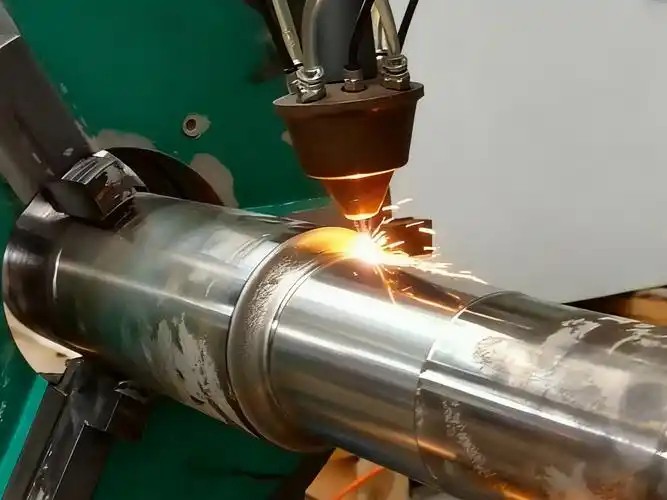
Laser Cladding Process
What Is Laser Cladding?
Laser cladding is a surface engineering process that uses a focused laser beam to melt a feedstock material—typically metal powder or wire—onto the surface of a component. A small amount of the substrate is also melted, allowing the deposited material to form a metallurgical bond with the underlying material.The purpose is not simply to put another material on top of a component. Laser cladding is normally used when the surface needs properties that the bulk material does not provide, such as higher wear resistance, corrosion resistance, heat resistance, or dimensional restoration.You can refer Four types of laser cladding to know more about laser cladding types.
This makes the process particularly useful for repairing expensive components, extending service life, and selectively modifying surfaces rather than manufacturing an entire part from a more expensive alloy.
How Does the Laser Cladding Process Work?
A typical laser cladding process involves several stages.
1. Surface Preparation
Before cladding, the damaged or working surface needs to be properly prepared.Contaminants such as:
- Oil
- Grease
- Rust
- Paint
- Oxides
- Dirt
can negatively affect process stability and cladding quality.For repair applications, heavily damaged material may also need to be removed by machining before laser cladding begins.The objective is to provide a clean and suitable substrate for the new material.
2. Laser and Cladding Material Delivery
The laser cladding head directs the laser beam toward the workpiece.At the same time, the cladding material is delivered into the processing area.In powder-based systems, a powder feeder controls the supply of metal powder while carrier gas transports the powder toward the melt pool.The basic equipment can therefore include:
- Laser source
- Laser cladding head
- Powder feeder
- Motion system
- Cooling system
- Shielding or carrier gas system
- CNC or robotic control system
The exact configuration depends on the component geometry and production requirements.
3. Formation of the Melt Pool
The laser concentrates energy into a relatively small area.This creates a localized molten pool on the substrate surface.The cladding material melts within this region and forms a new layer as the laser head moves along the programmed path.So controlling the melt pool is critical.If the energy input is too low, the process may result in poor bonding or insufficient melting.If the energy input is too high, excessive substrate melting can increase dilution and heat input.
4. Layer-by-Layer Deposition
The laser cladding head moves along a predefined path while continuously depositing material.Individual deposition tracks overlap to form a continuous cladding layer.For applications requiring greater thickness, multiple layers can be deposited.The final geometry therefore depends on factors such as:
- Track width
- Layer height
- Overlap
- Powder feed rate
- Laser power
- Travel speed
- Number of layers
This makes motion control an important part of a laser cladding system.
5. Post-Cladding Machining
Laser cladding is often not the final manufacturing step.For components that require precise dimensions, the deposited surface may need to be machined after cladding.Typical finishing processes include:
- Turning
- Milling
- Grinding
- Polishing
For example, a worn shaft may first be cleaned and inspected, followed by laser cladding to restore material. The shaft can then be turned or ground back to its required final diameter.This combination of laser cladding + machining can be particularly useful for high-value components where complete replacement is undesirable.
What Materials Can Be Used for Laser Cladding?
One of the major advantages of laser cladding is the ability to select a cladding material according to the required surface performance.However, material selection cannot be separated from the substrate and operating environment.
Stainless Steel
Stainless steel-based cladding materials can be used where corrosion resistance and general surface protection are important.Applications may include components exposed to moisture, chemicals, or corrosive process environments.
Nickel-Based Alloys
Nickel-based alloys are commonly considered for applications requiring combinations of:
- Corrosion resistance
- High-temperature performance
- Wear resistance
They can be used for certain industrial components operating under demanding conditions.
Cobalt-Based Alloys
Cobalt-based cladding materials can be selected for applications where high wear resistance and elevated-temperature performance are required.They may be considered for specific:
- Valve components
- Wear surfaces
- Industrial tooling
- High-temperature components
The exact alloy should be selected according to the actual wear mechanism and operating temperature.
Tool Steel
Tool-steel-based materials can be used for repairing or improving certain:
- Dies
- Molds
- Tooling components
- Wear-resistant surfaces
For mold repair, compatibility between the cladding material and the original mold material is particularly important.
Carbide-Reinforced Materials
For severe abrasive wear, carbide-containing cladding materials can be considered.These materials can provide hard reinforcing phases within the deposited layer.However, the highest hardness is not necessarily the best solution for every application. Impact loading, toughness, machining requirements, and the actual wear mechanism must also be considered.
What Problems Can Laser Cladding Solve?
Laser cladding is particularly valuable when a component has a localized surface problem rather than complete structural failure.
Wear Repair
Industrial components can lose material through:
- Abrasive wear
- Sliding wear
- Erosion
- Repeated contact
Laser cladding can restore worn areas and, with an appropriate cladding material, improve resistance to future wear.
Corrosion Protection
A suitable corrosion-resistant alloy can be deposited onto a substrate to provide a protective surface layer.This approach can be useful when the base material provides the required structural properties while the surface requires better corrosion resistance.
Dimensional Restoration
Dimensional restoration is one of the most practical laser cladding repair applications.Components such as:
- Shafts
- Rollers
- Hydraulic rods
- Bearing seats
- Mechanical components
can lose material during operation.Instead of manufacturing a completely new component, laser cladding can rebuild the damaged area.The component can then be machined to its original dimensions.
Surface Performance Improvement
Laser cladding does not have to be used only after damage occurs.For some new components, a different material can be deposited on the working surface to provide specific properties such as:
- Wear resistance
- Corrosion resistance
- High-temperature resistance
This makes laser cladding a surface engineering technology as well as a repair technology.
Laser Cladding Applications
Laser cladding is used across industries where component surfaces experience significant wear, corrosion, or dimensional loss.
Mold and Die Repair
Molds and dies can be extremely expensive and may have complex geometries.Localized damage does not necessarily mean the entire mold must be replaced.Laser cladding can be considered for:
- Injection molds
- Die-casting molds
- Forging dies
- Stamping dies
- Industrial tooling
After cladding, precision machining may be required to restore the original geometry.
Shaft and Roller Repair
Shafts and rollers are common laser cladding repair applications.Typical components include:
- Industrial shafts
- Hydraulic shafts
- Drive shafts
- Rollers
- Bearing areas
When only a specific surface has worn, laser cladding can rebuild the missing material instead of replacing the entire component.
Mining Equipment
Mining equipment can operate under extremely abrasive conditions.Components exposed to rock, mineral particles, impact, and continuous friction may experience significant surface wear.Laser cladding can be considered for selected:
- Shafts
- Rollers
- Wear components
- Mechanical parts
The appropriate cladding material depends heavily on the specific wear mechanism.
Oil and Gas Equipment
Oil and gas equipment may encounter combinations of pressure, corrosion, erosion, and mechanical wear.Laser cladding can be considered for selected components such as:
- Valves
- Pump components
- Wear surfaces
- Specialized mechanical components
For these applications, material compatibility and process qualification are particularly important.
Power Generation Equipment
Power-generation equipment often contains expensive components that operate under demanding thermal and mechanical conditions.Potential applications include:
- Turbine components
- Valve components
- Pump parts
- Wear-resistant surfaces
For critical components, laser cladding should be supported by appropriate inspection and process validation.
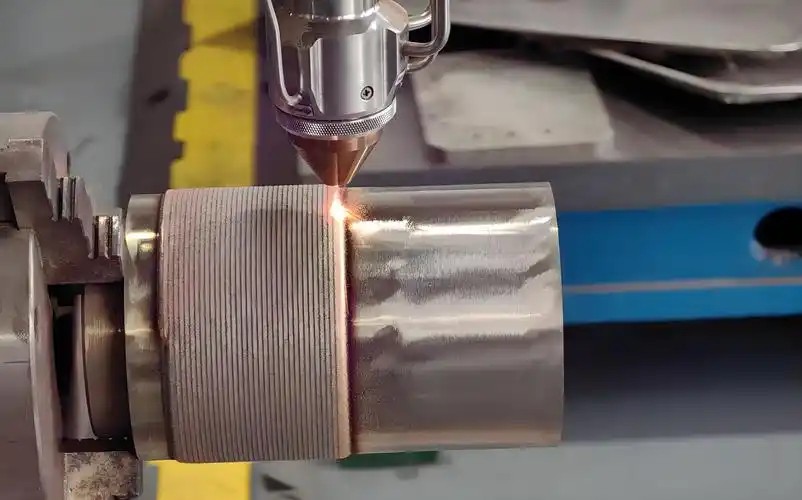
Laser cladding
Laser Cladding vs Laser Welding
Laser cladding and laser welding both use laser energy, but their primary objectives are different.
| Feature | Laser Cladding | Laser Welding |
|---|---|---|
| Main purpose | Surface repair or surface modification | Joining components |
| Typical result | Deposited material layer | Welded joint |
| Material addition | Commonly used | May or may not be used |
| Typical application | Repair, wear resistance, corrosion protection | Joining metal parts |
| Process focus | Surface deposition | Joint formation |
| Post-process machining | Often required for precision repair | Depends on application |
A simple way to understand the difference is:
Laser welding connects components, while laser cladding adds or restores material on a component surface.
For example, welding two stainless steel plates together is a laser welding application.Rebuilding a worn shaft surface with a wear-resistant alloy is a laser cladding application.Although both processes use lasers, their equipment, process parameters, material delivery systems, and application objectives can be significantly different.
Laser Cladding vs Laser Metal Deposition
The terms laser cladding and laser metal deposition (LMD) are sometimes used in overlapping contexts.Laser metal deposition is a broader term used to describe laser-based processes in which material is deposited onto a substrate.Laser cladding is commonly associated with depositing material onto an existing surface to improve or restore its properties.
Depending on the manufacturer, research field, or industrial application, terminology can vary.Therefore, when evaluating equipment, it is more important to understand the actual process configuration and application requirements than to rely only on the name of the technology.
What Affects Laser Cladding Quality?
A laser cladding system is only as effective as its process development.Several parameters can significantly affect the final result.
Laser Power
Laser power affects the amount of energy delivered to the processing area.It influences:
- Melt pool size
- Melting behavior
- Deposition rate
- Penetration
- Heat input
Higher power does not automatically mean better cladding.The appropriate power must be matched with the material, spot size, travel speed, and deposition conditions.
Cladding Speed
Travel speed affects the energy delivered per unit length.If the speed is too high, insufficient melting or bonding may occur.If it is too low, excessive heat input and substrate melting may occur.
Powder Feed Rate
For powder-based laser cladding, the powder feed rate directly affects deposition conditions.Too much powder may not be completely melted.Too little powder can reduce deposition efficiency.Stable powder delivery is therefore an important part of the system.
Spot Size
The laser spot size affects energy density and track geometry.A smaller spot can provide a concentrated energy distribution, while a larger spot can cover a wider processing area.The correct configuration depends on the component and required deposition geometry.
Overlap Rate
When multiple tracks are deposited next to each other, the overlap between adjacent tracks affects surface uniformity and overall layer quality.Poor overlap control can result in uneven surfaces or inconsistent deposition.
Shielding and Carrier Gas
Gas flow can affect powder delivery and protection of the processing area.The appropriate gas configuration depends on the cladding material, equipment design, and process requirements.
Substrate Material
The substrate is equally important.Different materials have different:
- Thermal conductivity
- Melting characteristics
- Metallurgical compatibility
- Thermal expansion behavior
Therefore, the same laser cladding parameters cannot simply be transferred from one material to another.
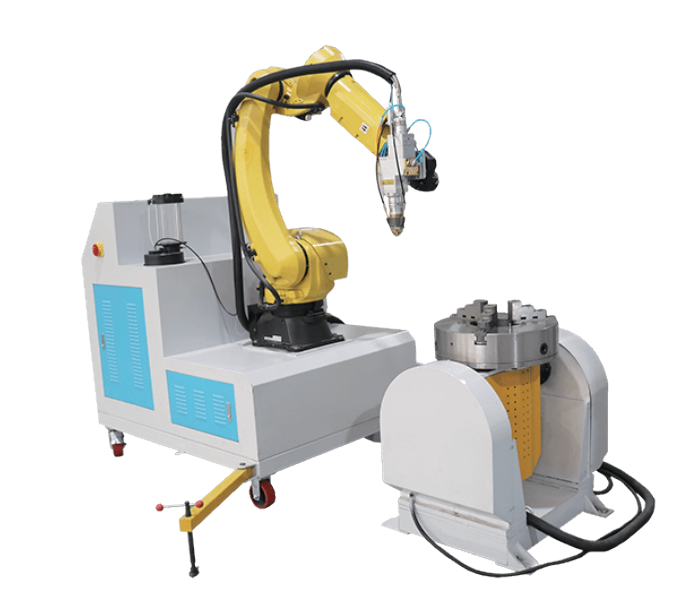
How to Choose a Laser Cladding Machine?
Choosing a laser cladding machine should start with the application rather than laser power alone.
Laser Source
The laser source is one of the main components of the system.Power, beam characteristics, wavelength, and source configuration can affect the available process window.The correct laser source should be selected according to the substrate, cladding material, deposition rate, and required geometry.
Laser Cladding Head
The cladding head controls how laser energy and cladding material are delivered to the workpiece.Important considerations can include:
- Optical design
- Powder delivery configuration
- Spot size
- Cooling
- Processing geometry
A good cladding head should provide stable and repeatable material deposition.
Powder Feeding System
For powder-based systems, the powder feeder is critical.Important factors include:
- Feeding stability
- Powder flow control
- Feeding accuracy
- Carrier gas control
- Compatibility with the selected powder
An unstable powder supply can directly affect deposition consistency.
Motion System
The motion system should match the geometry of the component.Depending on the application, a laser cladding machine may use:
- XYZ linear axes
- Rotary axes
- CNC platforms
- Robotic systems
- Customized motion systems
For cylindrical components such as shafts and rollers, a rotary axis can be particularly useful.For large or complex components, a customized CNC or robotic system may be more appropriate.
Control System
The control system coordinates the laser, powder feeding, motion system, and other equipment.A suitable control system can improve:
- Path accuracy
- Repeatability
- Process coordination
- Production efficiency
For automated applications, control capability becomes increasingly important.
Workpiece Size and Weight
The size and weight of the workpiece can significantly affect machine design.A small repair machine may be suitable for relatively compact components.Large shafts, rollers, molds, and industrial components may require:
- Larger working areas
- Higher-capacity rotary systems
- Heavy-duty machine structures
- Customized fixtures
- Higher-load motion systems
Therefore, a laser cladding machine should be designed around the actual workpiece rather than using a standard configuration without considering component size.
Laser Cladding Machine Price: Why Can It Vary So Much?
Laser cladding is a highly customized product, so there will be significant differences between machines with different configurations and for different applications.The price of a laser cladding machine can vary significantly because laser cladding equipment is not simply a laser source mounted on a machine.The overall cost can be affected by:
- Laser power
- Laser source
- Cladding head
- Powder feeder
- CNC control system
- Robotic system
- Rotary axis
- Working area
- Machine structure
- Cooling system
- Automation level
- Customized fixtures
For example, a compact manual or semi-automatic repair system and a fully automated CNC or robotic laser cladding system can have completely different configurations and prices.Therefore, comparing laser cladding machines only by laser power can be misleading.A better comparison should consider the complete system and whether it is actually suitable for the intended application.
requently Asked Questions About Laser Cladding
What is laser cladding used for?
Laser cladding is used to repair worn components, restore dimensions, and add wear-, corrosion- or heat-resistant surface layers to metal components.
Is laser cladding the same as laser welding?
No. Both use a laser as a heat source, but laser welding primarily joins components, while laser cladding deposits material onto an existing surface for repair or surface modification.
What materials are used in laser cladding?
Common materials include nickel-based alloys, cobalt-based alloys, stainless steels, tool steels, titanium alloys and carbide-reinforced materials. The appropriate material depends on the substrate and service conditions.
Can laser cladding repair worn parts?
Yes. Repair and dimensional restoration are important applications. Material can be deposited onto worn areas and subsequently machined to restore the required geometry.
Is laser cladding better than thermal spraying?
Not in every application. Laser cladding can provide metallurgical bonding and controlled localized deposition, while thermal spray can be attractive for large-area coating and applications where minimal substrate melting is desired.
Can laser cladding be used for corrosion protection?
Yes. Corrosion-resistant alloys can be deposited onto selected surfaces to protect components exposed to aggressive environments.
What is laser metal deposition?
Laser Metal Deposition (LMD) is a closely related term for laser-based directed material deposition. Laser cladding, LMD, DMD and DED are often used in overlapping contexts, although the exact terminology depends on the process and application.
Can laser cladding replace traditional cladding methods?
Not entirely; it depends on the specific circumstances.
Conclusion
Laser cladding is a laser-based surface engineering technology used to repair worn components, restore dimensions, and improve surface properties such as wear and corrosion resistance.Unlike laser welding, which primarily focuses on joining components, laser cladding focuses on depositing material onto an existing surface.The quality of the result depends on much more than laser power. The laser source, cladding head, material feeding system, motion system, substrate, cladding material, and process parameters all need to work together.
ZS Laser has been deeply involved in the field of laser welding for over ten years. We have extensive experience in the tuning and control of laser systems, and we have mature products available for both welding and cladding.
If you are considering laser cladding for component repair, surface protection, or dimensional restoration, contact ZS Laser to discuss your application and develop a suitable solution.

WhatsApp
Scan the QR Code to start a WhatsApp chat with us.