 ZS Laser Equipment

Metal gates are widely used in residential, commercial, industrial, agricultural, and infrastructure projects. From simple garden gates to large industrial security gates, most metal gates require welding during fabrication.For small-scale fabrication, traditional welding processes such as MIG, TIG, and stick welding are still widely used. For manufacturers producing large quantities of standardized or customized metal gates, however, automated and robotic welding can significantly improve productivity and consistency.
In particular, laser welding and robotic laser welding can be attractive for certain metal gate manufacturing applications where high welding speed, low heat input, and repeatability are important.This guide explains the common materials used for gates, the welding methods available, and how manufacturers can choose an appropriate welding gate solution.
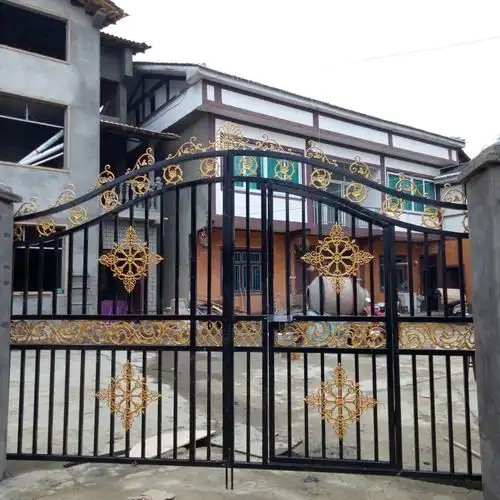
Metal Gate
What Is Gate Welding?
Gate welding refers to the process of joining metal components during the fabrication of a gate.A typical welded metal gate may consist of:
- Square or rectangular tubes
- Round tubes
- Flat bars
- Steel plates
- Metal sheets
- Decorative bars
- Hinges and brackets
- Reinforcement components
- Frames and supports
For example, a simple steel gate may first be fabricated by cutting square tubes to the required dimensions. The tubes are then positioned in a fixture, clamped, and welded together to form the main frame.Additional bars, mesh, hinges, or decorative components can then be welded to the frame.Therefore, gate welding is not a single welding operation. It is usually a combination of cutting, positioning, clamping, tack welding, final welding, grinding, and surface finishing.
What Materials Are Used for Metal Gates?
Before selecting a welding machine, it is important to identify the material being used.Different gate materials have different welding characteristics.
Mild Steel Gates
This is one of the most common materials used for metal gates.It is widely used because it offers:
- Good weldability
- Relatively low material cost
- Good mechanical strength
- Easy cutting and fabrication
- Wide availability
Mild steel gates are commonly manufactured from square tubes, rectangular tubes, round tubes, plates, and flat bars.MIG welding, stick welding, and laser welding can all be considered depending on the thickness and production requirements.For large-scale production, automated laser welding can be particularly interesting when the joints are suitable for the process.
Carbon Steel Gates
Carbon steel is also widely used for industrial and commercial gates.It can provide higher strength than some mild-steel products, but the actual welding characteristics depend on the specific grade and carbon content.
For ordinary carbon-steel gate fabrication, MIG/MAG welding is commonly used because it is flexible and relatively productive.Laser welding can also be used for suitable carbon-steel components, but welding parameters and joint design must be properly developed to reduce the risk of cracking and other weld defects.
Stainless Steel Gates
Stainless steel is commonly selected when corrosion resistance and appearance are important.Typical applications include:
- Residential entrance gates
- Commercial gates
- Decorative gates
- Food-processing facilities
- Architectural structures
- High-end building entrances
Common stainless-steel grades include 201,304 and 316, although the appropriate grade depends on the environment and application.TIG welding is traditionally popular for stainless-steel fabrication because it provides excellent control and can produce clean welds.
Laser welding is also well suited to many stainless-steel applications because it can produce narrow welds with concentrated heat input and relatively low thermal distortion.This can be particularly useful for thin stainless-steel tubes and sheet-metal gate components.
Aluminum Gates
Aluminum gates are selected primarily for their low weight and corrosion resistance.Aluminum is commonly used for:
- Residential gates
- Sliding gates
- Decorative gates
- Lightweight architectural gates
- Commercial entrance systems
However, aluminum is more challenging to weld than ordinary mild steel.Its high thermal conductivity and reflective characteristics require careful process development.TIG and MIG welding are commonly used for aluminum fabrication. Laser welding can also be used, but the specific alloy, thickness, joint design, laser source, and process parameters should be evaluated through testing.
Which Welding Methods Can Be Used for Gate Welding?
There is no single welding method suitable for every gate.The most common options include:
- MIG/MAG welding
- TIG welding
- Stick welding
- Laser welding
- Robotic welding
The best choice depends on the gate design and production requirements.
MIG Welding for Metal Gates
MIG/MAG welding is one of the most widely used processes for metal gate fabrication.It is especially suitable for mild steel and carbon-steel structures.Advantages include:
- Relatively high deposition rate
- Good productivity
- Suitable for structural fabrication
- Easy availability of equipment and consumables
- Suitable for various material thicknesses
MIG welding is particularly useful for gates made from square tubes, rectangular tubes, plates, and other structural components.For workshops producing different gate designs in relatively small quantities, MIG welding offers considerable flexibility.However, MIG welding can produce more spatter and a wider heat-affected zone than laser welding.Depending on the required appearance, additional grinding and finishing may also be necessary.
TIG Welding for Stainless Steel and Decorative Gates
TIG welding is often used when appearance and welding control are important.It is particularly common for stainless-steel gates and thinner metal components.The main advantages of TIG welding include:
- Excellent arc control
- Precise heat input control
- Good weld appearance
- Suitable for thin materials
- Low spatter
The main disadvantage is productivity.Compared with automated laser welding, TIG welding generally requires more operator time and can be less suitable for high-volume production.For a one-off decorative gate, however, TIG can still be an excellent choice.
Stick Welding for Gate Installation and Repair
Stick welding, also known as MMA welding, remains useful for certain gate applications.It is especially convenient for:
- On-site repair
- Outdoor installation
- Maintenance
- Heavy steel gates
- Construction-site welding
One advantage of stick welding is that it does not require a continuous shielding gas supply.However, it is generally less productive than MIG welding for repetitive factory production and can require more post-weld cleaning.For manufacturing gates in a controlled factory environment, MIG, laser, or robotic welding may therefore provide better productivity depending on the application.
Laser Welding for Metal Gates
Laser welding is increasingly being considered for metal fabrication because it uses a highly concentrated heat source.For suitable gate components, laser welding can provide:
- High welding speed
- Narrow weld width
- Low heat input
- Reduced thermal distortion
- Consistent weld geometry
- High repeatability
- Potentially reduced post-weld finishing
These characteristics are particularly useful for manufacturers producing gates from relatively thin tubes, sheets, and profiles.For example, when welding a square-tube gate frame, excessive heat from conventional welding can cause distortion. If the frame moves during welding, dimensional accuracy can become difficult to maintain.The concentrated heat input of laser welding can help reduce this problem when the joint design and process parameters are appropriate.
However, laser welding requires better joint preparation than some conventional welding processes.The gap between components, surface condition, material, thickness, laser power, focus position, welding speed, shielding gas, and fixture accuracy can all influence the result.Therefore, laser welding should not be selected simply because it is faster. The complete welding process needs to be developed around the actual gate design.
Robotic Laser Welding for High-Volume Gate Production
For manufacturers producing large quantities of similar gates, robotic laser welding can offer additional advantages.A typical system may include:
- Fiber laser source
- Laser welding head
- Industrial robot
- Welding fixture
- Positioning system
- Wire feeder when filler wire is required
- Protective enclosure
- Control system
- Safety system
The robot moves the welding head according to a programmed path, while the fixture keeps the gate components in the required position.This is particularly useful when the gate design is repetitive.For example, a manufacturer may produce hundreds or thousands of metal frames with the same dimensions.Instead of relying entirely on manual welding, the production process can be organized as:
Tube Cutting → Part Preparation → Fixture Loading → Clamping → Tack Welding → Robotic Laser Welding → Inspection → Finishing
This can significantly improve production consistency.
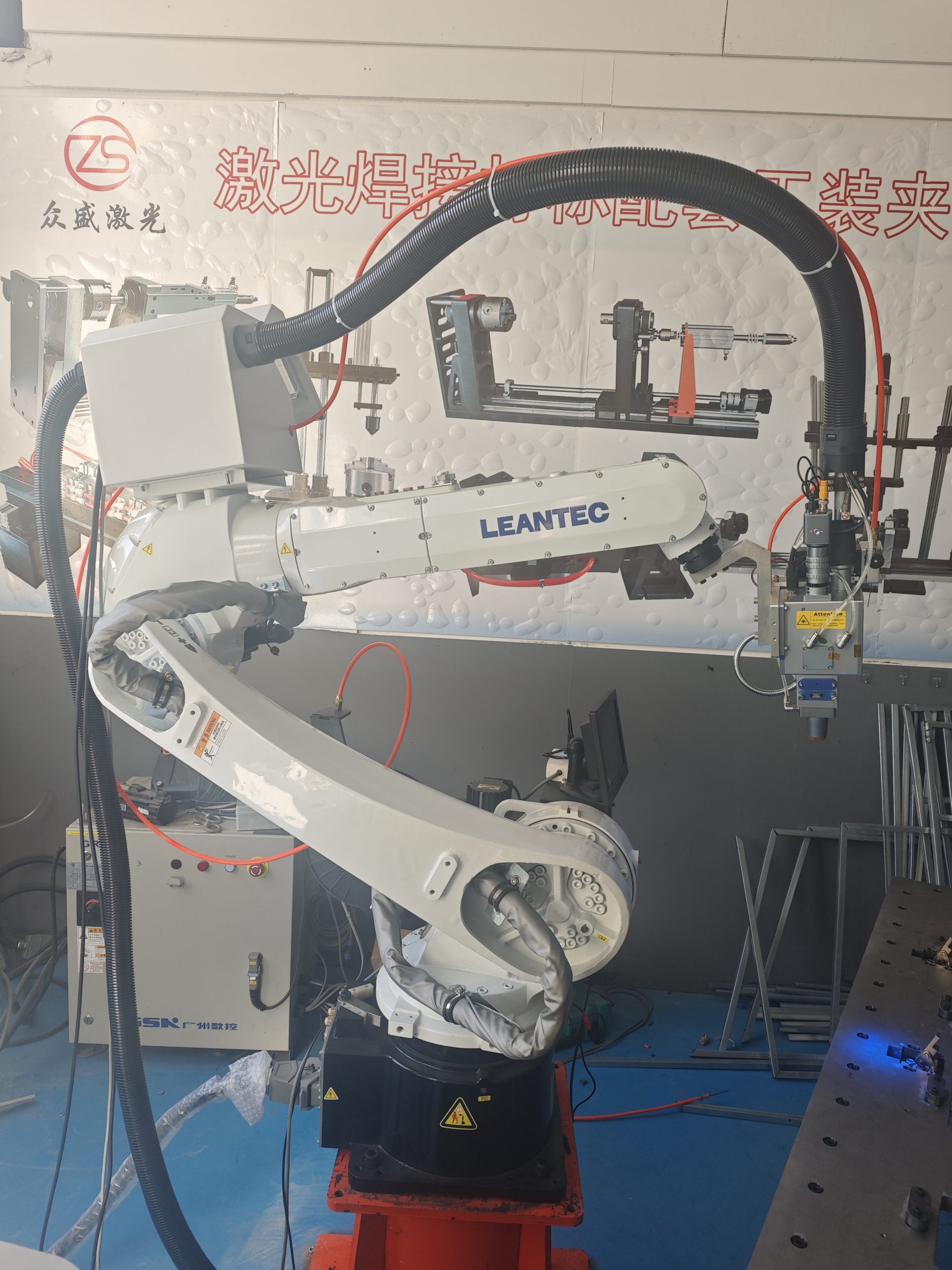
ZS Robotic Fully Automated Welding Machine
Why Are Large Welding Fixtures Important for Metal Gates?
A gate is usually much larger than the individual tubes or plates used to manufacture it.This creates an important challenge: dimensional control.A welding fixture must keep multiple components in the correct position during welding.A suitable gate welding fixture may control:
- Overall length
- Overall width
- Tube position
- Joint angle
- Welding gap
- Frame squareness
- Component alignment
Without an appropriate fixture, even a high-quality welding machine cannot guarantee that the finished gate will maintain the required dimensions.For large gates, the fixture itself can become a major part of the production system.
Large Custom Welding Fixtures for Gates
Large gates often require customized fixtures because their dimensions and structures can vary significantly.For example, a large industrial gate may be several meters wide and contain:
- Multiple horizontal tubes
- Vertical reinforcement bars
- Decorative structures
- Mesh panels
- Hinges
- Locking components
A fixture for such a gate must provide sufficient rigidity while still allowing operators or robots to access the welding joints.The larger the fixture becomes, the more difficult it is to control:
- Fixture deformation
- Positioning accuracy
- Clamping force
- Robot accessibility
- Loading and unloading
- Overall rigidity
Therefore, designing a large gate welding fixture requires more than simply increasing the size of a small fixture.ZS Laser boasts extensive design experience, having participated in the design of numerous large-scale tooling fixtures. We strategically arrange cylinder and clamping positions, and can customize various welding fixtures for different product types.Below is a sample of a fixture we designed previously. Click here to view detailed project information.
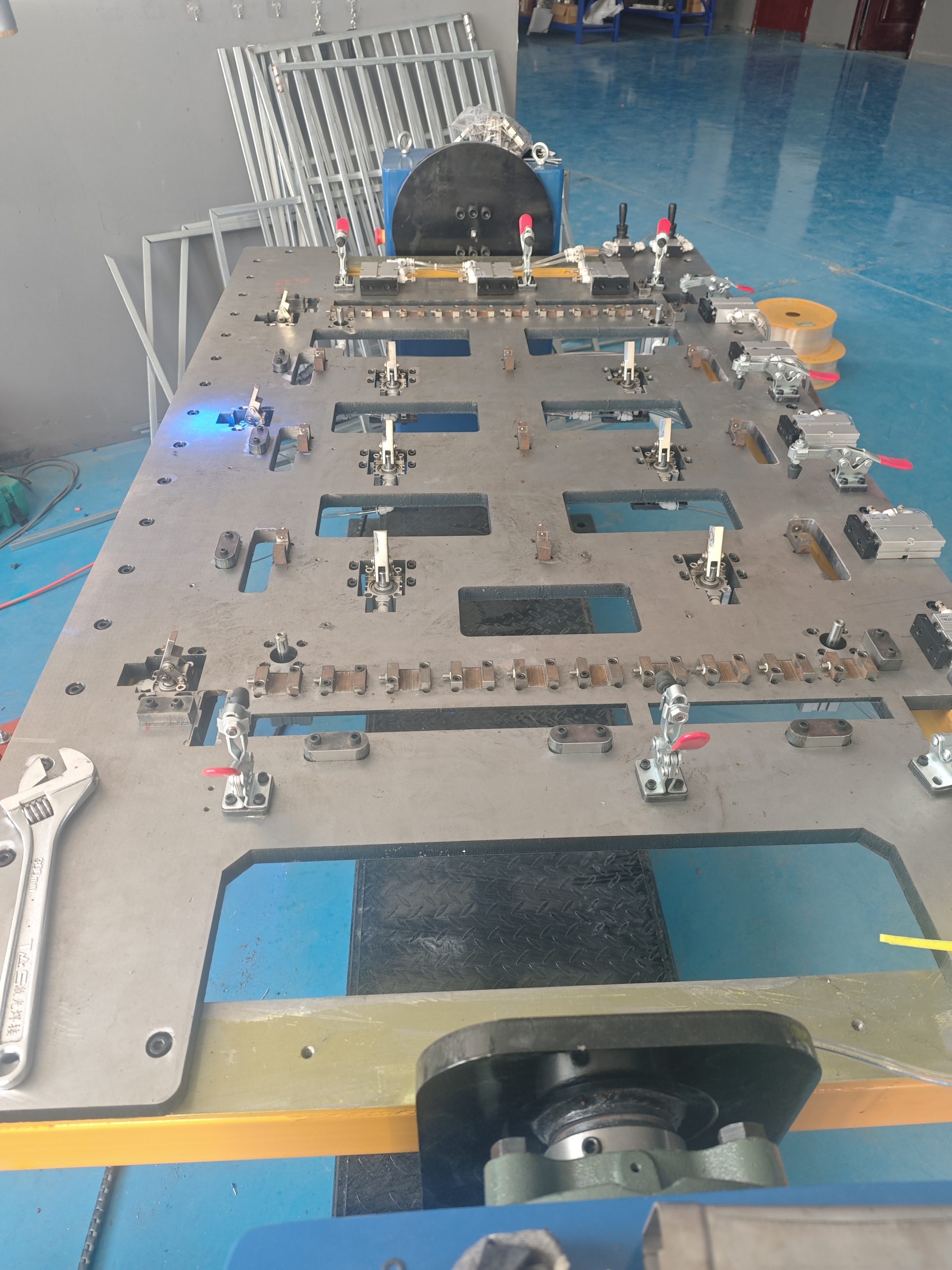
ZS Cage Welding Custom Welding Fixtures
What Type of Gate Is Suitable for Laser Welding?
Laser welding can be considered for many types of metal gates, including:
Residential Metal Gates
For stainless-steel or thin metal decorative gates, laser welding can provide clean and controlled welds.
Security Gates
Steel security gates may contain many repetitive tube-to-tube joints that can potentially be automated.
Industrial Gates
Large industrial gates can benefit from robotic welding when production volumes justify automation.
Sliding Gates
Sliding gates often contain long frames made from tubes and profiles. Automated welding can improve consistency for repetitive designs.
Fencing and Gate Panels
Manufacturers producing large quantities of standardized fencing panels and gate sections may benefit from automated welding fixtures and robotic welding systems.
Automated Production of Metal Gates with Laser Cutting and Welding
For manufacturers producing metal gates, fences, frames, and other tubular structures, laser technology can be used to automate much of the production process.Instead of cutting and welding each component manually, the production line can start with raw metal tubes and gradually turn them into finished gate structures through coordinated cutting, positioning, fixturing, and welding processes.
A typical automated workflow may include:
Raw tube → Laser tube cutting → Part sorting → Fixture positioning → Automated laser welding → Finished gate
1. Laser Tube Cutting
The process can start with standard metal tubes, such as square tubes, rectangular tubes, or round tubes.A laser tube cutting machine can automatically cut the raw material according to the required dimensions and cutting patterns. Depending on the machine configuration, it can also produce holes, slots, and other features required for assembly.
This reduces the need for separate cutting and drilling operations and helps maintain consistent dimensions between components.
2. Automatic Positioning and Fixturing
After cutting, the tube components are placed into a dedicated welding fixture.For mass production, the fixture can be designed specifically for a particular gate or fence structure. It holds the tubes in the correct position and maintains the required geometry during welding.This is especially important for large gates because even a small positioning error can accumulate across the entire frame.
3. Automated Laser Welding
Once the components are positioned, a laser welding system or robotic laser welding system can automatically weld the required joints.The welding robot can follow a programmed welding path and repeat the same process for multiple workpieces.Compared with manual welding, automated laser welding can provide:
- More consistent weld positioning
- Higher production efficiency
- Repeatable welding quality
- Reduced dependence on operator skill
- Lower thermal distortion when the process is properly developed
For manufacturers producing large quantities of similar gates or fence panels, automation can significantly improve production efficiency.
4. Large Fixtures for Large Gates
Large metal gates present an additional challenge: the welding fixture itself needs to be large, rigid, and accurately manufactured.A large-format fixture may need to support the entire gate frame while providing sufficient positioning points to prevent movement and deformation during welding.The fixture can also be customized according to the gate’s:
- Length and width
- Tube dimensions
- Joint locations
- Welding sequence
- Production volume
- Robot working range
For different gate designs, the fixture configuration may also need to be changed or redesigned.
From Raw Material to Finished Gate
The biggest advantage of this approach is that laser cutting and laser welding can be connected into a more complete production workflow.Instead of treating cutting and welding as two completely independent operations, manufacturers can develop a production process in which tube cutting, component preparation, positioning, and welding work together as one system.
For high-volume production of metal gates, fences, frames, and similar tubular structures, this type of automation can help manufacturers improve consistency, reduce manual operations, and increase overall production efficiency.
Frequently Asked Questions About Welding Gates
Can you weld a metal gate with MIG welding?
Yes. MIG welding is widely used for steel and stainless-steel gate fabrication and is particularly practical for structural frames and general metal fabrication.
Can you laser weld a metal gate?
Yes, provided that the material, thickness, joint design, fit-up, and production conditions are suitable. Laser welding is particularly interesting for repeatable gate components and high-volume production.
Is laser welding better than MIG welding for gates?
Not universally. MIG welding is more forgiving of joint gaps and is highly flexible, while laser welding can provide higher speed, lower heat input, and greater repeatability for suitable joints.
Can a robot weld a large metal gate?
Yes. Robotic welding can be used for large gate frames when the fixture, robot working envelope, welding access, and gate design are properly engineered.
Does a gate require a special welding fixture?
For repetitive production, a dedicated fixture is highly recommended. It helps maintain dimensional accuracy and reduces variation between finished gates.
Conclusion
Welding gate fabrication involves much more than simply selecting a welding machine. The material, tube or sheet thickness, gate structure, production volume, joint design, fixture, and required appearance all influence the appropriate welding process.
ZS Laser focuses on providing high-quality laser welding and cutting equipment and customized welding solutions for different production requirements. We can develop laser welding systems, robotic welding solutions, and customized welding fixtures according to your gate size, material, structure, and production volume.
If you are looking for a laser welding solution for metal gates, contact ZS Laser to discuss your application and production requirements.

WhatsApp
Scan the QR Code to start a WhatsApp chat with us.