 ZS Laser Equipment

Laser welding stainless steel is widely used in modern metal fabrication because it offers concentrated heat input, high welding speed potential, and good control over weld formation. From thin stainless steel sheets and kitchen equipment to industrial enclosures, pipes, and precision components, laser welding provides a practical joining solution for many stainless steel applications.
However, successful stainless steel laser welding depends on more than laser power. The stainless steel grade, material thickness, joint configuration, shielding gas, surface condition, and welding speed all influence the final result.
In this guide, we explain how laser welding stainless steel works, which stainless steel grades are suitable, how to select welding parameters, and which type of laser welding machine is best for different applications.
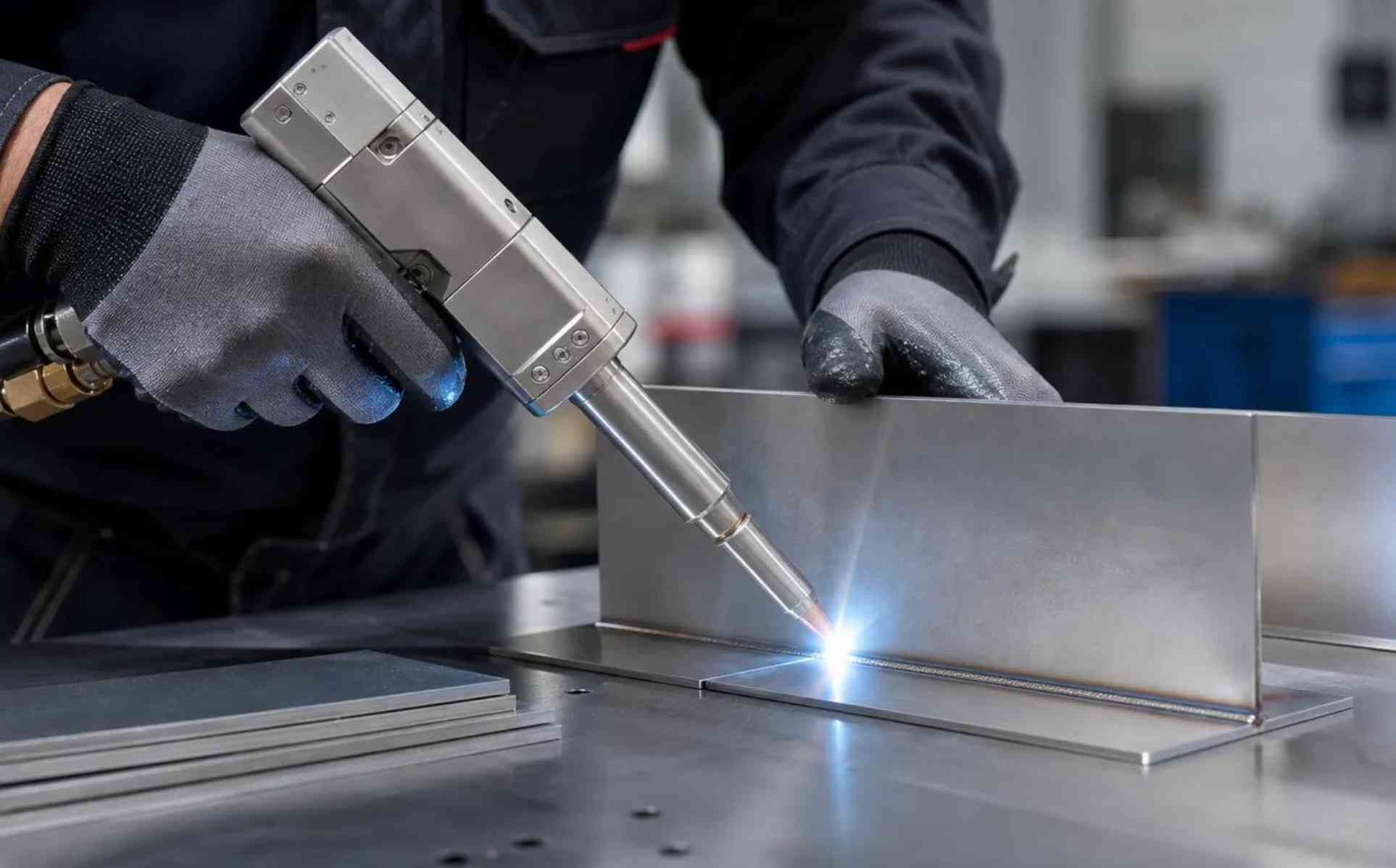
Handheld laser welding stainless steel
1. Why Is Stainless Steel Suitable for Laser Welding?
Stainless steel is one of the common materials used in industrial laser welding. Many stainless steel grades can be welded effectively with a suitable fiber laser system, making the process useful for manufacturers that need consistent weld quality and efficient production.
Concentrated Heat Input
Laser welding delivers energy to a relatively small area. This allows the material to melt locally while limiting unnecessary heating of the surrounding metal.
Under suitable conditions, concentrated heat input can help reduce the heat-affected area and control thermal distortion. This is particularly useful for thin stainless steel sheets, decorative components, and products where dimensional accuracy matters.
However, distortion is not eliminated entirely. Material thickness, fixture design, weld length, heat accumulation, and welding sequence can all affect the final dimensions.
High Welding Speed Potential
Laser welding can achieve high welding speeds on suitable stainless steel joints. This can help improve production efficiency, especially when the same components are manufactured repeatedly.
The actual speed depends on material thickness, required penetration, joint geometry, laser power, and other process parameters. A higher welding speed is only beneficial when the weld still meets the required quality standard.
Good Weld Appearance
Stainless steel products are often used in applications where appearance matters, including kitchen equipment, cabinets, enclosures, and architectural metalwork.
With appropriate joint preparation and parameter settings, laser welding can produce relatively narrow, consistent weld seams. Depending on the application, this may reduce the amount of grinding and finishing required after welding.
Nevertheless, weld appearance alone does not prove that a joint is free from internal defects or meets its mechanical requirements.
Suitable for Automation
Laser welding can be integrated with CNC motion platforms and industrial robots. This makes it suitable for both manual fabrication and automated production.
For simple components, a handheld laser welding machine may provide sufficient flexibility. For repetitive parts that require accurate positioning, a CNC platform or robotic welding system can help improve process consistency.
2. Which Types of Stainless Steel Can Be Laser Welded?
Different stainless steel grades have different chemical compositions and metallurgical characteristics. Although many grades are suitable for laser welding, their welding behavior and process requirements are not identical.
2.1 Laser Welding 304 Stainless Steel
304 stainless steel is one of the most widely used austenitic stainless steel grades. It offers a useful combination of corrosion resistance, formability, and weldability.Typical applications include:
- Kitchen equipment and cookware
- Stainless steel cabinets and enclosures
- Sheet metal components
- Pipes and fittings
- General industrial products
- Decorative stainless steel parts
304 stainless steel is generally well suited to laser welding when the joint design and process parameters are appropriate.
For thin sheets, careful control of heat input helps reduce burn-through and distortion. For thicker components, the required penetration and joint fit-up must be evaluated before selecting the laser power and welding method.
2.2 Laser Welding 316 and 316L Stainless Steel
316 and 316L stainless steel are commonly selected for applications requiring improved corrosion resistance compared with 304 in certain environments.They are used in chemical equipment, industrial components, food-processing equipment, and other products exposed to demanding service conditions.
316L is a low-carbon grade. Its lower carbon content helps reduce the risk of sensitization associated with welding under relevant conditions, although the final corrosion performance also depends on the material, heat cycle, service environment, and post-weld treatment.Laser welding can be used for these grades, but the welding procedure must still be selected according to the joint geometry, material thickness, and required properties.
For applications involving aggressive environments or strict corrosion requirements, the welded area may need appropriate cleaning and passivation or other specified post-weld treatment.
2.3 Laser Welding 430 Stainless Steel
430 stainless steel is a ferritic stainless steel used in applications such as household appliances, decorative panels, and selected industrial components.Its metallurgical behavior differs from that of austenitic grades such as 304 and 316L. Therefore, welding procedures should not automatically be transferred from one grade to another without evaluation.
When laser welding 430 stainless steel, manufacturers should consider the material thickness, joint design, required mechanical properties, and any restrictions related to the finished product.Representative sample testing can help establish suitable parameters for production.
2.4 Laser Welding Martensitic Stainless Steel
Martensitic stainless steel grades are used in applications requiring particular combinations of strength, hardness, or wear resistance.
Some martensitic grades are more sensitive to welding-related cracking and changes in hardness than common austenitic stainless steels. The welding procedure may need to account for the alloy composition, material thickness, joint restraint, and cooling conditions.Depending on the grade and application, preheating or post-weld heat treatment may be necessary.
For this reason, martensitic stainless steel should be evaluated individually rather than treated as equivalent to 304 or 316L.
Can All Stainless Steel Grades Be Laser Welded?
Not every stainless steel grade can be welded using the same procedure. Many common grades are suitable for laser welding, but the correct approach depends on their composition, metallurgical behavior, thickness, and intended service conditions.
For demanding applications, confirm the material grade and test representative workpieces before establishing the production process.
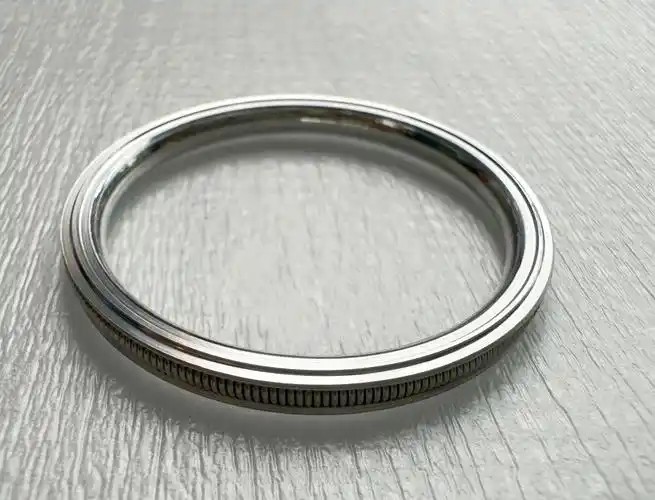
Stainless steel sealing ring
3. Handheld Laser Welding Stainless Steel
Handheld laser welding is a practical option for many stainless steel fabrication applications. The operator holds a laser welding gun and guides it along the joint, while the machine controls the laser output and related process functions.
Compared with a fully automated system, a handheld laser welder offers greater flexibility when manufacturers work with different products, changing joint positions, or relatively small production batches.
Typical Applications
Handheld fiber laser welding machines are commonly considered for:
- Stainless steel sheet metal
- Metal cabinets and enclosures
- Kitchen equipment
- Stainless steel tables and work surfaces
- Pipes and fittings
- General metal fabrication
- Selected decorative and architectural components
The suitability of handheld welding depends on the joint accessibility, material thickness, required penetration, and operator skill.
Advantages of Handheld Laser Welding
Flexible operation: Operators can move around the workpiece and weld accessible joints in different positions without programming a complete motion path.
Adaptability to different products: Handheld equipment is useful for workshops producing multiple types of stainless steel components.
Potentially reduced finishing work: On suitable joints, a well-controlled process can produce clean welds that require less grinding or polishing.
Optional filler wire: A wire feeder can be used when the joint gap, weld profile, or application requirements call for filler material.
Relatively simple production setup: For suitable applications, handheld welding can avoid the need for a dedicated CNC platform or robotic cell.
What Should Be Considered?
Handheld laser welding depends on the operator’s ability to guide the gun consistently. If a component requires a highly repeatable path, precise positioning, or continuous welding around complex geometry, a CNC or robotic system may provide better process control.
Laser safety must also be addressed. Appropriate protective measures, controlled access, equipment safeguards, and effective fume extraction are essential.
Handheld welding is therefore a strong option for many stainless steel fabrication tasks, but it is not automatically the best solution for every production environment.
4. Laser Welding Stainless Steel: Thickness and Power Selection
Material thickness is one of the important factors when choosing a stainless steel laser welding machine. However, laser power alone does not determine the maximum weldable thickness.
The result also depends on welding speed, joint configuration, focus position, shielding gas, material condition, and the penetration required by the application.
Thin Stainless Steel Sheets
Thin stainless steel sheets can be susceptible to burn-through, distortion, and inconsistent weld formation if the heat input is not properly controlled.
For these applications, the process should be developed to achieve sufficient fusion without introducing excessive heat.
Joint fit-up is particularly important. Large gaps between thin sheets may be difficult to bridge consistently without filler material or an appropriate joint redesign.
Medium-Thickness Stainless Steel
As material thickness increases, the required penetration generally becomes more demanding.
The laser power and welding speed must be matched to the joint design and the desired weld depth. Depending on the application, filler wire may help accommodate gaps or achieve the required weld profile.
A sample test should establish whether the proposed equipment can consistently meet the required penetration and quality standard.
Thicker Stainless Steel Components
For thicker components, manufacturers should evaluate the complete welding process rather than relying on a nominal power rating.
Important considerations include:
- Required penetration depth
- Joint preparation and gap tolerance
- Welding speed and heat input
- Number of weld passes, if applicable
- Filler wire requirements
- Mechanical properties and inspection criteria
Some applications may require a different joint design, a higher-power system, multiple passes, or an alternative welding process.
How Should You Choose Laser Power?
The correct power should be determined by the material, thickness, joint geometry, and production target.
A higher-power machine is not necessarily the best choice for every stainless steel product. Excessive heat input can create burn-through or other defects on thin material, while insufficient energy may cause incomplete fusion on thicker sections.
Sample welding is a practical way to determine whether the selected power and process settings meet the application requirements.
5. Recommended Laser Welding Parameters for Stainless Steel
There is no single parameter table that applies to every stainless steel laser welding machine. Even when two machines have the same rated power, their welding heads, beam characteristics, control systems, and process configurations may differ.The following parameters should be considered together during process development.
| Parameter | Main Function | What to Consider |
|---|---|---|
| Laser power | Controls the available laser energy | Balance penetration against burn-through and excessive heat input |
| Welding speed | Determines how quickly the laser travels along the joint | Adjust according to penetration and weld formation |
| Focus position | Influences the energy distribution at the workpiece | Optimize for the material thickness and joint geometry |
| Wobble width and frequency | Control the oscillating beam pattern on compatible welding heads | Adjust according to weld width, gap tolerance, and process stability |
| Shielding gas | Protects the welding area from atmospheric contamination | Select suitable gas coverage and flow |
| Filler wire | Adds material to the weld pool | Use when needed for joint gaps, weld profile, or specified properties |
Laser Power and Welding Speed
Laser power and welding speed should be adjusted together.
Increasing power may increase penetration under suitable conditions, but excessive energy can cause burn-through, spatter, or an undesirable weld profile. Increasing welding speed can reduce heat input per unit length, but may also lead to insufficient penetration if the process is not adjusted accordingly.
The goal is not to maximize either value independently. It is to find a stable operating window that produces the required weld quality.
Focus Position and Wobble Settings
The focus position affects how laser energy is distributed at the workpiece. An unsuitable focus position may influence penetration, weld width, and process stability.
For welding heads that support beam oscillation, wobble width and frequency can also influence weld formation and the ability to accommodate certain joint gaps.
These settings should be optimized for the actual welding head, material, and joint rather than copied directly from an unrelated application.
Shielding Gas and Filler Wire
Shielding gas helps protect the molten metal from atmospheric contamination. The correct gas type, nozzle position, and flow rate depend on the material, joint configuration, and equipment.
Filler wire is not always necessary. Some well-fitted joints can be welded without it, while other applications benefit from additional material to bridge a gap or achieve a specified weld profile.
For critical stainless steel joints, validate the complete process using representative samples.
6. Common Problems When Laser Welding Stainless Steel
Laser welding can produce good results, but inappropriate settings, poor joint preparation, or unsuitable process conditions can lead to defects.
Understanding the likely causes helps manufacturers troubleshoot more systematically.
6.1 Spatter
Spatter may occur when the molten pool becomes unstable or the welding process introduces excessive or poorly controlled energy.Potential contributing factors include unsuitable power and speed settings, poor joint fit-up, surface contamination, or an inappropriate beam pattern.
To improve the process, check the material surface, joint gap, focus position, and shielding gas coverage. Adjust the relevant parameters systematically and compare the resulting welds.
Simply increasing laser power may make the problem worse rather than solve it.
6.2 Porosity
Porosity refers to gas-related cavities within the weld metal.Possible causes include oil, moisture, surface contamination, inadequate gas protection, and unfavorable joint conditions.
Before welding, ensure that the material is clean and dry. Also check the gas supply, nozzle condition, and shielding coverage.For critical applications, visual inspection should be supplemented by appropriate inspection or testing methods.
6.3 Incomplete Penetration
Incomplete penetration occurs when the weld does not reach the required depth or fully join the intended joint region.
Possible causes include insufficient energy for the selected welding speed, unsuitable focus position, excessive joint gaps, or an inappropriate joint design.
Review the required penetration first, then optimize the welding parameters and verify the result through suitable inspection.
6.4 Burn-Through
Burn-through is a common concern when welding thin stainless steel sheets.
Excessive heat input, slow welding speed, poor joint fit-up, or unsuitable beam oscillation can contribute to this problem.
A suitable combination of power, speed, and focus position can help control heat input. Proper workpiece support and clamping may also improve consistency.
6.5 Weld Discoloration
Stainless steel may develop heat-related discoloration around the weld.
The degree of discoloration depends on the heat cycle, shielding gas coverage, and surface condition. In applications where appearance or corrosion resistance is important, the welding process and post-weld cleaning procedure should be evaluated together.
Depending on the product specification, suitable cleaning or passivation may be required.
6.6 Cracking
Cracking is not a single-parameter problem. Its risk depends on the stainless steel grade, material composition, joint restraint, thermal cycle, and other metallurgical factors.
Some grades require more careful procedure development than others. Where cracking is a concern, confirm the material grade and obtain qualified welding guidance before production.
7. Handheld vs. CNC vs. Robotic Laser Welding for Stainless Steel
Choosing the right equipment is just as important as selecting the welding parameters.
The three main equipment categories differ in how the welding path is controlled and how the workpiece is positioned.
| Machine Type | Typical Applications | Main Advantages | Important Considerations |
|---|---|---|---|
| Handheld laser welding machine | Sheet metal, cabinets, kitchen equipment, and varied fabrication work | Flexible operation and quick adaptation to different workpieces | Path consistency depends on the operator |
| CNC platform laser welding machine | Repetitive components, pipes, rings, and dedicated workpieces | Programmed motion and repeatable positioning | Working range, axis configuration, and fixtures must match the part |
| Robotic laser welding system | Large components, complex spatial welds, and automated production lines | Flexible multi-axis movement and automation integration | Requires suitable robot selection, cell design, and safety systems |
When Should You Choose a Handheld Machine?
A handheld machine is often suitable when the product range is varied and weld seams are accessible to the operator.
It can be a practical choice for fabrication shops that need flexibility without investing in a dedicated automatic welding system for every product.
When Is a CNC Platform Better?
A CNC platform is worth considering when the same components are welded repeatedly and require consistent positioning.
For example, a stainless steel ring, pipe fitting, or enclosure component may need a dedicated fixture to locate the workpiece and maintain the joint gap. A CNC system can execute a programmed welding path while the fixture keeps the part in the intended position.
Depending on the application, additional rotary axes, pneumatic clamps, wire feeders, and automatic loading equipment can be integrated.
The number and arrangement of axes should be selected according to the workpiece geometry. A three-axis platform, for example, is different from a four-axis system that combines XYZ movement with a rotary axis.
When Is Robotic Laser Welding More Suitable?
A robotic system may be preferable when the workpiece is large, the weld path is spatially complex, or the production process requires extensive automation.
Robots can approach suitable welds from different directions within their working envelope and can be integrated with positioners, fixtures, sensors, and material-handling systems.
However, robotic welding is not automatically the most economical solution for every part. The decision should consider cycle time, production volume, workpiece size, required accuracy, and system complexity.
8.How to Choose a Stainless Steel Laser Welding Machine
Before purchasing a stainless steel laser welding machine, evaluate the complete application rather than choosing equipment based only on rated power or price.
Step 1: Confirm the Stainless Steel Grade
Identify whether the material is 304, 316L, 430, a martensitic grade, or another stainless steel.
The grade affects weldability, corrosion performance, and potential metallurgical concerns.
Step 2: Determine the Material Thickness and Joint Type
Record the material thickness and identify whether the joint is a butt joint, lap joint, fillet joint, or another configuration.
The required penetration and acceptable joint gap influence the laser power, welding head, and process parameters.
Step 3: Define the Required Weld Quality
Determine whether the application requires a particular weld appearance, full penetration, specified mechanical properties, or leak-tightness.
A joint used for sealing or pressure-related service may require dedicated testing. Visual appearance alone cannot confirm leak-tightness.
Step 4: Choose the Appropriate Equipment Type
Select handheld welding for flexible manual work, a CNC platform for repeatable programmed paths, or a robotic system for suitable complex and automated production tasks.
If the part has a special shape, consider whether a dedicated fixture, rotary axis, or pneumatic clamping mechanism is needed.
Step 5: Test Representative Workpieces
For demanding applications, sample testing can help establish suitable power, speed, focus, shielding gas, and filler wire settings.
Evaluate weld appearance, penetration, distortion, and any application-specific inspection requirements before finalizing the production setup.
Step 6: Consider the Complete Production Cost
The equipment cost is only one part of the decision. Also consider fixture design, operator requirements, production cycle time, maintenance, post-weld finishing, and inspection.
The right system is the one that meets the required quality and output at an appropriate total cost.
9.Frequently Asked Questions
Can Stainless Steel Be Laser Welded?
Yes. Many stainless steel grades, including 304 and 316L, can be laser welded using suitable equipment and process parameters. The result depends on the material grade, thickness, joint design, and required weld quality.
Is Handheld Laser Welding Suitable for Stainless Steel?
Yes. Handheld laser welding is commonly used for suitable stainless steel sheet metal, cabinets, enclosures, and other fabricated components. The equipment and parameters should be selected according to the material thickness and joint requirements.
Does Laser Welding Stainless Steel Require Filler Wire?
Not always. Some well-fitted joints can be welded without filler wire. Other applications may require filler material to bridge gaps, achieve a specified weld profile, or meet the requirements of the joint.
Is Laser Welding Better Than TIG Welding for Stainless Steel?
Neither process is universally better. Laser welding can offer high welding speed potential and concentrated heat input in suitable applications. TIG welding remains useful for many joints and production conditions.
The best method depends on material thickness, joint accessibility, required quality, production volume, and equipment availability.
What Laser Power Is Needed for Stainless Steel?
The required power depends on material thickness, joint configuration, welding speed, and penetration requirements. Rated power alone cannot determine whether a particular joint can be welded successfully.
Testing the actual material and joint is recommended when selecting equipment for production.
Can Laser Welding Stainless Steel Produce Leak-Tight Welds?
It can be used for applications requiring sealed joints, provided that the material, joint design, and welding procedure are suitable and the required quality is achieved.
However, a visually complete weld does not automatically guarantee leak-tightness. Applications requiring sealing should use an appropriate leak-testing method and acceptance criteria.
Conclusion
Laser welding stainless steel is a practical solution for many metal fabrication applications. It offers concentrated heat input, high welding speed potential, and opportunities for consistent weld formation when the material, joint design, and process parameters are properly matched.
Common grades such as 304 and 316L are widely used in laser welding, while other grades require evaluation according to their metallurgical characteristics. Successful results depend on more than laser power: joint fit-up, focus position, welding speed, shielding gas, and surface preparation all matter.
Handheld laser welding machines offer flexibility for general fabrication, CNC platform systems provide programmed motion for repeatable components, and robotic welding systems can support more complex or automated production.
ZS Laser provides handheld laser welding machines, CNC automatic welding platforms, robotic welding systems, and customized welding solutions for different industrial applications. For stainless steel components with special shapes, dedicated fixtures, rotary positioning, or specific weld quality requirements, evaluating the actual workpiece is an important first step toward selecting the right system.
Contact ZS Laser to discuss your stainless steel welding application and find a suitable equipment solution for your production needs.

WhatsApp
Scan the QR Code to start a WhatsApp chat with us.