 ZS Laser Equipment
Stud welding is widely used in sheet metal fabrication, automotive components, electrical enclosures, and various structural parts manufacturing. However, in real production, stud welding is not a standardized process. Different products require different machine configurations, mainly depending on:
Stud size and type
Material (carbon steel, stainless steel, aluminum, etc.)
Welding position (flat, vertical, inclined, curved surfaces)
Production volume and automation requirements
Based on these practical needs, we have developed the Automatic Laser Stud Welder, a flexible platform integrating laser welding technology, CNC motion control, and customizable fixture systems, capable of adapting to various stud welding applications.
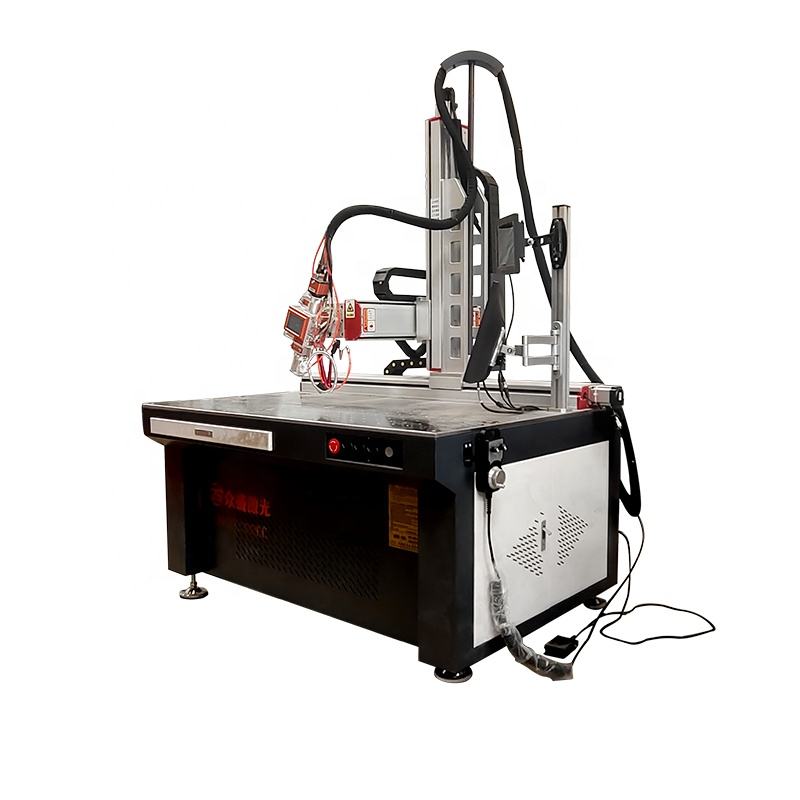
Automatic Laser Welding Machine
What Does This Machine Actually Provide?
This is not just a stud welder. It is a modular automated welding platform that enables:
Automatic positioning of welding points
Adaptation to different workpiece geometries
Support for multiple welding methods
Consistent welding quality in batch production
Core System Configuration
1.Laser Welding System
The machine is equipped with a fiber laser source, configurable according to different applications:
Power range: 1000W – 3000W
Welding modes:
Pulsed laser welding (high precision, low heat input)
Continuous laser welding (deeper penetration, higher efficiency)
The specific parameters depend on material type, thickness, and stud size. It is recommended to consult us for selecting the most suitable configuration.
2.Stud Welding Head
The stud welding head can be configured based on different working conditions:
Fixed welding head
Adjustable angle mounting
Optional additional motion axis (for complex angles)
Different configurations correspond to different welding scenarios:
Welding studs on flat surfaces: the welding head can be mounted vertically with an XYZ motion system, and no angle adjustment is required.
Welding on inclined surfaces: an angled welding head or additional motion axis is required.
Welding on curved surfaces: an AB rotation axis can be added to the welding head, combined with a rotary fixture system.
3.CNC Motion System (XYZ Axes)
Standard configuration includes:
XYZ three-axis servo motion system
Positioning accuracy: ±0.05 mm
High repeatability, suitable for batch production
This enables:
Multi-point stud welding
Complex welding paths
Automatic positioning without manual alignment
4.Rotary Fixture System (Optional)
For special product structures, a rotary fixture can be added. Different clamping ranges and motion methods can be selected based on the product.
It is especially suitable for:
Curved welding paths
Cylindrical or symmetrical structures
Continuous welding requirements
Advantages of rotary fixtures:
Smooth welding trajectory
Improved efficiency
Better welding consistency
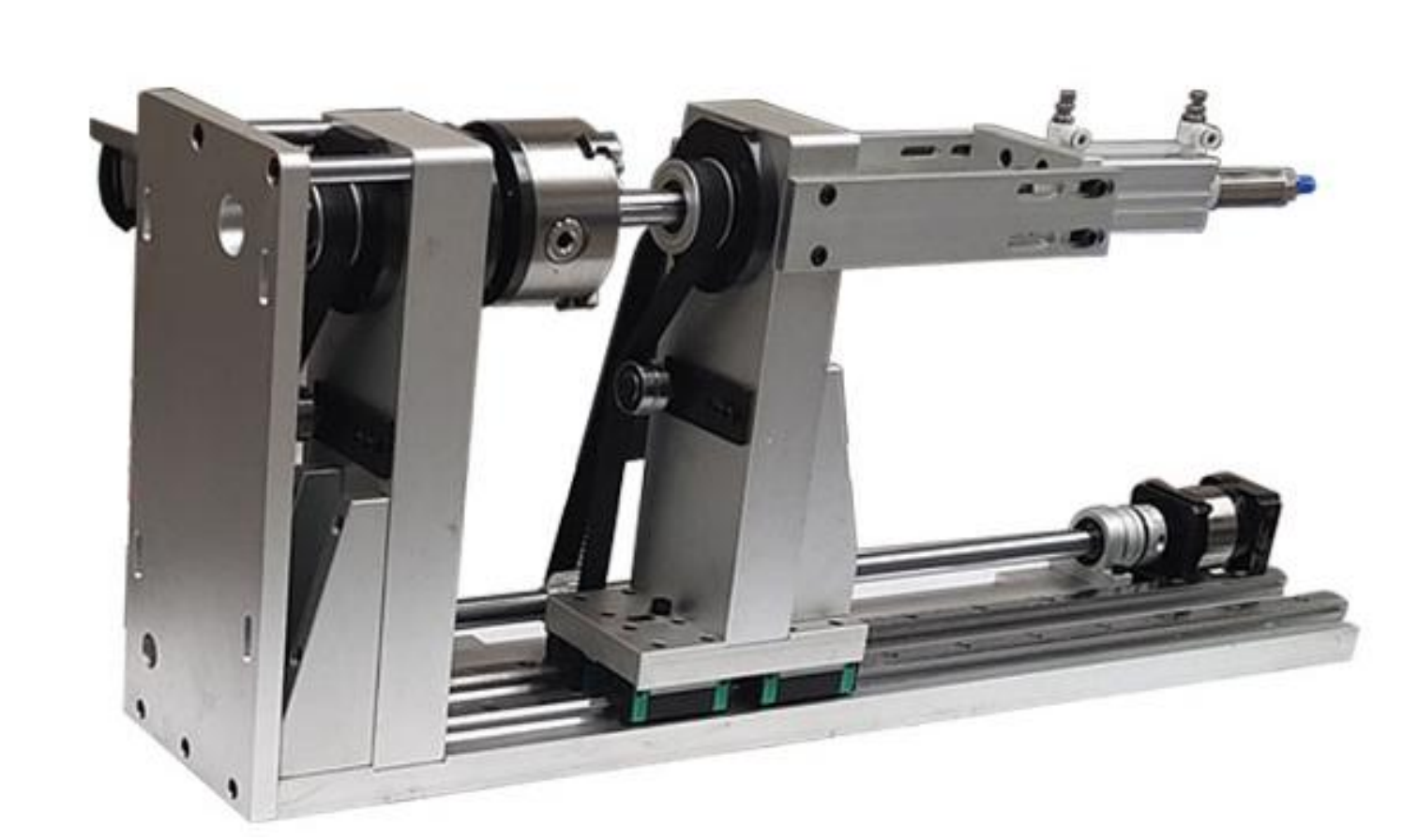
Synchronous parallel sliding fixture
Welding Solutions for Different Applications (ZS Laser)
Solution 1: Moving Welding Head (Standard Solution)
Suitable for:
Flat sheet metal parts
Multi-point welding layouts
Irregular welding positions
Process:
Place studs on the workpiece
CNC controls the movement of the welding head
Welding is completed point by point,as shown in the video below:
Solution 2: Fixed Welding Head + Rotary Fixture
Suitable for:
Curved welding
Symmetrical structures
High-efficiency batch production
Process:
Welding head remains fixed (vertical or angled)
Workpiece is mounted on a rotary fixture
Continuous or circular welding is completed through rotation.
Solution 3: Multi-Axis System
Suitable for:
Inclined surface welding
Complex 3D structures
Non-standard workpieces
Configuration features:
Additional motion axis on the welding head (left-right or front-back swing)
Combined with rotary fixture system
This configuration is not limited to stud welding; it can also be used for welding various small metal components.
How to Choose the Right Configuration
The machine configuration must be determined based on your product.
1.If your product has many welding points and a relatively regular structure, and only simple curved welding is required, you can choose a standard XYZ motion system.
2.If your application requires welding studs onto curved surfaces or the product is symmetrical, a rotary fixture system is recommended.
3.If the welding angle is not vertical, the structure is complex, or higher precision is required, a multi-axis system is recommended.
The fastest approach is to provide us with your product details, and our engineers will recommend the most suitable configuration.
Materials and Industries Applications
The machine supports a wide range of materials:
Carbon steel
Stainless steel
Aluminum alloys
Copper
Galvanized materials
Note:
For highly reflective materials such as copper, sample testing is recommended to determine optimal parameters.
For galvanized materials, spatter may occur; this can usually be managed by increasing shielding gas flow and optimizing parameters.
Typical Applications
Electrical cabinets and enclosures
Stud welding is used for mounting internal components and grounding points. Typically, M4–M8 studs are welded inside cabinets to fix breakers, relays, terminal blocks, and power modules. Thin sheet materials (1–3 mm) with many welding points require high consistency, making automated systems ideal.
Automotive sheet metal parts
Used for mounting brackets, sensor points, wiring harness supports, and battery pack structures. These applications require fast cycle times, high strength, and consistent quality, often combined with automation or robotic systems.
Metal housings and sheet metal structures
Used for internal mounting of PCBs, brackets, and rails. Compared to drilling and tapping, it preserves surface integrity, making it ideal for coated or anodized products.
Structural brackets and load-bearing components
Used for mounting points and structural connections. Typically involves thicker materials (>3 mm) and larger studs (M8–M12), requiring higher strength.
Industrial equipment enclosures
Used for fixing covers, panels, and functional modules. Requires long-term stability and consistent quality in batch production.
HVAC systems (ducting and insulation)
Used for welding insulation pins onto ducts. Requires high speed, stable adhesion, and no burn-through of thin materials.
Shipbuilding and offshore engineering
Used for cable supports, pipe mounts, and internal structures. Requires high reliability in harsh environments (humidity, vibration).
Steel structures (shear studs)
Used in bridges and composite structures to improve bonding between steel and concrete. Requires high power and strong welding performance.
Home appliances and stainless steel products
Used for hidden fastening in kitchen equipment, ovens, and appliances, improving appearance and assembly efficiency.
New energy and battery systems
Used in battery housings, energy storage systems, and photovoltaic structures, requiring lightweight design and automation.
Machinery and automation equipment
Used for mounting rails, sensors, and structural supports, often integrated into automated production lines.
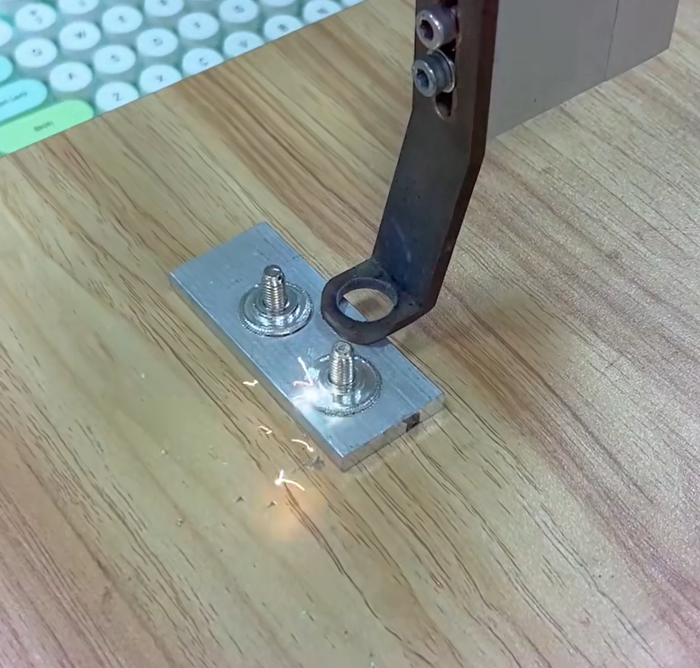
Stud Laser Welding
Advantages of the Automatic Laser Stud Welder
1.Flexible Configuration
Modular design allows adaptation to different products. For flat parts, XYZ systems are used; for curved parts, rotary fixtures; for complex structures, additional axes can be added.
2.High Precision and Consistency
CNC servo control ensures positioning accuracy within ±0.05 mm, maintaining consistent weld quality across all points.
3.Suitable for Automated Production
Can be integrated into production lines with automatic loading/unloading or robotic systems, improving efficiency and reducing setup time.
4.Reduced Labor Dependency
Minimizes reliance on skilled operators. The system is program-controlled, requiring only basic operation and monitoring.
5.Stable Welding Quality
Precise control of parameters ensures consistent results, reducing defects such as weak welds or misalignment.
6.Customization Capability
Every product is different, so we provide customized solutions.
Based on Product Drawings
We analyze welding positions, structure, and layout to design the overall solution.
Matching Stud Specifications
We select appropriate welding methods, laser power, and parameters based on stud size and material.
Optimizing Production Cycle
We optimize motion paths and layout to improve efficiency and meet production targets.
Customizable Options Include
Worktable size
Motion system structure (XYZ, gantry, multi-axis)
Fixture design
Automation level (semi-automatic, fully automatic, or production line integration)
Conclusion And Contact Us
The Automatic Laser Stud Welder is not just a machine, but a flexible welding solution platform for modern manufacturing.
By combining laser welding, CNC motion control, and modular configurations, it delivers efficient and high-precision stud welding for a wide range of applications.
Contact Us
We provide:
Free sample testing
Process evaluation
Customized solution design
Contact us to find the best stud welding solution for your application.
If you want to understand the difference between laser stud welding and traditional stud welding, you can refer to (Laser Stud Welding vs Traditional Stud Welder: Which one you should choose).

WhatsApp
Scan the QR Code to start a WhatsApp chat with us.