 ZS Laser Equipment

In the welding process, welding rod and welding wire are two major categories of welding consumables. Although both are used to join metals, they differ significantly in application scenarios, welding methods, and performance. What exactly is the difference between welding rods and welding wires? ZS Machinery will provide an explanation.
What Is a Welding Rod?
A welding rod is commonly used in Shielded Metal Arc Welding (SMAW). It is a consumable electrode mainly used to provide filler metal and form the weld during the welding process, while its external flux coating protects the welding area.
In short, during welding, a welding rod acts as both a conductive carrier and a source of filler material, it plays an important role in protecting weld quality.
A standard welding rod usually consists of the following two core parts:
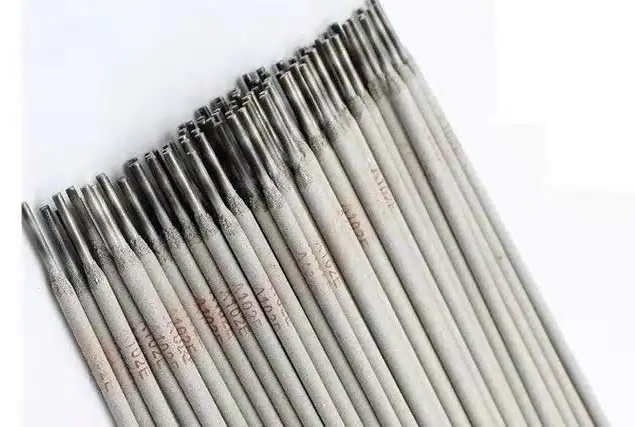
Welding rod
1.Metal Core
The metal core is the internal metallic part of the welding rod, typically a solid metal rod. It serves as a current conduction channel to generate the arc and melts under high temperature to become the main source of weld metal.
Its material is generally the same as or similar to the base material. For example:
carbon steel welding rods use carbon steel cores, and stainless steel rods use stainless steel cores. This ensures consistency in the mechanical properties after welding.
2.Flux Coating
The flux coating is a special material covering the outside of the metal core and is a critical component of the welding rod.
Its main functions include:
(1) Generating shielding gas to isolate air (prevent oxidation)
(2) Forming slag to cover the weld and prevent defects during cooling
(3) Stabilizing the arc for easier control
(4) Improving weld formation and quality
Common types of flux coating include acidic electrodes, basic electrodes (low-hydrogen electrodes), and rutile electrodes. Different types are suitable for different welding requirements such as strength and crack resistance.
Shape and Size of Welding Rods
Welding rods are typically straight metal sticks with standardized lengths and diameters.
Common sizes include:
Diameter: 2.0 mm / 2.5 mm / 3.2 mm / 4.0 mm / 5.0 mm
Length: generally 300 mm – 450 mm
One end of the welding rod is usually bare (without coating) for clamping by the electrode holder to conduct electricity.
Working Principle of Welding Rods
During the welding process:The welding rod contacts the workpiece and ignites an arc. The arc generates high temperatures (up to several thousand degrees Celsius), melting the metal core into liquid metal. Meanwhile, the flux coating burns to produce gas and slag (gas protects the molten pool, slag covers the weld), and after cooling, a strong welded joint is formed.
Main Characteristics of Welding Rods
Flexible operation, suitable for various welding environments
No need for external shielding gas
Suitable for outdoor work
Requires skilled operators
Relatively low efficiency (frequent rod replacement required)
Typical Applications of Welding Rods
Welding rods are widely used in:
Steel structure engineering
Construction
Pipeline welding
Equipment repair and maintenance
They are especially suitable for on-site operations and environments without shielding gas conditions.
Welding rods are not just filler materials, but core consumables that integrate conductivity, filling, and protection, and they still play an important role in traditional welding processes.
What Is Welding Wire?
Welding wire is a metal filler material supplied in a continuous form, mainly used in gas-shielded welding processes (such as MIG/MAG) as well as laser welding and robotic automatic welding.Unlike welding rods, welding wire is continuously fed through a wire feeding system and melts continuously during the welding process to form the weld.
Simply put, welding wire mainly functions as filler metal and helps stabilize the arc, making it one of the most important consumables in modern automated welding.To learn more about welding wire, please refer to the differences between single-wire and double-wire feeding in laser welding.
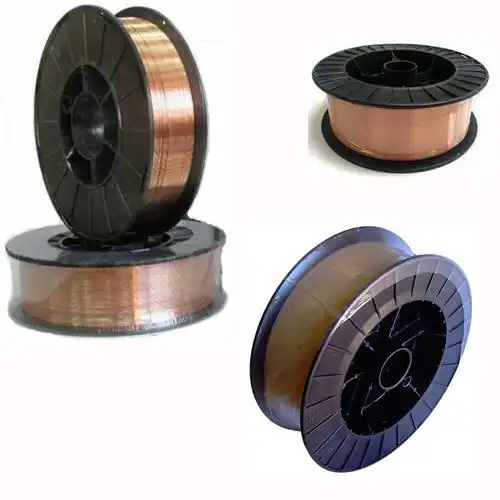
Welding wire
Basic Structure and Forms of Welding Wire
Welding wire is usually a thin metal wire wound on a spool and automatically fed into the welding area through a wire feeder.According to structure, welding wire is mainly divided into two types:
1.Solid Wire
Solid wire is the most common type, consisting of uniform metal without flux coating.
Characteristics:
Requires external shielding gas (such as CO₂, argon, or mixed gases)
Stable arc with low spatter
Smooth and aesthetically pleasing weld formation
Suitable for automation and high-quality welding
2.Flux-Cored Wire
Flux-cored wire contains flux inside and is covered by a metal sheath.
Characteristics:
Provides self-shielding (some types do not require external gas)
Better adaptability, suitable for outdoor environments
High efficiency and deeper penetration
Relatively more spatter
Working Principle of Welding Wire
During the welding process:
The wire is continuously fed into the welding area
Current passes through the wire to form an arc (or it is melted by laser in laser welding)
The wire melts into liquid metal at high temperature
It fuses with the base material to form a weld
Under the protection of shielding gas (or flux), oxidation and porosity are prevented
This continuous feeding method allows long, stable welding without frequent material replacement.
Common Specifications and Materials of Welding Wire
Common diameters:
0.8 mm/1.0 mm/1.2 mm/1.6 mm
Larger diameters provide higher deposition rates and are suitable for larger welds or thicker materials.
Common Materials
Carbon steel wire
Stainless steel wire
Aluminum alloy wire
Copper and copper alloy wire
The material of the welding wire should match the base material to ensure proper mechanical properties and corrosion resistance.
Typical Applications of Welding Wire
Welding wire is widely used in modern industrial manufacturing, especially in:
Automotive manufacturing (body structures, components)
Sheet metal fabrication (cabinets, stainless steel products)
Industrial automation production lines
Machinery and equipment manufacturing
Laser wire filling welding
In applications requiring high efficiency, stability, and mass production, welding wire is almost a standard choice.
Main Characteristics of Welding Wire
Continuous Welding with High Efficiency
Welding wire is continuously supplied by an automatic feeding system, allowing long uninterrupted welding and significantly improving productivity.
Suitable for Automation
It can be integrated with robots, automated platforms, and laser welding equipment to achieve fully or semi-automatic welding.
Stable Welding Process
With stable wire feeding and gas protection, the welding process is continuous and uniform, ensuring consistent weld quality.
Good Weld Appearance
Compared with welding rods, weld seams produced by welding wire are smoother and more aesthetically pleasing, often requiring less post-processing.
Higher Environmental Requirements
Since most welding wires require shielding gas, outdoor environments or wind can disturb the gas, affecting welding quality. Therefore, it is more suitable for indoor or controlled environments.
Welding wire is a key material for achieving high efficiency, automation, and consistency in modern welding technology. It is gradually replacing traditional welding rods in industrial manufacturing and laser welding applications.
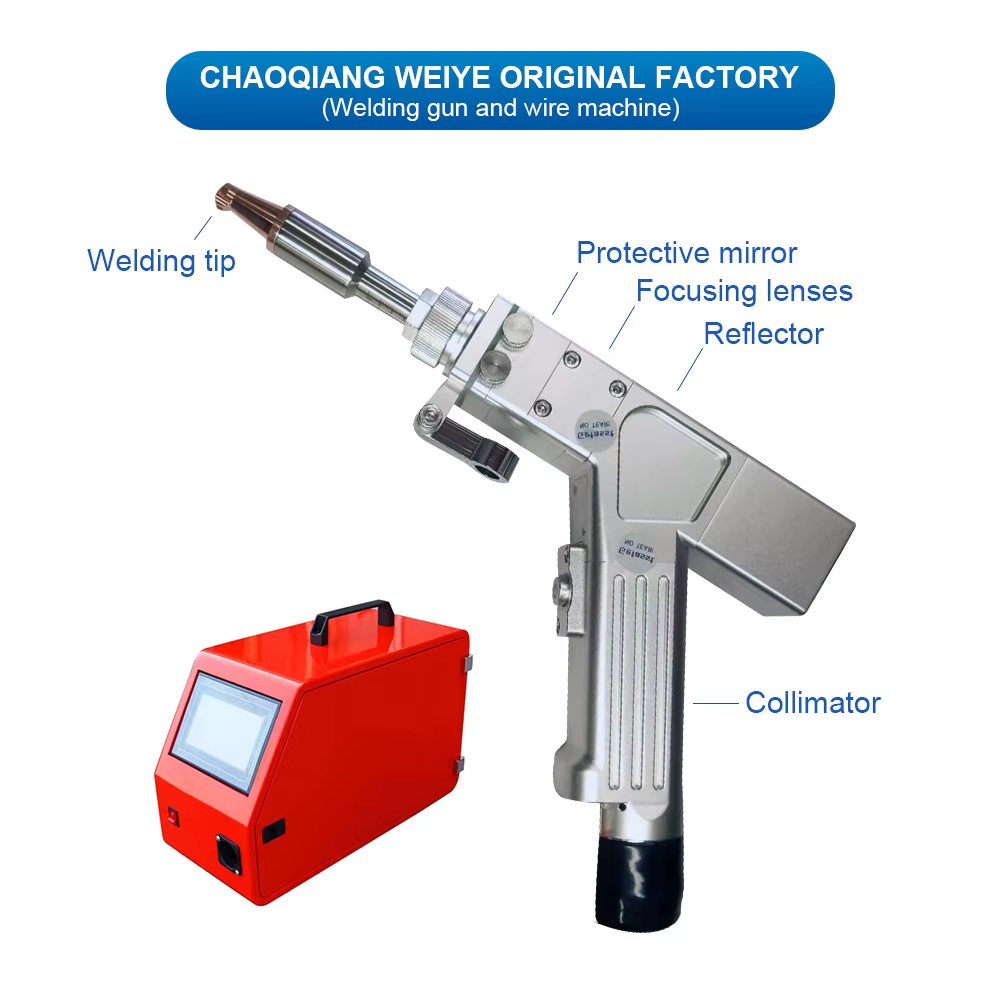
Laser welding gun and wire feeder
Welding Rod vs Welding Wire: Comparison Table
| Comparison Item | Welding Rod | Welding Wire |
| Form & Feeding Method | Short stick, manually replaced | Continuous spool, automatically fed |
| Welding Method | Mainly SMAW | MIG/MAG, laser welding, automated welding |
| Efficiency | Lower, suitable for small batch or repair | High, suitable for mass production |
| Weld Quality | Operator-dependent, less stable | Stable and consistent, ideal for automation |
| Working Environment | Suitable for outdoor and complex conditions | Better for indoor or controlled environments (gas affected by wind) |
From the comparison,we can see that welding rods are more suitable for flexible and on-site applications, while welding wires are better suited for industrial, automated, and large-scale production. In practical applications, neither replaces the other; the choice depends on specific working conditions.
Get the Right Welding Solution for Your Application
Choosing between a welding rod and welding wire is not just a technical decision—it directly affects your production efficiency, welding quality, and overall cost.
If you’re not sure which solution fits your application, or if you’re considering upgrading to laser welding for higher efficiency and better consistency, we can help.
We provide:
Free sample welding tests
Welding process evaluation
Equipment selection guidance
Customized welding solutions based on your product
Feel free to contact ZS Machinery with your drawings or application details. Our technical team will recommend the most suitable welding solution for your needs.

WhatsApp
Scan the QR Code to start a WhatsApp chat with us.