 ZS Laser Equipment

Laser welding is widely used in metal fabrication, automotive manufacturing, machinery production, and many other industries. While standard laser welding machines work well for repeatable welding tasks, some manufacturers handle a much wider variety of products. Different workpieces may have different shapes, dimensions, joint positions, and welding angles, making a fixed welding setup insufficient.This is where custom way laser welding becomes important.
Custom way laser welding is not simply about using a different welding machine. It involves adapting the welding method, torch position, welding path, machine structure, and motion control system to the specific requirements of each workpiece.
Depending on the production requirements, custom welding can be performed manually by skilled operators or automatically through multi-axis CNC platforms and robotic welding systems. The two approaches rely on different capabilities: manual welding depends heavily on operator skills, while automated welding requires accurate path planning, flexible motion control, and properly configured equipment.
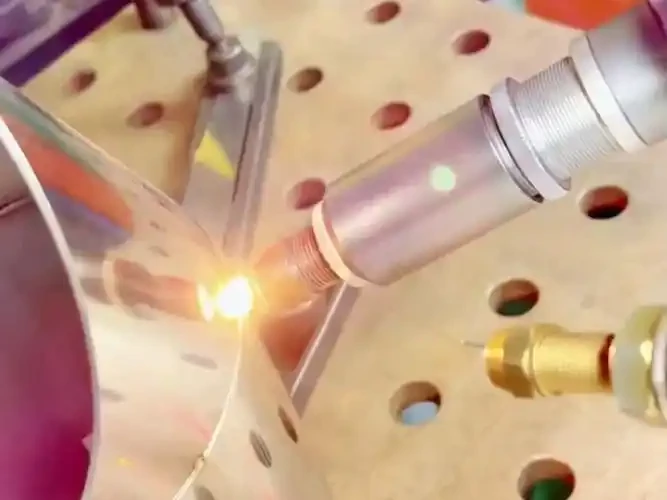
Automobile exhaust pipe laser welding
What Is Custom Laser Welding?
Custom laser welding refers to welding operations that require specific adjustments to the welding method, torch orientation, movement path, or equipment configuration according to the geometry and requirements of a particular workpiece.Unlike standardized production, where the same welding seam is repeated on identical components, custom welding often involves different products and welding positions.
For example, a manufacturer may need to weld:
- Flat metal sheets and sheet metal enclosures
- Pipes, tubes, and cylindrical components
- Metal brackets and structural parts
- Irregularly shaped housings
- Components with welding seams on multiple surfaces
- Workpieces requiring angled or curved welding paths
Each application may require a different torch position, approach angle, movement direction, or fixture arrangement.Custom laser welding can therefore be divided into two main approaches: manual custom welding and automated custom welding.
Manual Custom Welding: It Depends on Operator Skills
Manual custom welding relies on the operator’s ability to adapt to different workpieces.With a handheld laser welding machine, the operator can move the welding torch freely and adjust its position and orientation according to the welding seam. This makes handheld equipment suitable for small-batch production, maintenance work, and applications involving different product shapes.
The operator needs to understand how to:
- Maintain the appropriate torch angle
- Control the movement speed along the welding seam
- Adjust the torch position for different joint geometries
- Maintain a consistent distance between the welding head and workpiece
- Adapt the welding technique to different materials and thicknesses
For example, when welding a metal enclosure with seams on several sides, the operator can manually change the torch direction and reposition the workpiece as needed.The main advantage of manual welding is flexibility. It does not require complex motion programming or a sophisticated multi-axis machine configuration.
However, welding quality and consistency depend significantly on the operator’s experience. When the number of products increases or production requires repeatable results, manual operation may become less efficient.
Automated Custom Welding: It Depends on Path Planning and Machine Configuration
Automated custom welding uses CNC-controlled platforms or industrial robots to perform welding operations along programmed paths.Instead of manually guiding the welding torch, engineers develop a motion program based on the workpiece geometry, joint position, and required welding direction. The machine then controls the movement of the welding head and, when necessary, the workpiece itself.
This approach requires more than a basic XYZ positioning system. The machine must have sufficient motion flexibility to position the welding head at the required location and orientation.Two important factors determine the capability of an automated custom welding system:
Path planning: The welding path must be programmed according to the actual geometry of the workpiece. Engineers need to consider the welding seam, torch orientation, approach direction, movement sequence, and possible mechanical interference.
Machine configuration: The equipment must provide enough motion axes and suitable mechanical structures to execute the programmed path. If the machine cannot reach the required position or angle, software programming alone cannot solve the problem.
For manufacturers handling multiple product types, a properly designed automated welding system can reduce repeated manual adjustments and improve production consistency.
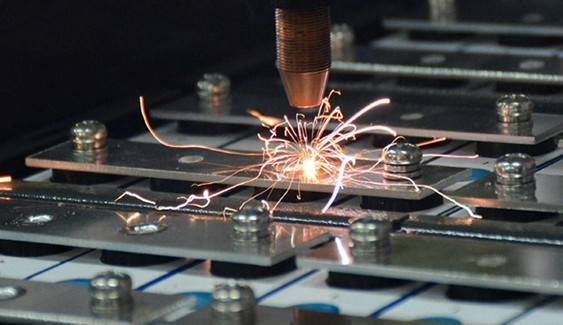
Pulse Laser Welding
Why Multi-Axis Motion Is Important for Custom Laser Welding
A conventional three-axis CNC laser welding platform controls the welding head along three linear directions: X, Y, and Z.This configuration works well for many flat, straight, and relatively simple welding applications. However, when the welding seam is located on an angled surface, a curved component, or a position that requires a different torch orientation, additional motion axes may be necessary.
By adding rotational or swing axes, the machine gains more degrees of freedom. This allows the welding head and workpiece to move in more directions and provides greater flexibility when executing complex welding paths.The number of axes is therefore an important factor in determining the motion capabilities of an automated laser welding machine.
Three-Axis CNC Laser Welding Platform
A three-axis system typically includes:
- X-axis: Horizontal movement
- Y-axis: Front-to-back movement
- Z-axis: Vertical movement
These axes control the position of the welding head within the machine’s working area.
Three-axis platforms are suitable for applications where the welding head can maintain a relatively fixed orientation throughout the welding process. They are often used for flat workpieces, simple components, and repeatable welding paths.
Five-Axis CNC Laser Welding Platform
For more complex welding applications, a five-axis CNC platform can add two independent torch swing axes to the basic XYZ configuration.
A typical configuration includes:
| Axis | Movement | Main function |
|---|---|---|
| X-axis | Horizontal movement | Positions the welding head |
| Y-axis | Front-to-back movement | Positions the welding head |
| Z-axis | Vertical movement | Adjusts welding height |
| Swing axis 1 | Front-to-back torch rotation | Adjusts torch orientation |
| Swing axis 2 | Left-to-right torch rotation | Adjusts torch orientation |
The three linear axes control the welding head position, while the two swing axes change its orientation.This configuration allows the welding torch to approach workpieces from different directions and maintain more suitable angles when welding angled surfaces or complex joints.
The actual working range depends on the mechanical design, swing angle, welding head dimensions, and fixture arrangement.
Six-Axis CNC Laser Welding Platform
A six-axis CNC laser welding platform can add a rotary fixture axis to the five-axis configuration.
A typical arrangement includes:
- Three linear axes for XYZ positioning
- Two torch swing axes for orientation adjustment
- One rotary axis for rotating the workpiece
The rotary axis allows the workpiece to change its position during welding. Combined with the movement of the welding head, this provides additional flexibility for welding cylindrical components, ring-shaped parts, pipe fittings, and workpieces with multiple welding surfaces.For manufacturers handling many different products, this type of configuration can reduce the need to manually reposition workpieces between welding operations.
However, the rotary axis must be properly integrated with the other axes. Its rotation range, load capacity, fixture design, and synchronization with the welding head all affect the final working capability.
Six-Axis Industrial Robots for Automated Custom Welding
Another way to achieve flexible automated welding is to use a six-axis industrial robot.Unlike a conventional CNC platform with linear axes and dedicated swing or rotary mechanisms, an industrial robot uses multiple articulated joints to control the position and orientation of the welding torch.
Six-axis robots are particularly useful for complex three-dimensional welding paths, irregular workpieces, and applications requiring the welding head to approach components from different directions.Their advantages include:
- Flexible torch orientation
- Large working envelope, depending on robot model
- Ability to follow complex spatial paths
- Integration with automated production lines
- Compatibility with rotary positioners and dedicated fixtures
A robotic system can also work with an external rotary positioner. In this arrangement, the robot controls the welding torch while the positioner rotates or repositions the workpiece.
It is important to distinguish between the robot’s six axes and the total number of axes in the complete system. When external positioners or additional motion devices are integrated, the system may have more than six controlled axes.
CNC Multi-Axis Platform vs. Six-Axis Robot
Both systems can perform automated custom welding, but they have different mechanical structures and application advantages.
| Comparison | Multi-Axis CNC Platform | Six-Axis Industrial Robot |
|---|---|---|
| Motion structure | Linear axes with swing or rotary mechanisms | Articulated robot joints |
| Working area | Defined by platform dimensions and axis travel | Defined by robot reach and installation |
| Motion flexibility | Depends on the selected axis configuration | Flexible positioning and torch orientation |
| Programming | CNC motion and welding path programming | Robot programming and path teaching |
| Typical applications | Dedicated workstations and repeatable custom parts | Complex spatial paths and automated production |
| Integration | CNC fixtures and rotary devices | Robot cells, positioners, conveyors, and safety systems |
The right choice depends on the workpiece, welding path, production volume, and required automation level. A CNC platform may be more suitable for a dedicated working area and defined motion configuration, while a robot can be advantageous when the application requires a larger or more flexible working envelope.
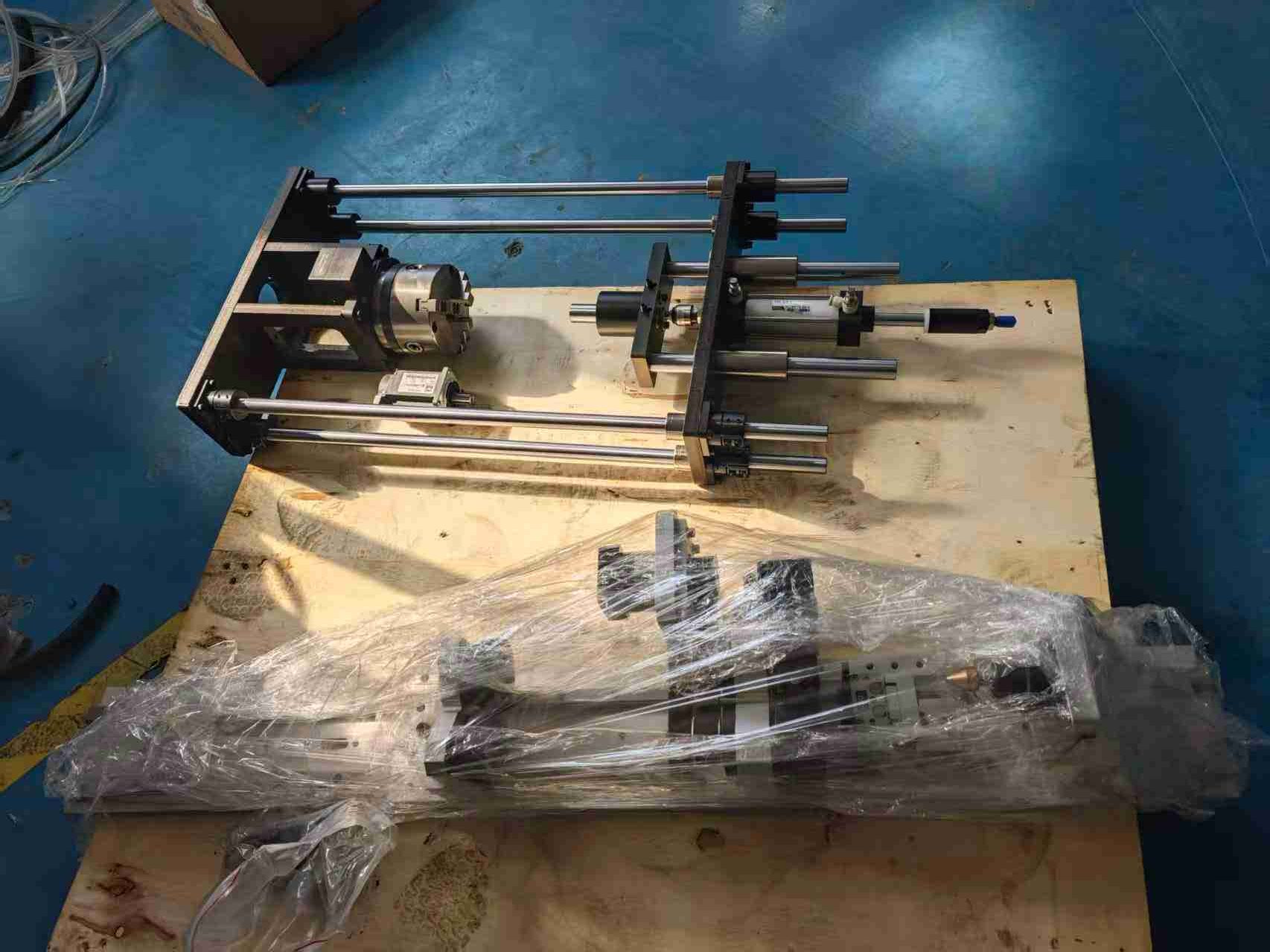
Welding fixures for customer
Why Multi-Axis Laser Welding Requires Advanced Control and Servo Systems
Adding more axes increases the machine’s motion capabilities, but it also makes the control system and mechanical configuration more demanding.A multi-axis welding machine is not simply a standard machine with additional motors. Every motion axis must be properly integrated into the complete control system.
CNC Control System
The CNC controller must support the required number of axes and provide the motion coordination functions needed by the machine.
For example, a basic XYZ platform requires three-axis positioning control. A five-axis or six-axis system requires additional control capability to coordinate the linear and rotational movements.
In ZS Laser’s current equipment configuration practice, platforms with five axes or fewer generally use a standard SYNTEC CNC control configuration. For machines requiring more than five controlled axes, an upgraded SYNTEC configuration is selected according to the application and system requirements.
The exact controller model and supported functions need to be confirmed for each machine configuration.
Servo Motors and Drives
Each independently controlled motion axis requires a suitable motor and drive system.
The selection needs to consider:
- Required positioning accuracy
- Movement speed and acceleration
- Workpiece or welding-head load
- Mechanical transmission structure
- Continuous operating requirements
- Coordination with other axes
As the number of axes increases, more motors, drives, wiring, and control functions are required. The system also becomes more complicated to integrate and commission.
Mechanical Structure and Motion Coordination
The mechanical structure must support the required movement without excessive vibration, deformation, or interference.
For multi-axis welding, engineers also need to consider the relationship between the welding head, workpiece, and surrounding machine structure.
For example, when the welding head swings while the workpiece rotates, the machine must ensure that the torch remains within its permitted working range and does not collide with the fixture or workpiece.
The control system, servo drives, mechanical transmission, and software must therefore be designed as one coordinated system.
This is why higher-axis-count machines generally require more engineering work and have higher configuration costs than simpler CNC platforms.
What Can Be Customized in an Automated Laser Welding Machine?
A custom welding system can involve much more than selecting the number of axes. Depending on the application, several machine components and functions may need to be adapted.
Machine structure: The platform size, gantry structure, enclosure, and working area can be designed according to the dimensions of the workpiece.
Motion configuration: The machine may use three-axis, four-axis, five-axis, or six-axis CNC motion, or an industrial robot, depending on the required welding path.
Welding head: Different welding heads and torch configurations may be selected according to the material, joint type, and welding process.
Control system: CNC or robotic control systems must be matched to the motion configuration and programming requirements.
Automation functions: Automatic loading and unloading, conveyors, sensors, and robotic handling can be integrated when required by the production process.
Dedicated fixtures: Positioning fixtures and clamping devices help locate the workpiece accurately and maintain repeatable welding conditions.
The fixture is particularly important, but it should be considered separately from the machine’s motion axes. A rotary fixture may provide an additional controlled axis, while a conventional fixed fixture simply holds and locates the workpiece.
How ZS Laser Develops Custom Laser Welding Solutions
At ZS Laser, custom laser welding equipment is developed according to the customer’s actual workpieces and production requirements.Rather than selecting a machine based only on its number of axes, we evaluate the entire welding application.Our typical process includes:
1. Workpiece and Application Analysis
We first understand the material, dimensions, geometry, joint design, welding seam positions, and expected production volume.
2. Welding Process Evaluation
The welding method, laser power, welding-head configuration, and process parameters are evaluated according to the material and joint requirements.
3. Motion System Design
Based on the welding path, we determine whether a three-axis, five-axis, six-axis CNC platform, or robotic system is more appropriate.
4. Control and Drive Configuration
The CNC or robot control system, servo motors, drives, and mechanical transmission are selected to match the required motion capabilities.
5. Fixture and Automation Integration
Workpiece positioning, clamping, rotary fixtures, and other automation functions are considered as part of the complete solution.
6. Machine Testing and Process Optimization
The machine is tested using representative workpieces. Motion paths, torch angles, welding parameters, and operating sequences are adjusted before delivery.
Project Example: Custom Six-Axis Laser Welding Platform for a Russian Manufacturer
ZS Laser recently completed a customized six-axis CNC laser welding platform for a large metal fabrication company in Russia.The customer processes a wide variety of metal products and requires a machine that can accommodate different workpiece geometries and welding positions.
To meet these requirements, ZS Laser designed a platform with three linear axes, two independent welding torch swing axes, and one rotary fixture axis. The machine also uses an upgraded CNC control configuration and corresponding servo drive components to support the six-axis motion system.
This project demonstrates how motion flexibility, control-system selection, and mechanical configuration work together in an automated custom welding solution.For manufacturers handling multiple product types, a properly configured multi-axis system can provide more options for welding-head positioning and workpiece movement, reducing the limitations of conventional fixed-orientation welding platforms.
How to Choose the Right Custom Laser Welding Solution
Not every manufacturer needs a five-axis or six-axis machine. The appropriate solution depends on the complexity of the workpiece and the welding operation.
- Handheld laser welding: Suitable for small batches, varied products, and applications where manual flexibility is more important than automated repeatability.
- Three-axis CNC welding: Suitable for relatively simple workpieces and welding paths that can be completed with a fixed torch orientation.
- Five-axis CNC welding: Suitable when the welding head needs additional angular adjustment to reach different surfaces and welding positions.
- Six-axis CNC welding: Suitable when both torch orientation and workpiece rotation are required.
- Six-axis robotic welding: Suitable for complex spatial welding paths, larger working envelopes, and integration into automated production systems.
The best solution is not necessarily the machine with the most axes. It is the machine that provides enough motion flexibility to complete the required welding paths reliably, without unnecessary mechanical complexity and investment.
Frequently Asked Questions
What is the difference between manual and automated custom laser welding?
Manual custom welding relies on the operator to adjust the welding torch position, angle, and movement path. Automated custom welding uses CNC platforms or robots to execute programmed paths, requiring suitable motion control and machine configuration.
How many axes are needed for custom laser welding?
The required number of axes depends on the workpiece geometry and welding path. Three axes may be sufficient for simple welding tasks, while five-axis or six-axis systems provide additional torch-orientation and workpiece-positioning capabilities.
Is a six-axis CNC laser welding machine better than a five-axis machine?
Not necessarily. A six-axis machine adds another controlled movement, such as a rotary fixture axis, but this additional capability is only useful when the application requires it. The correct configuration should be based on the actual welding requirements.
What is the difference between a six-axis CNC platform and a six-axis robot?
A six-axis CNC platform typically combines linear motion axes with dedicated torch swing or rotary mechanisms. A six-axis robot uses six articulated joints to control the welding torch position and orientation. Both can perform complex welding tasks, but their working envelopes, mechanical structures, and programming methods differ.
Does adding more axes increase the cost of a laser welding machine?
Generally, yes. More axes require additional motors, servo drives, mechanical components, control capacity, integration, and commissioning work. The final cost also depends on the working area, laser source, welding head, fixtures, and automation requirements.
Conclusion
Custom laser welding can be performed manually or through automated equipment. Manual welding depends primarily on operator experience and the ability to adapt to different workpieces, while automated welding relies on motion flexibility, path planning, and coordinated machine control.
For manufacturers handling a wide variety of products, multi-axis CNC laser welding platforms and six-axis robotic systems provide more options for positioning the welding head and workpiece. However, achieving reliable automated welding requires the right combination of motion axes, control systems, servo drives, mechanical structures, and welding process development.
ZS Laser provides customized laser welding solutions, including CNC platforms, multi-axis welding systems, and robotic laser welding equipment. We can evaluate your workpieces and welding requirements to develop a machine configuration that matches your production needs.
Contact ZS Laser to discuss your custom laser welding project.

WhatsApp
Scan the QR Code to start a WhatsApp chat with us.