 ZS Laser Equipment

ZS Laser has recently completed the production of a customized 6-axis CNC laser welding platform for a large metal fabrication company in Russia. The customer handles a wide variety of workpieces and welding applications, requiring a machine with greater motion flexibility and a more advanced control configuration than a conventional CNC laser welding platform.
To meet these requirements, ZS Laser designed a six-axis system that combines three linear motion axes, two laser welding torch swing axes, and one rotary fixture axis. This configuration allows the machine to adjust both the welding head position and its working angle while rotating the workpiece, making it suitable for more complex and varied welding tasks.
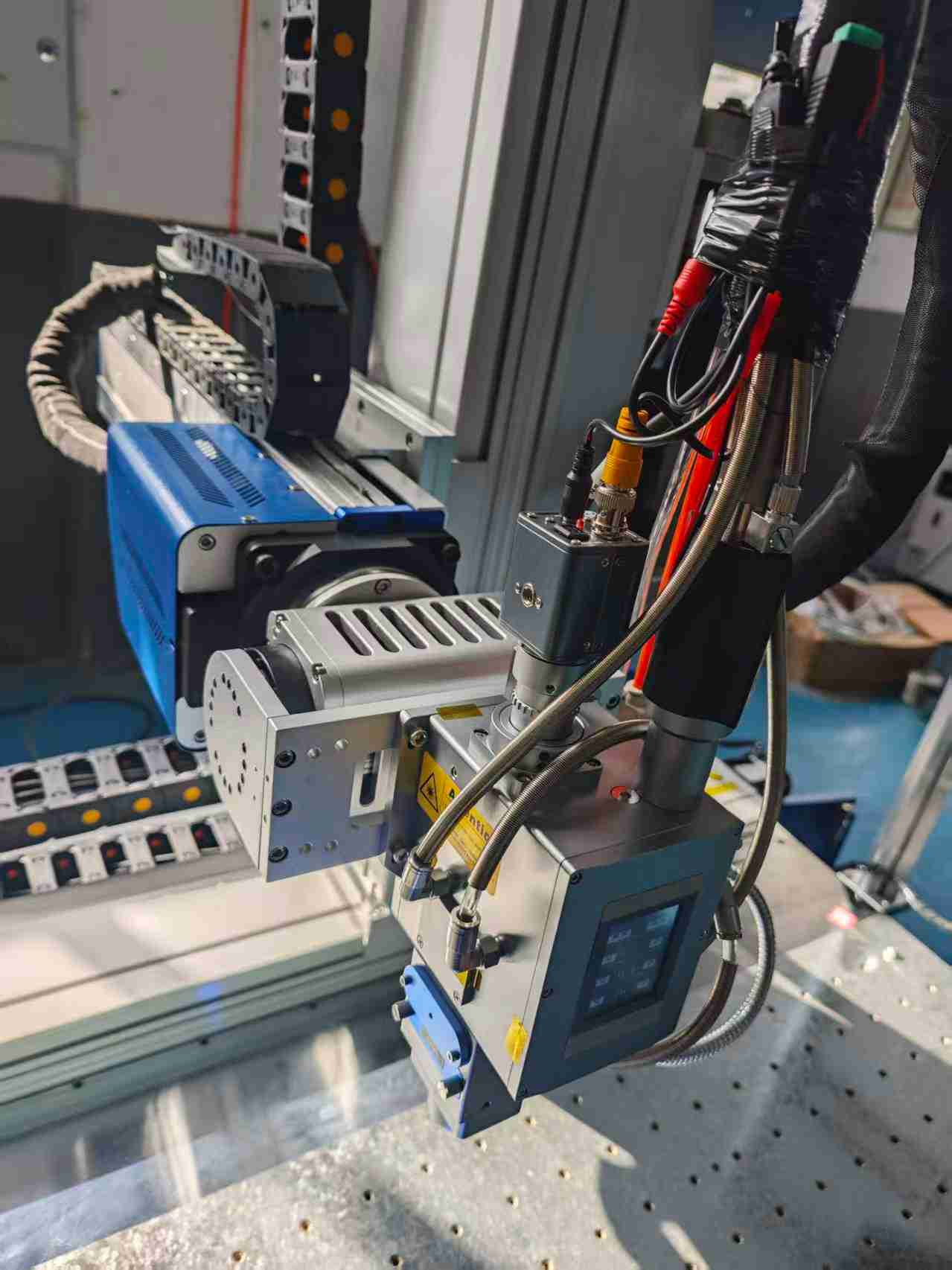
CNC Laser welding machine details
A Custom Six-Axis Configuration for Multiple Welding Applications
Unlike standard three-axis or four-axis CNC laser welding platforms, this customized machine has six independently controlled motion axes:
- X-axis: Controls the horizontal movement of the welding head.
- Y-axis: Controls the front-to-back movement of the welding head.
- Z-axis: Controls the vertical movement of the welding head.
- Torch front-to-back swing axis: Adjusts the welding torch angle in the front-to-back direction.
- Torch left-to-right swing axis: Adjusts the welding torch angle in the left-to-right direction.
- Rotary fixture axis: Rotates the workpiece to support welding at different positions and angles.
These six axes work together to provide more movement options than a conventional CNC welding platform. The three linear axes position the welding head, the two swing axes adjust its orientation, and the rotary axis changes the workpiece position.
This combination is particularly useful for manufacturers processing different types of metal components, where welding seams may be located on different surfaces or require different torch orientations.
To meet the diverse welding needs of our customers, they have opted for several of our additional tooling products. These tooling fixtures are easily disassembled to facilitate welding of different products.
What Do the Number of Axes Mean in a CNC Laser Welding Machine?
In a CNC laser welding machine, the number of axes generally refers to the number of independently controlled motion directions or degrees of freedom available in the machine configuration.
More axes provide additional movement possibilities. For example, a three-axis platform mainly controls the welding head along the X, Y, and Z directions. Adding a rotary axis allows the workpiece to rotate, while additional torch swing axes provide more flexibility in adjusting the welding head orientation.
However, more axes do not automatically mean that a machine can weld every possible position. Actual working flexibility also depends on mechanical travel, torch geometry, fixture design, workpiece dimensions, and motion interference.
For manufacturers handling multiple product types, the right combination of motion axes can significantly expand the range of welding operations that one machine can perform.
SYNTEC CNC Control Systems for Different Axis Configurations
The CNC control system is another important part of a multi-axis laser welding platform.Different axis configurations require different levels of control capability. The controller must support the required axes and coordinate their movements according to the programmed welding path.
In ZS Laser’s current equipment configuration practice, CNC laser welding platforms with five axes or fewer generally use a standard SYNTEC CNC control configuration. For machines requiring more than five controlled axes, an upgraded SYNTEC control configuration is selected to meet the additional motion-control requirements.
The upgraded system provides a suitable control platform for more complex multi-axis configurations. The specific controller model and supported functions are selected according to the machine’s actual design.
It is important to understand that selecting a controller with sufficient axis capacity is only one part of building a multi-axis welding machine. The complete motion system must also be designed to match it.
Servo Drives and Mechanical Design Determine Actual Motion Performance
A CNC controller may support a certain number of axes, but this does not mean the machine will automatically achieve the required motion flexibility.
Each controlled axis needs a suitable motor and servo drive configuration. The mechanical transmission, structural rigidity, load capacity, positioning accuracy, and software coordination must also be considered.
As the number of axes increases, the machine becomes more complicated to design, assemble, program, and commission. Multiple movements may need to operate together while maintaining the required welding position and torch orientation.
For this reason, a high-axis-count laser welding platform requires more than an upgraded control system. Its servo drives, mechanical components, electrical configuration, and control software must be matched as a complete system.
This is also why multi-axis CNC laser welding machines generally involve higher configuration costs than conventional platforms. The additional investment comes not only from the extra motors and drives, but also from the more demanding system integration and commissioning work.
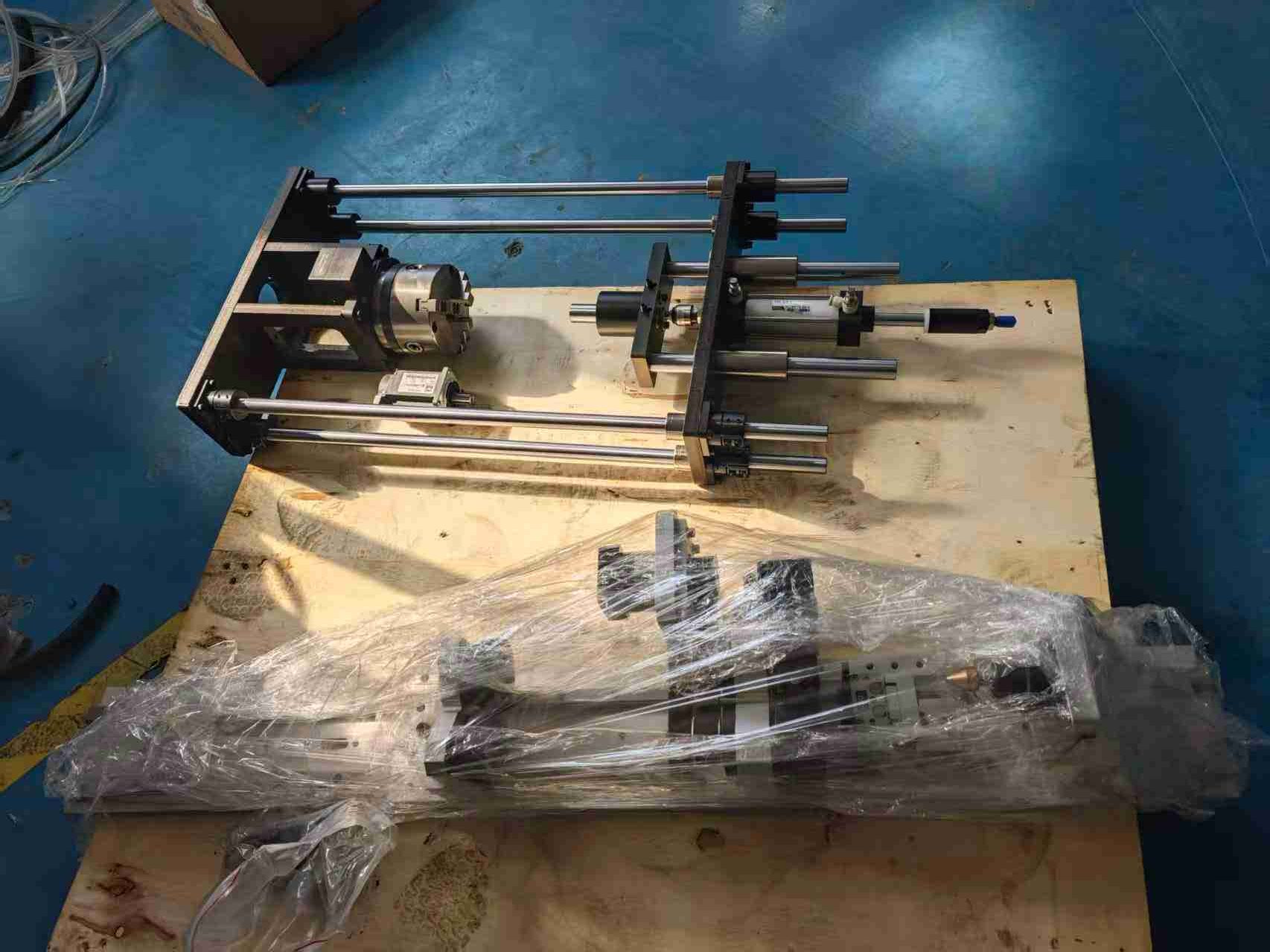
Welding fixures for customer
Why Did the Russian Customer Choose a Six-Axis Laser Welding Platform?
The customer’s main requirement was the ability to process a wide variety of metal workpieces rather than repeatedly weld one fixed product.
For a large fabrication company, different workpieces may have different dimensions, geometries, joint positions, and welding angles. A conventional platform may require more manual repositioning or additional fixtures when the welding positions vary.
The six-axis configuration offers more ways to position the welding head and workpiece. This gives the customer greater flexibility when setting up different welding jobs.
The final machine configuration was therefore developed around the customer’s production requirements, rather than simply adding axes for the sake of achieving a higher axis count.
ZS Laser: Customized CNC Laser Welding Solutions
This Russian project demonstrates ZS Laser’s approach to customized CNC laser welding equipment.
We do not consider the number of axes to be the only factor when designing a CNC laser welding machine. The correct configuration depends on the workpiece geometry, welding seam positions, required torch angles, production volume, and automation requirements.
Depending on the application, ZS Laser can provide different CNC laser welding configurations, including three-axis, four-axis, five-axis, and six-axis platforms, as well as robotic laser welding systems.
For manufacturers processing multiple product types or complex metal components, our team can evaluate the required motion range and recommend a suitable combination of CNC control, servo drives, welding head movement, and workpiece fixtures.
Contact ZS Laser to discuss your workpieces and welding requirements. We can help develop a CNC laser welding solution based on your actual production needs.

WhatsApp
Scan the QR Code to start a WhatsApp chat with us.