 ZS Laser Equipment

Introduction
When people hear the term welding torch, they often think of traditional TIG or MIG welding equipment. However, with the rapid development of modern manufacturing, laser welding technology has introduced a new generation of welding torches that offer higher precision, faster welding speeds, and greater compatibility with automated production systems.
Today, laser welding torches are widely used in industries such as sheet metal fabrication, automotive manufacturing, aerospace, battery production, and precision engineering. Different applications require different torch designs, and selecting the right welding torch can have a significant impact on weld quality, production efficiency, and overall manufacturing costs.
In this article, we will explore the major types of laser welding torches available today, their applications, key advantages, and how to choose the most suitable solution for your welding projects.
What Is a Laser Welding Torch?
A laser welding torch, sometimes referred to as a laser welding head, is the core component responsible for delivering the laser beam to the workpiece. In addition to focusing and controlling laser energy, modern laser welding torches often integrate various auxiliary functions, including:
- Shielding gas delivery
- Automatic wire feeding
- Seam tracking
- Process monitoring
- Focus control
Unlike traditional MIG or TIG welding torches that generate heat through an electric arc, laser welding torches utilize a highly concentrated laser beam to create welds. This allows for a smaller heat-affected zone, higher welding precision, and significantly faster welding speeds.
To meet different production requirements, modern laser welding systems have evolved into several distinct torch designs.
Type 1: Handheld Laser Welding Torch
The handheld laser welding torch is currently the most widely used type of laser welding torch and has played a major role in popularizing laser welding technology in recent years. Similar to a traditional TIG torch, it features a gun-style design that allows operators to perform welding tasks manually.
From an appearance standpoint, a handheld laser welding torch typically consists of a handle, laser output head, shielding gas nozzle, and wire feeding mechanism.
Depending on power level and cooling requirements, handheld torches are generally available in two categories:
- Lightweight plastic-housing designs
- Heavy-duty all-metal industrial designs
Lower-power models (1000W–1500W) typically feature compact and lightweight bodies, while higher-power models (2000W–3000W) require larger cooling systems and more robust structures.
In recent years, leading torch manufacturers such as SUP Laser and Qilin Laser have introduced various upgraded designs, including:
- Single-wobble welding torches
- Dual-wobble welding torches
- Integrated wire-feeding welding torches
By controlling beam oscillation through internal wobble mechanisms, these torches can create wider weld seams, improve gap-bridging capability, and enhance weld appearance.
Handheld laser welding torches are commonly used for:
- Stainless steel welding
- Carbon steel welding
- Aluminum alloy welding
- Sheet metal fabrication
- Door and window manufacturing
- Kitchen equipment production
Main Advantages
Handheld laser welding torches offer excellent flexibility, low training requirements, and relatively low investment costs, making them ideal for small and medium-sized manufacturers as well as high-mix, low-volume production environments.
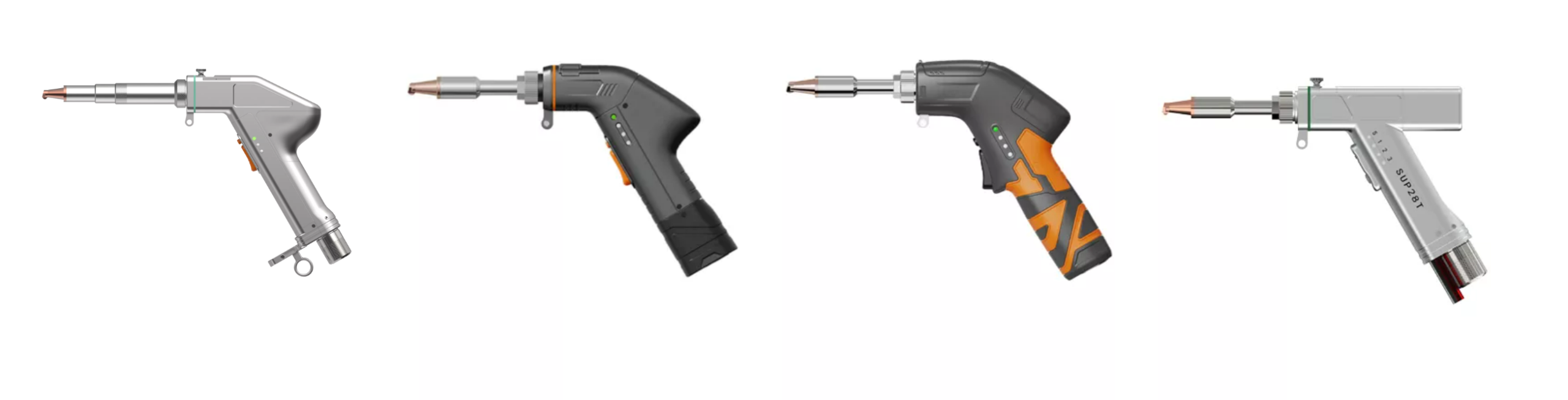
Super Handheld Laser Welding Torches
Type 2: Wobble Laser Welding Torch
The wobble laser welding torch is an upgraded version of the conventional laser welding torch and has become the standard configuration in many handheld laser welding systems.
Its key feature is the integration of a high-speed galvanometer-based oscillation system inside the torch. Instead of delivering the laser beam in a straight line, the beam follows a programmed oscillation pattern during welding.
Depending on the manufacturer and model, common wobble patterns include:
- Circular oscillation
- Linear oscillation
- Triangular oscillation
- Figure-eight oscillation
Major torch manufacturers such as SUP Laser and Qilin Laser have also developed:
- Single-wobble systems
- Dual-wobble systems
- Composite oscillation structures
These designs address different welding requirements and material challenges.
Compared with fixed-spot welding torches, wobble welding torches can produce wider weld seams and provide greater tolerance for assembly gaps and dimensional variations.
For difficult-to-weld materials such as aluminum alloys and galvanized steel, beam oscillation improves molten pool dynamics and helps reduce common welding defects such as:
- Porosity
- Cracking
- Excessive spatter
Typical Applications
- Aluminum alloy welding
- Stainless steel welding
- Galvanized steel welding
- Battery enclosure welding
- Automotive component manufacturing
- Structural sheet metal welding
Main Advantages
Wobble welding torches create wider weld seams, offer better gap tolerance, improve weld appearance, and significantly reduce welding defects such as porosity, lack of fusion, and hot cracking. As a result, they have become one of the most widely adopted laser welding torch designs in the industry.
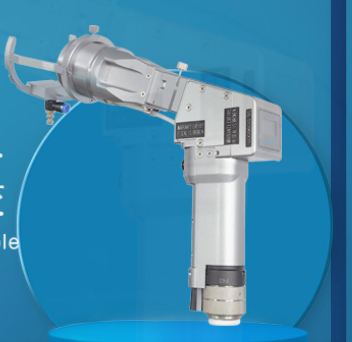
QiLin Wobble Laser Welding Torch
Type 3: Automatic Laser Welding Head
An automatic laser welding head is commonly used on CNC platforms, gantry welding systems, and automated production lines.
Unlike handheld welding torches, automatic welding heads are permanently mounted on motion systems and perform welding tasks through programmed movement.
From a structural perspective, automatic welding heads usually feature a compact all-metal design without handles, triggers, or other manual operation components.
Internally, they may include:
- Focusing optics
- Shielding gas nozzles
- Sensor interfaces
- Automatic focusing mechanisms
Advanced models can also integrate:
- Vision positioning systems
- Seam tracking systems
- Auto-focus functions
These features enable reliable operation in complex mass-production environments.
Compared with manual welding systems, automatic welding heads focus more on precision, speed, and consistency. Since welding paths are fully controlled by software, every workpiece receives identical weld quality.
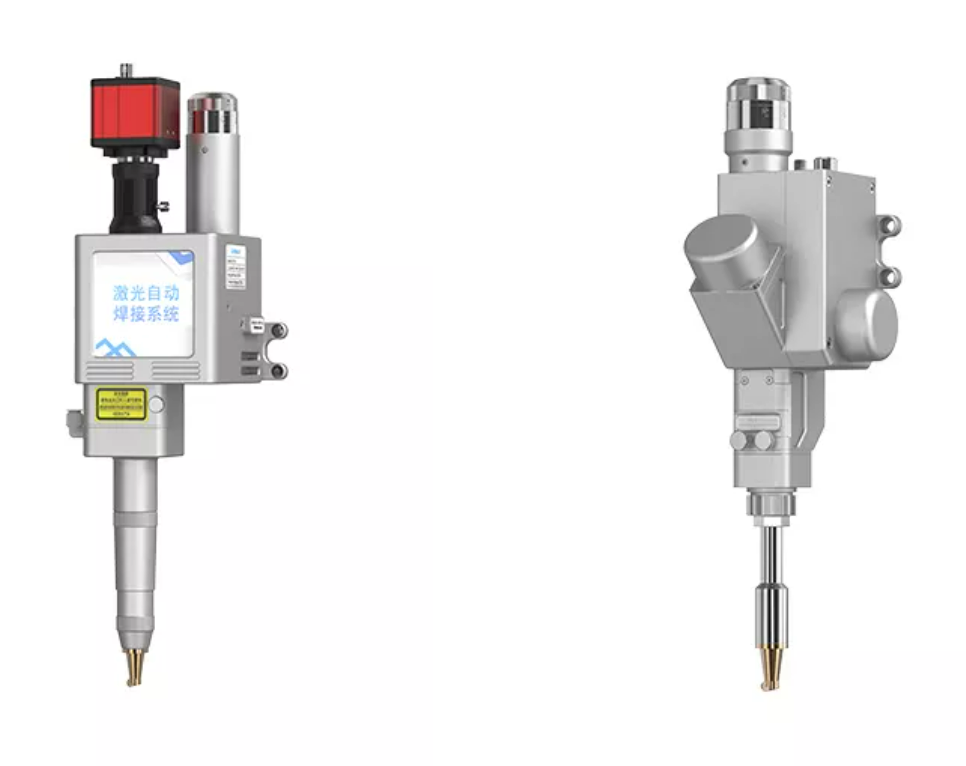
Automatic Laser Welding Head
Typical Applications
- Sheet metal fabrication
- Electrical cabinet manufacturing
- Battery tray welding
- Hardware production
- Precision metal component manufacturing
- Automated production lines
Main Advantages
Automatic welding heads provide excellent precision, repeatability, and productivity. They support 24/7 continuous production and are among the most common laser welding solutions used in modern smart manufacturing facilities.
Type 4: Robot Laser Welding Torch
A robot laser welding torch is specifically designed for integration with industrial robotic arms.
Compared with handheld welding torches, robot welding torches eliminate the handle structure and adopt a more compact, lightweight design to reduce robot payload and improve dynamic performance.
From the outside, robot welding torches typically feature an enclosed all-metal industrial housing and are mounted directly to the robot’s sixth axis through a flange connection.
Internally, they may include:
- Collimation optics
- Focusing optics
- Shielding gas nozzles
- Collision protection interfaces
High-end models may also support:
- Automatic focus adjustment
- Seam tracking
- Vision recognition systems
Because robotic welding requires frequent high-speed movement and orientation changes, robot welding torches are designed with stricter requirements for weight distribution, rigidity, and vibration resistance.
Many models also feature elongated torch bodies that allow access to narrow spaces and deep cavities.
Structural Characteristics
- Handle-free design
- Flange mounting structure
- Fully enclosed metal housing
- High-power continuous operation capability
- Optional auto-focus modules
- Optional vision tracking systems
Typical Applications
- Automotive body welding
- Battery tray manufacturing
- Construction machinery components
- Railway transportation components
- Aerospace structural parts
Main Advantages
Robot laser welding torches offer compact structures, lightweight designs, and excellent reliability. They are specifically engineered for high-speed robotic operation and large-scale automated production environments.
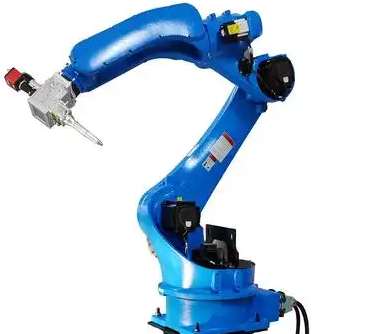
Robotic Laser Welding
Type 5: Laser Cladding Head
A laser cladding head is a specialized laser processing head designed for additive manufacturing and component repair.
Unlike conventional laser welding torches that join two parts together, a laser cladding head deposits new metal material onto the surface of an existing component to restore, reinforce, or rebuild it.
Compared with standard welding heads, laser cladding heads have a more complex appearance. Their most distinctive feature is the addition of powder feeding structures around the nozzle.
Depending on the design, cladding heads can utilize:
- Side powder feeding
- Coaxial powder feeding
Among these, coaxial powder feeding systems are the most widely used.
During operation, metal powder is delivered through the nozzle and directed into the laser interaction zone, where both the powder and substrate melt simultaneously to form a new metallurgical layer.
Because laser cladding requires precise coordination of laser energy, metal powder, and shielding gas, cladding heads are generally larger than conventional welding heads and feature robust all-metal construction.
Structural Characteristics
- Coaxial powder feeding nozzle
- Multi-channel shielding gas system
- All-metal industrial construction
- Continuous powder feeding capability
- Compatible with high-power laser sources
Typical Applications
- Shaft repair
- Mold restoration and remanufacturing
- Roller refurbishment
- Mining equipment repair
- Wear-resistant and corrosion-resistant coating production
Main Advantages
Laser cladding can significantly extend component life without replacing expensive parts. By depositing high-performance alloy materials onto worn surfaces, manufacturers can improve durability while reducing maintenance and replacement costs.
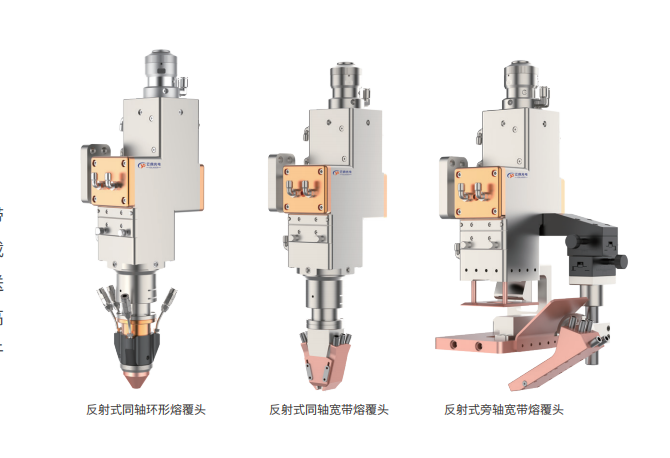
Laser cladding torch
Type 6: Galvo Laser Welding Head
A galvo laser welding head is specifically designed for high-speed precision welding and utilizes a high-speed galvanometer scanning system as its core component.
Unlike conventional welding heads that rely on mechanical movement to position the laser, galvo welding heads use rapidly moving mirrors to redirect the laser beam across the workpiece.
As a result, welding speeds can be dramatically increased without moving the entire welding head.
Structural Characteristics
From the outside, galvo welding heads typically feature a compact enclosed metal structure.
Internally, they commonly include:
- High-speed dual-axis galvanometer system
- Focusing optics
- F-Theta lens
- Vision positioning module (optional)
- Process monitoring system (optional)
The biggest difference between galvo heads and traditional welding heads is that beam positioning is achieved through mirror movement rather than mechanical axis movement, resulting in extremely fast response times.
Main Features
- Ultra-fast beam scanning speed
- High positioning accuracy
- Rapid response
- Minimal mechanical movement
- Suitable for micro-welding applications
- Easy integration into automated production lines
Typical Applications
- Battery tab welding
- Copper busbar welding
- Motor connector welding
- Electronic component manufacturing
- Sensor welding
- Relay and connector production
- Precision medical device welding
Main Advantages
The greatest advantage of galvo welding heads is the combination of speed and precision.
For industries such as new energy batteries, consumer electronics, and semiconductor manufacturing, where thousands of repetitive welds are required, galvo systems can complete multiple welds within seconds while maintaining exceptional consistency and stability.
Today, galvo welding heads have become one of the mainstream solutions for:
- Lithium battery PACK production lines
- Cylindrical battery welding
- Prismatic battery tab welding
- Copper-aluminum connector welding
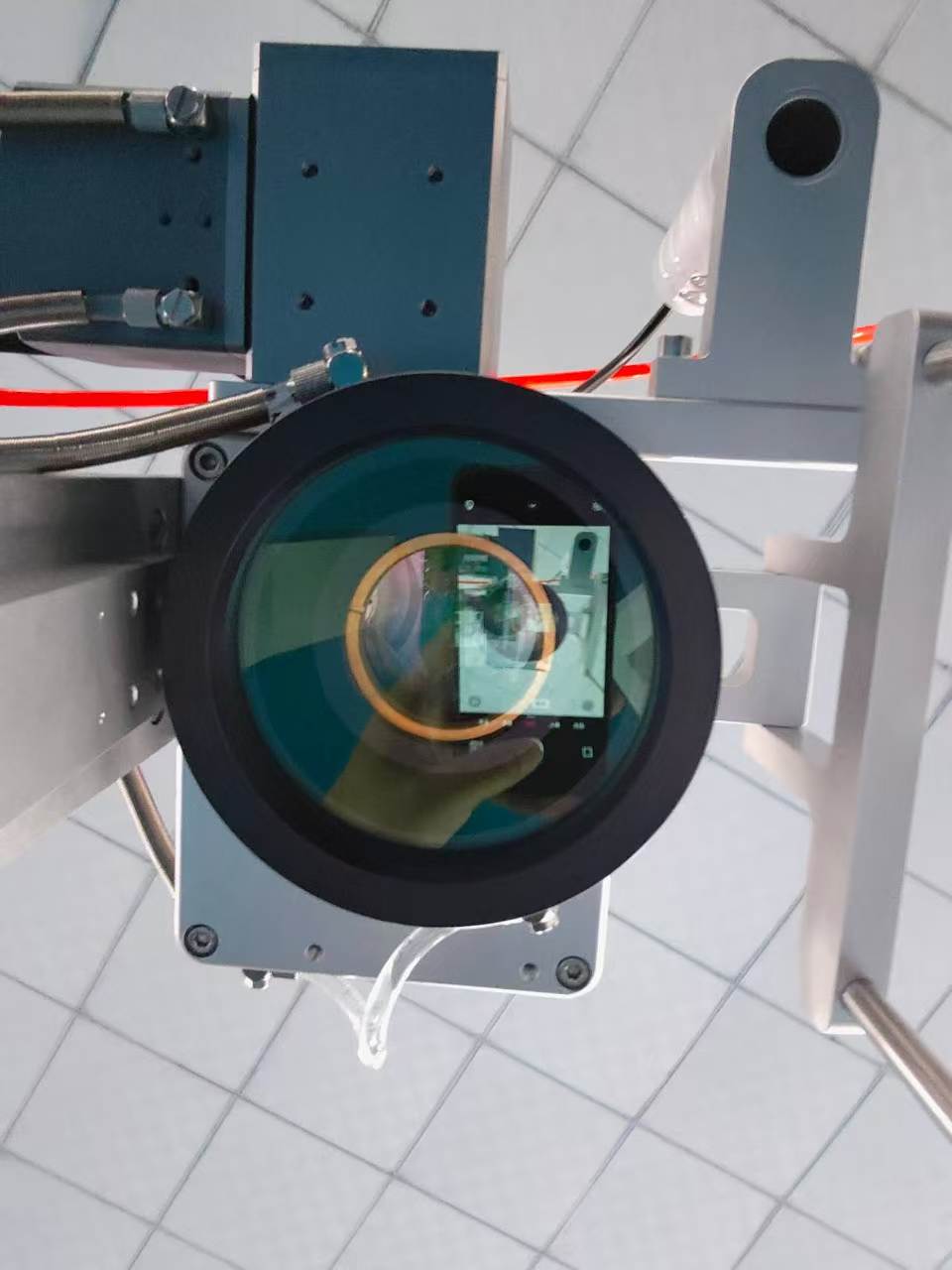
Galvo Laser Welding Head
Conclusion
As laser welding technology continues to evolve, a wide range of laser welding torches have been developed for different manufacturing applications. From flexible handheld welding torches to highly efficient robotic welding systems and specialized laser cladding heads for repair and remanufacturing, each torch type serves a unique purpose.
Understanding the structural characteristics and application scenarios of different laser welding torches can help manufacturers improve weld quality, increase productivity, and reduce overall manufacturing costs.
With more than ten years of experience in the laser welding industry, ZS Laser provides comprehensive laser welding solutions, including handheld welding machines, automatic welding systems, robotic welding systems, and laser cladding equipment. We use industry-leading welding torch brands to ensure reliability, performance, and long-term stability.
If you are unsure which laser welding solution is best suited for your production requirements, feel free to contact our team. We will be happy to provide professional recommendations and customized solutions for your application.

WhatsApp
Scan the QR Code to start a WhatsApp chat with us.