 ZS Laser Equipment

A 1500W laser welding machine is a popular choice for workshops and manufacturers looking to improve metal welding efficiency without investing in a high-power industrial laser system. It offers a practical balance between welding capability, equipment cost, and operating flexibility, especially for common sheet metal fabrication and metalworking applications.
But what can a 1500W laser welding machine actually weld? Is it suitable for stainless steel, carbon steel, aluminum, or galvanized sheet metal? How thick can it weld, and when should you consider upgrading to a 2000W or 3000W machine?
The answers depend not only on laser power but also on the material, workpiece thickness, joint design, welding speed, and process requirements.
This guide explains the practical capabilities of a 1500W laser welder and helps you determine whether it is suitable for your production needs.
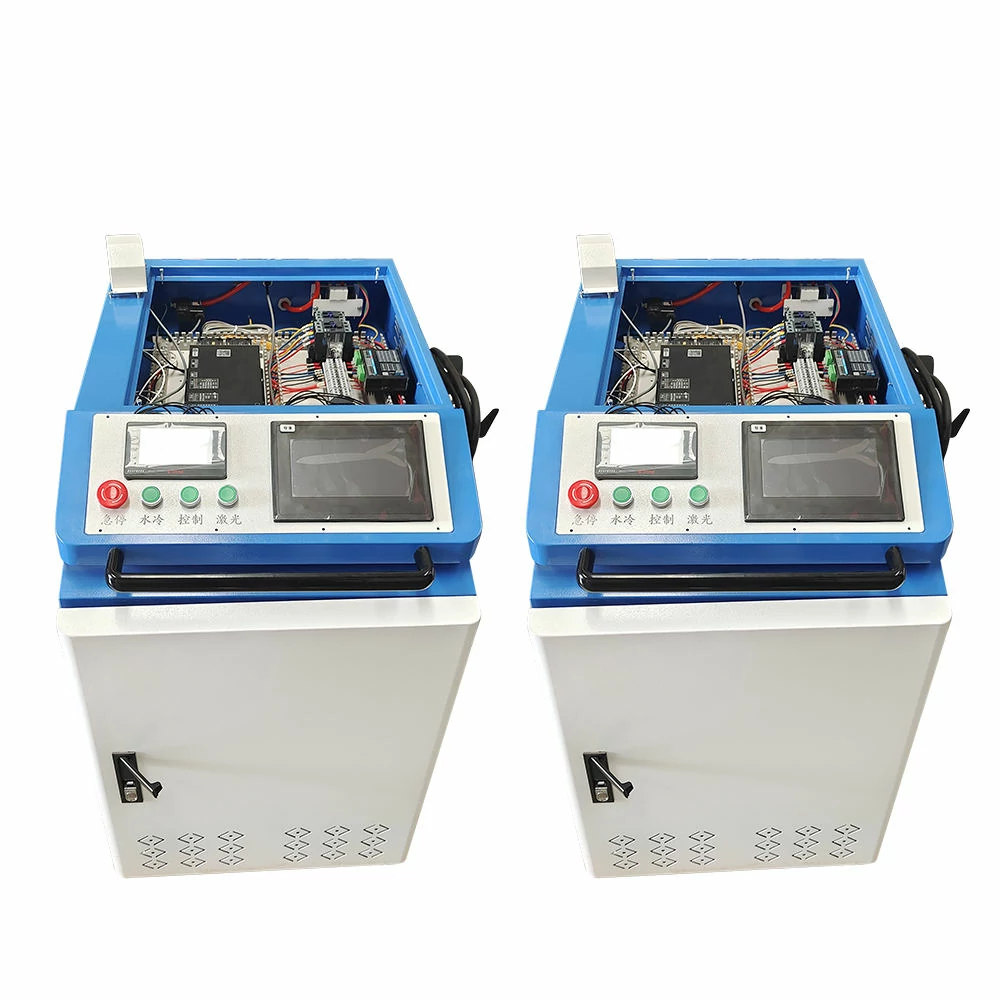
1500W Laser welding machine
What Materials Can a 1500W Laser Welding Machine Weld?
A 1500W laser welding machine can weld several commonly used metals, including stainless steel, carbon steel, and certain aluminum alloys. It can also be used for some galvanized steel and other metal applications when the process is properly adjusted.However, different materials absorb and conduct laser energy differently. The same 1500W laser source may produce different welding results on different metals.
Stainless Steel
Stainless steel is one of the most suitable materials for a 1500W laser welding machine.
It is widely used in kitchen equipment, food processing machinery, metal enclosures, decorative products, and industrial components. Laser welding can produce narrow weld seams with relatively low heat input, helping reduce distortion and post-welding finishing work.
A 1500W laser welder is commonly used for:
- Stainless steel sheets and plates
- Kitchen sinks and kitchen equipment
- Stainless steel cabinets and enclosures
- Exhaust pipes and metal tubes
- Stainless steel frames and brackets
- Sheet metal assemblies
For many general-purpose applications, 1500W provides sufficient welding capacity without the additional investment required for a higher-power machine.
Carbon Steel
Carbon steel is another common material for 1500W laser welding.Applications include metal furniture, machinery housings, sheet metal structures, brackets, frames, and general fabrication components.
Compared with traditional arc welding, laser welding can provide higher welding speeds and a narrower heat-affected area under suitable conditions. It is particularly useful when manufacturers need consistent weld appearance and reduced deformation on thin and medium-thickness components.
A 1500W machine can handle many carbon steel sheet metal welding tasks. However, the appropriate parameters depend on the carbon content, thickness, joint structure, and required penetration depth.
Aluminum and Aluminum Alloys
Aluminum can be laser welded, but it generally requires more careful process development than stainless steel or carbon steel.Aluminum has high thermal conductivity and reflectivity, and its surface oxide layer can affect weld formation. Some aluminum alloys are also more susceptible to porosity and hot cracking.
A 1500W laser welder may be suitable for thin aluminum components and selected welding applications, but its capability should be confirmed through sample testing.If your production involves relatively thick aluminum parts, high welding speeds, or demanding penetration requirements, a 2000W or 3000W machine may provide a more suitable process window.
For aluminum welding, the alloy type, joint preparation, shielding gas, and welding parameters are especially important.
Galvanized Steel
Galvanized steel is used in electrical cabinets, automotive components, ventilation systems, and various sheet metal products.It can be laser welded, but the zinc coating creates an additional process challenge. When exposed to welding heat, zinc can vaporize and produce fumes. This may lead to porosity, spatter, and unstable weld formation if the process is not properly controlled.
For galvanized materials, manufacturers should pay attention to:
- The thickness and condition of the zinc coating
- Joint design and coating position
- Appropriate welding parameters
- Effective fume extraction and ventilation
- Whether coating removal or other preparation is necessary
A 1500W machine can be considered for suitable galvanized sheet metal applications, but welding trials are recommended before production.
Copper and Other Highly Reflective Metals
Copper is more challenging to weld with a standard 1500W laser welding setup because it has high reflectivity and thermal conductivity.
Although laser welding of copper is possible, the required laser characteristics and process conditions may differ significantly from those used for stainless steel or carbon steel.
For copper components, especially when thicker sections or stable deep penetration are required, a dedicated process evaluation is necessary. Do not assume that a 1500W machine suitable for stainless steel will automatically deliver the same results on copper.
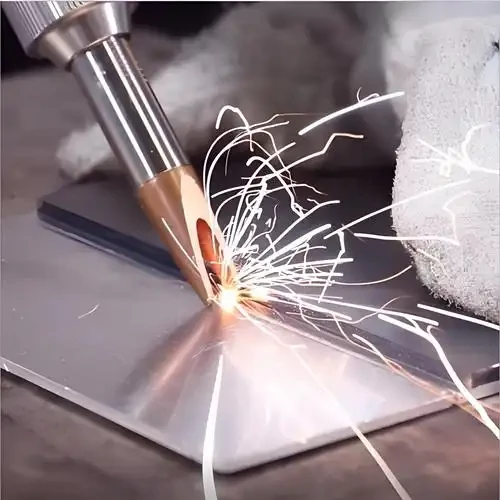
laser welding metal
How Thick Can a 1500W Laser Welding Machine Weld?
Material thickness is one of the most important considerations when selecting laser welding power.For general stainless steel applications, a 1500W handheld laser welding machine can commonly be used for workpieces around 3 mm thick, depending on the joint design and required welding quality.
The following table provides a practical reference for evaluating different power levels.
| Laser power | Stainless steel welding reference |
|---|---|
| 1500W | Around 3 mm |
| 2000W | Around 4 mm |
| 3000W | Around 6 mm |
These figures are general application references, not guaranteed maximum thickness specifications. Actual welding capability depends on the material, joint type, penetration requirements, welding speed, wire feeding, and machine configuration.
Why Does Joint Design Affect Welding Thickness?
Two workpieces with the same thickness may require different laser welding parameters because their joint structures are different.
For example, a lap joint, butt joint, and fillet joint have different heat transfer conditions and penetration requirements.A close-fitting joint with consistent positioning is generally easier to weld than a joint with a large gap or poor alignment.
For thicker materials, joint preparation and fit-up become increasingly important. If the gap is too large, the molten pool may not bridge the joint consistently, even when the laser power is sufficient.
Does Adding Welding Wire Increase Thickness Capacity?
A wire feeder can help fill gaps and add material to the weld seam. It is useful when the workpiece fit-up is not perfect or when the application requires additional weld reinforcement.However, adding welding wire does not automatically increase the penetration capacity of the laser source.
Laser power must still be sufficient to melt the base materials and achieve the required fusion. Wire feeding is a process aid, not a substitute for adequate laser energy.
What Products Can a 1500W Laser Welder Manufacture?
The practical value of a 1500W laser welding machine becomes clearer when we look at actual manufacturing applications.It is especially suitable for many thin- and medium-thickness metal fabrication tasks where manufacturers need flexible operation, good weld appearance, and relatively high welding efficiency.
Sheet Metal Fabrication
Sheet metal fabrication is one of the most common application areas for 1500W handheld laser welding machines.
Typical workpieces include:
- Electrical cabinets and control boxes
- Metal enclosures and equipment housings
- Sheet metal frames and brackets
- Stainless steel panels
- Metal furniture components
For these products, laser welding can help reduce heat deformation and improve weld consistency. It can also reduce the amount of grinding and finishing required for certain visible seams.
Kitchen Equipment and Stainless Steel Products
Commercial kitchens and food processing facilities use a wide range of stainless steel components.Examples include kitchen sinks, worktables, storage cabinets, equipment housings, and stainless steel frames.
A 1500W laser welder is a practical option for many of these products, particularly when the materials are relatively thin and the welding joints are accessible.The narrow heat-affected area can help maintain the appearance of stainless steel surfaces and reduce distortion around the weld seam.
Metal Pipes and Tubes
A 1500W laser welding machine can also be used for selected pipe and tube welding applications.
Typical examples include:
- Stainless steel tube assemblies
- Metal pipe fittings
- Tube-to-plate connections
- Small frames made from round or square tubes
- Brackets and supports made from tubular sections
For circular workpieces, a rotary fixture can help rotate the workpiece while maintaining a consistent welding position. If the application requires repeatable welding around pipes, rings, or cylindrical components, a suitable rotary-axis system may be more efficient than manual repositioning.
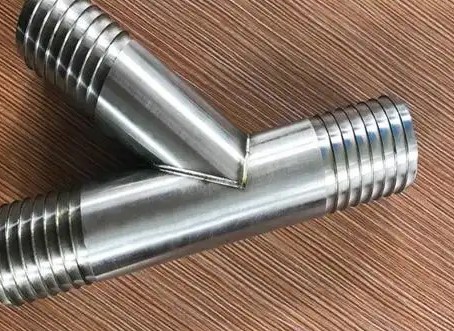
Stainless Steel tube laser welding
Automotive and Machinery Components
Many automotive and machinery manufacturers use laser welding for brackets, covers, housings, support structures, and other metal components.A 1500W handheld laser welder may be suitable for repair work, small-batch production, and flexible welding operations.
For repetitive production involving complex workpieces or strict positioning requirements, a CNC laser welding platform or robotic laser welding system may be a better choice.
The appropriate solution depends on production volume, welding path complexity, and the required level of automation.
What Are the Limitations of a 1500W Laser Welding Machine?
Although 1500W is suitable for many common metal welding applications, it is not the right choice for every project.Understanding its limitations is just as important as understanding what it can weld.
It May Not Be Suitable for Thick Workpieces
When welding thicker metal sections, the laser must provide enough energy to achieve the required penetration and maintain a stable molten pool.If your regular production involves stainless steel parts significantly thicker than approximately 3 mm, a 2000W or 3000W machine may be worth considering.
Higher power can provide more process flexibility, particularly when production speed and penetration depth are important.
Aluminum Welding May Require Higher Power
Aluminum’s thermal conductivity and reflectivity make it more demanding than many common steel applications.A 1500W machine may work for selected thin aluminum parts, but it should not be selected based on stainless steel thickness figures alone.
If aluminum is your main production material, provide the alloy type and thickness for process evaluation.
It Is Not Always the Best Choice for Continuous High-Volume Production
A handheld laser welder is designed for flexible operation. The operator manually guides the welding head along the joint.This is convenient for products with different shapes and small production batches. However, manual operation may become a limitation when the same welding path must be repeated thousands of times.
For high-volume production, a CNC laser welding machine or robotic laser welding system can offer better repeatability and reduce dependence on operator technique.
In other words, choosing a higher laser power does not automatically solve production automation requirements. Power and machine structure are two separate considerations.
Should You Choose a 1500W, 2000W, or 3000W Laser Welding Machine?
The best power level depends on your actual production requirements rather than simply choosing the highest available wattage.
| Selection factor | 1500W | 2000W | 3000W |
|---|---|---|---|
| General stainless steel sheet welding | Suitable for many applications | More process flexibility | Suitable, with greater power capacity |
| Thicker stainless steel workpieces | More limited | Better suited | Better suited |
| Thin carbon steel fabrication | Suitable | Suitable | Suitable |
| Aluminum welding | Requires application testing | More flexibility for selected applications | More power capacity for demanding applications |
| Equipment investment | Generally lower | Medium | Generally higher |
Choose 1500W If:
- Most of your work involves stainless steel or carbon steel sheet metal.
- Your typical stainless steel thickness is around 1–3 mm.
- You mainly manufacture cabinets, kitchen equipment, frames, and sheet metal products.
- You want a practical entry-level industrial handheld laser welding solution.
- Your production does not regularly require deep penetration in thick materials.
Choose 2000W If:
- You frequently weld stainless steel around 3–4 mm thick.
- You need more flexibility for different material thicknesses.
- Aluminum welding is part of your production and sample testing supports the selected process.
- You want additional power capacity for future production requirements.
Choose 3000W If:
- You regularly work with thicker metal sections.
- Your stainless steel welding applications may involve thicknesses around 5–6 mm.
- Production efficiency and penetration requirements justify the higher power.
- You need more process flexibility for demanding welding applications.
If your production involves only thin sheet metal, a 3000W machine may be unnecessary. A suitable 1500W or 2000W configuration can be more economical.
What Other Machine Configurations Should You Consider?
Laser power is only one part of a laser welding machine. The welding head, wire feeder, cooling system, and automation options can also influence the final result.
Welding Head and Welding Modes
Different welding heads support different functions and process configurations.Depending on the machine, options may include straight-line welding, wobble welding, and different beam oscillation patterns.
Wobble welding can help accommodate certain joint gaps and produce a wider weld seam. However, the appropriate oscillation width and welding parameters must be determined according to the workpiece.
Wire Feeder
A wire feeder is useful for applications that require additional filler material.It can help fill joint gaps, improve weld seam formation, and provide more control over weld reinforcement.
If your workpieces have consistent, close-fitting joints, wire feeding may not always be necessary. If the gaps vary or the weld requires additional filler, it is worth considering.
Cooling System
Cooling capacity must match the laser source and the machine’s operating requirements.A water-cooled system is commonly used for 1500W and higher-power handheld laser welding equipment. The chiller should be selected according to the laser source, welding head, ambient temperature, and expected operating conditions.
Do not select a cooling system based only on the laser power number. The complete equipment configuration should be checked.
Handheld or Automated Laser Welding?
A handheld laser welder is suitable when products vary frequently, workpieces are relatively easy to access, and operators need flexibility.If your factory repeatedly welds the same parts, uses complex three-dimensional welding paths, or requires consistent production output, consider a CNC or robotic laser welding machine.
For automated production, the number of axes, fixture design, servo system, CNC control, and welding path planning are just as important as laser power.
How to Confirm Whether a 1500W Laser Welding Machine Is Suitable for Your Project
Before purchasing a laser welding machine, it is better to evaluate your actual workpieces rather than relying only on a general power recommendation.To assess whether 1500W is sufficient, prepare the following information:
- Material: Stainless steel, carbon steel, aluminum, galvanized steel, or another metal.
- Thickness: The thickness of each component being joined.
- Joint type: Butt joint, lap joint, corner joint, fillet joint, or another structure.
- Welding requirements: Required penetration, weld appearance, strength, and acceptable deformation.
- Production requirements: Daily output, working hours, and whether the process is manual or automated.
- Workpiece images or drawings: These help evaluate joint accessibility and potential fixture requirements.
For demanding applications, sample welding is the most reliable way to confirm the appropriate laser power and process parameters.A machine that works well for one stainless steel product may not deliver the same result on a different alloy, thickness, or joint structure.
Frequently Asked Questions
Can a 1500W laser welder weld 3mm stainless steel?
Yes. A 1500W laser welding machine can commonly be used for stainless steel workpieces around 3 mm thick under suitable welding conditions. The actual result depends on joint design, material grade, fit-up, welding speed, and the required penetration.
Can a 1500W laser welding machine weld aluminum?
Yes, it can weld selected aluminum applications, particularly thinner materials. However, aluminum is more challenging because of its high thermal conductivity and reflectivity. The alloy type and workpiece thickness should be evaluated through sample testing.
Can a 1500W laser welder weld carbon steel?
Yes. Carbon steel is one of the common materials for 1500W laser welding. It is suitable for many sheet metal fabrication tasks, frames, brackets, cabinets, and other metal components.
Is 1500W enough for a small metal fabrication workshop?
For a workshop mainly processing thin stainless steel and carbon steel, 1500W can be a practical choice. If the workshop regularly handles thicker materials or demanding aluminum applications, a 2000W or 3000W machine may be more appropriate.
Is a 1500W laser welder suitable for production lines?
A handheld 1500W laser welder can be used in production environments, especially where operators need flexibility. For repetitive high-volume welding, a CNC laser welding machine or robotic laser welding system may provide better repeatability and production efficiency.
Should I buy a 1500W or 2000W laser welding machine?
If your main applications involve stainless steel around 1–3 mm thick, 1500W may be sufficient. If you frequently weld thicker stainless steel or need more process flexibility, 2000W is worth considering. The final choice should be based on your actual workpieces and welding tests.
Conclusion: Is a 1500W Laser Welding Machine Right for You?
A 1500W laser welding machine is a practical solution for many common metal fabrication applications. It can weld stainless steel and carbon steel, handle selected aluminum applications, and support the production of cabinets, kitchen equipment, metal frames, sheet metal components, and other industrial products.
For general stainless steel welding, approximately 3 mm is a useful reference point for evaluating a 1500W machine. However, the actual welding capability depends on material properties, joint design, process parameters, and production requirements.
If your main goal is flexible welding of thin and medium-thickness metal components, 1500W may be the right starting point. If you regularly work with thicker materials or need greater production flexibility, consider 2000W or 3000W.
Contact ZS Laser with your material type, workpiece thickness, and welding requirements. Our team can help evaluate your application, recommend a suitable laser power and machine configuration, and arrange sample welding tests when necessary.

WhatsApp
Scan the QR Code to start a WhatsApp chat with us.