 ZS Laser Equipment

tCopper pipes are widely used in HVAC systems, refrigeration equipment, plumbing, heat exchangers, automotive components, and industrial cooling systems. Their excellent thermal conductivity, corrosion resistance, and good formability make copper an important material for tube and pipe applications.However, when it comes to copper pipe welding, the process is not as straightforward as welding steel. Copper has high thermal conductivity and high reflectivity, which makes it more challenging to control heat during welding.
For this reason, brazing is still one of the most commonly used methods for joining copper pipes, especially in HVAC, refrigeration, and plumbing applications.At the same time, laser welding can also be used for certain copper pipe applications. It is particularly worth considering for small-batch or production-oriented copper pipe prefabricated components, where consistent weld quality, localized heat input, and automation are important.
This article explains the common types of copper pipes, why copper is difficult to weld, why brazing is widely used, and when laser welding can be a practical option.
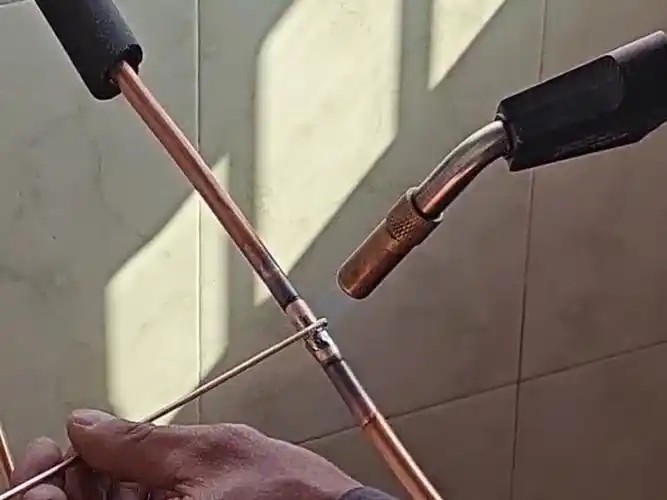
Brazing of air conditioning copper pipes
Types of Copper Pipes
Before discussing copper pipe welding, it is useful to understand the different types of copper tubes commonly used in industry.Copper pipes are available in different grades, tempers, dimensions, and manufacturing forms. The appropriate type depends on the application.
Pure Copper Pipe
Pure copper pipes have high electrical and thermal conductivity and are widely used for heat transfer and fluid transportation.Typical applications include:
- Air conditioning
- Refrigeration
- Plumbing
- Heat exchangers
- Cooling systems
So it is commonly available in different tempers, such as soft, annealed, and hard-drawn tubing.
Annealed Copper Pipe
Annealed copper tubing is softer and more flexible than hard copper tubing.It is often supplied in coils and can be bent relatively easily, making it useful for:
- Refrigeration lines
- Air conditioning systems
- HVAC installations
- Small-diameter tubing
Its flexibility is useful during installation, although the thin wall of some tubing can make heat control important during joining.
Hard Copper Pipe
Hard-drawn copper tubing has higher rigidity and is commonly supplied in straight lengths.It can be used in:
- Plumbing systems
- HVAC systems
- Industrial piping
- Heat-transfer equipment
Compared with soft tubing, hard copper pipe is less flexible but can provide better dimensional stability during assembly.
Copper Alloy Tubes
Some applications use copper alloys rather than pure copper.Depending on the required properties, copper alloys can provide different combinations of:
- Strength
- Corrosion resistance
- Thermal performance
- Wear resistance
The alloy composition should always be considered when selecting a welding process because different copper materials can behave differently during heating and welding.
Why Is Copper Pipe Difficult to Weld?
Copper has several physical properties that make fusion welding more difficult than welding common steels.
High Thermal Conductivity
The most important challenge is copper’s high thermal conductivity.Copper transfers heat away from the welding area very quickly.When a heat source is applied to the joint, a significant amount of heat can spread into the surrounding material instead of remaining concentrated in the weld zone.This can make it difficult to establish and maintain a stable molten pool.For thin-wall copper pipes, excessive heat can also result in:
- Burn-through
- Pipe deformation
- Excessive penetration
- Distortion
Therefore, controlling heat input is critical.
High Reflectivity
Copper also has high reflectivity, particularly for commonly used near-infrared laser wavelengths.This is especially important when laser welding is considered.A portion of the incident laser energy can be reflected rather than absorbed by the copper surface, making the welding process more demanding.Modern laser systems and process strategies can improve copper welding performance, but the actual result depends on the material, laser source, wavelength, power density, joint design, and process parameters.
Thin Pipe Walls
Many copper tubes have relatively thin walls.Thin-wall tubing requires careful control of heat input regardless of the joining method.Too much energy can cause burn-through, while insufficient energy may result in incomplete fusion or an unstable joint.This is particularly important for precision copper tube assemblies.
Surface Condition
Copper pipe surfaces can also contain:
- Oxides
- Oil
- Grease
- Dirt
- Other contaminants
These contaminants can affect the joining process and final joint quality.Proper cleaning and preparation are therefore important before welding or brazing.
Why Is Brazing Commonly Used for Copper Pipes?
Although copper can be welded, brazing remains one of the most widely used joining methods for copper pipes.This is particularly true in:
- HVAC
- Refrigeration
- Air conditioning
- Plumbing
- General copper piping
The reason is relatively straightforward: brazing is well established for joining copper tubes and fittings.
During brazing, a filler metal is heated until it melts and flows into the joint. The copper pipe itself does not normally need to melt.This makes brazing fundamentally different from fusion welding.
Common Copper Pipe Brazing Applications
Brazing is commonly used for:
- Refrigeration tubing
- Air conditioning lines
- Copper pipe fittings
- HVAC connections
- Heat exchanger components
- Plumbing connections
For many conventional copper pipe installations, brazing is practical, established, and widely understood by technicians.Therefore, if the application is simply joining standard copper pipes and fittings on an HVAC or refrigeration system, brazing is often the first process to consider rather than laser welding.
Can Copper Pipes Be Laser Welded?
Yes, copper pipes can be laser welded.
However, this does not mean that laser welding is the standard replacement for brazing.Laser welding is better viewed as a specialized joining option for selected copper pipe and tube assemblies.It becomes particularly suitable when the copper pipe is part of a manufactured component and the manufacturer needs a repeatable production process.
For example, if you produce a specific copper tube assembly in small or medium batches.Instead of manually brazing every component,you may evaluate laser welding to achieve:
- Consistent weld positioning
- Controlled heat input
- High repeatability
- Reduced operator dependence
- Faster production
- Easier automation
In these situations, laser welding can be worth testing.
When Is Laser Welding Suitable for Copper Pipe?
Laser welding is generally more attractive for production-oriented copper pipe assemblies rather than ordinary field pipe installation.
Small-Batch Copper Pipe Production
Small-batch manufacturing is one potential application.For example, a manufacturer may produce several hundred or several thousand identical copper tube assemblies.The components may have the same:
- Pipe diameter
- Wall thickness
- Joint design
- Welding position
- Welding path
Once the laser welding process has been developed and verified, the same parameters can be repeatedly applied to the production parts.This can provide better consistency than manually controlled joining processes.
Copper Pipe Prefabricated Components
Laser welding can also be considered for prefabricated copper pipe components.Examples include:
- Copper tube assemblies
- Tube-to-fitting assemblies
- Cooling tube components
- Heat-transfer components
- Customized copper pipe modules
In these applications, the workpiece can be positioned in a fixture and welded in a controlled production environment.This is quite different from installing copper pipes directly at a construction site.
Automated Copper Tube Welding
Automation is another reason manufacturers may consider laser welding.A laser welding system can potentially be integrated with:
- Welding fixtures
- Rotary axes
- Linear motion systems
- Robotic systems
- Automatic loading and unloading
This makes laser welding particularly interesting when the same copper pipe component needs to be produced repeatedly.
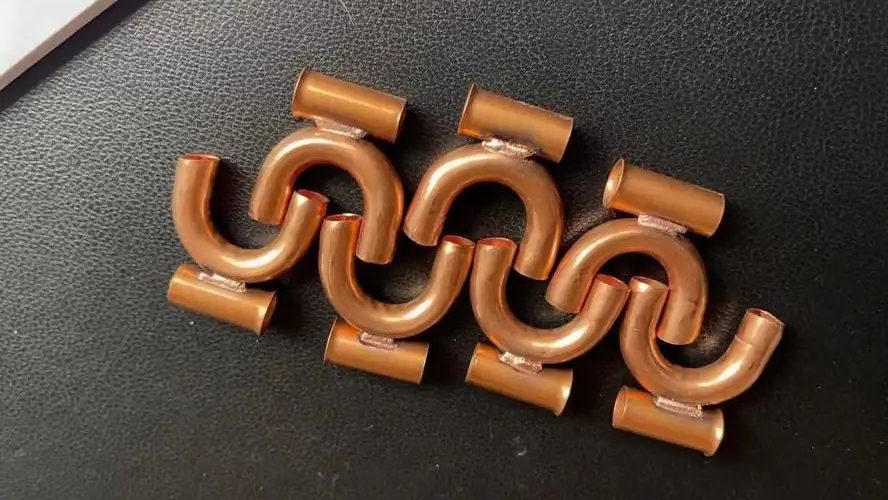
Copper laser welding preform
Laser Welding vs. Brazing for Copper Pipe
Laser welding and brazing are not simply two competing technologies where one is always better.They are suitable for different production requirements.
| Factor | Brazing | Laser Welding |
|---|---|---|
| Conventional copper pipe joining | Very common | Specialized |
| HVAC and refrigeration installation | Very common | Less common |
| Plumbing | Very common | Limited |
| Factory prefabricated components | Common | Potentially attractive |
| Small-batch production | Practical | Potentially attractive |
| Automation | Possible | Excellent potential |
| Heat input | Relatively broad | Highly concentrated |
| Operator dependence | Depends on process | Lower after process development |
| Equipment cost | Generally lower | Generally higher |
| Process development | Well established | Usually requires testing |
For ordinary copper pipe installation, brazing will often remain the practical choice.
For repetitive production of copper pipe assemblies, laser welding may offer advantages that justify the additional equipment and process-development effort.
What About TIG and MIG Welding Copper Pipe?
TIG Welding
TIG provides good control over the welding arc and can be used for specialized copper components.It may be considered when:
- Fusion welding is required
- Production volume is relatively low
- Manual welding is acceptable
- The operator has experience with copper welding
However, copper’s high thermal conductivity makes heat control important.
MIG Welding
MIG welding can provide a higher deposition rate than TIG and may be useful for certain larger copper components.However, it is also a specialized process when applied to copper tubing.For typical HVAC, refrigeration, and plumbing copper pipe connections, brazing remains much more common.
What Needs to Be Tested Before Laser Welding Copper Pipe?
If you are considering laser welding for a copper pipe assembly, sample testing is highly recommended.Laser welding performance cannot be determined simply by looking at the pipe diameter or selecting a laser power.Important factors include:
Copper Material
The exact copper grade or alloy should be identified.
Pipe Wall Thickness
Thin-wall copper tubing requires particularly careful heat control.
Pipe Diameter
The diameter affects joint geometry and may also affect how the welding head or rotary fixture needs to move around the component.
Joint Design
The joint may be:
- Butt joint
- Lap joint
- Tube-to-fitting joint
- Tube-to-plate joint
- Circumferential joint
The fit-up and joint gap are also important.
Laser Source
The laser source and wavelength can significantly affect energy absorption in copper.
Welding Parameters
Parameters such as:
- Laser power
- Welding speed
- Focus position
- Beam size
- Shielding gas
must be developed according to the actual workpiece.
Why Sample Testing Matters
A copper pipe that can be welded successfully in one application may not produce the same result in another application.For example, two copper tubes may have the same diameter but different wall thicknesses or joint structures.Their required welding parameters may therefore be completely different.Sample testing allows the manufacturer to evaluate the actual process before investing in production equipment.
The testing process can determine:
- Whether sufficient penetration can be achieved
- Whether burn-through occurs
- Whether the weld is stable
- Whether excessive deformation occurs
- Whether porosity is acceptable
- Whether the required production speed can be achieved
- Whether the finished joint meets mechanical or leak requirements
A practical approach is:
Actual workpiece → Sample testing → Parameter optimization → Weld inspection → Final equipment configuration
This approach is especially important for copper because its thermal and optical properties make the welding process more sensitive to configuration and parameters.
How to Choose the Right Copper Pipe Joining Method
The first question should not be “Which welding machine should I buy?”Instead, determine what kind of copper pipe application you have.
Brazing is usually suitable when:
- You are joining conventional copper pipes and fittings
- You are working with HVAC or refrigeration systems
- You are performing plumbing installation
- The process is primarily manual
- Production does not require automated fusion welding
You can choose TIG or MIG when:
- A fusion weld is specifically required
- The component is suitable for arc welding
- Production volume is relatively low
- Manual welding is acceptable
You can choose laser welding when:
- The copper pipe is part of a prefabricated component
- The same component is produced repeatedly
- Small or medium production batches are involved
- Consistent weld quality is important
- Localized heat input is beneficial
- Automation is required or planned
- The manufacturer wants to reduce operator dependence
For laser welding applications, actual sample testing should normally be carried out before selecting the final equipment.
Copper Pipe Laser Welding from ZS Laser
ZS Laser provides laser welding solutions for customized metal components and production applications.For copper pipe and tube assemblies, we recommend evaluating the actual workpiece first rather than selecting equipment based only on laser power.
You can provide the copper pipe sample, drawings, material, wall thickness, joint structure, and production requirements. Our team can evaluate the application and carry out sample testing to determine whether laser welding is suitable for your product.
If the process is feasible, we can design a perfect welding system according to the actual production requirements, including welding equipment, fixtures, rotary axes, and automation solutions.

WhatsApp
Scan the QR Code to start a WhatsApp chat with us.