 ZS Laser Equipment

Plastic components can be joined using several different welding technologies. Two methods that are often considered for thermoplastic applications are hot air welding and laser welding.Although both processes use heat to join plastic parts, they work in fundamentally different ways.A hot air welder heats the plastic surface with a stream of hot gas, while plastic laser welding uses laser energy to generate heat at the joint interface.
As a result, the two technologies differ significantly in equipment cost, welding precision, production speed, joint design, appearance, and automation potential.
So, which one should you choose?
The answer depends on the plastic material, component design, production volume, required weld quality, and application.
What Is a Hot Air Welder?
A hot air welder is a plastic welding machine that uses heated air or another heated gas to soften and melt thermoplastic materials.The heated gas is directed toward the welding area through a nozzle. The plastic surfaces, and often a plastic filler rod, are heated until they become sufficiently soft or molten. The operator then brings the materials together to form the weld.Hot air welding is commonly used for thermoplastics such as:
- PVC
- PP
- PE
- HDPE
- ABS
- PVDF
- Other compatible thermoplastic materials
The exact weldability depends on the specific polymer grade and application.Hot air welding is especially common in plastic fabrication, repair work, tanks, ducts, pipes, sheets, and other relatively large plastic structures.
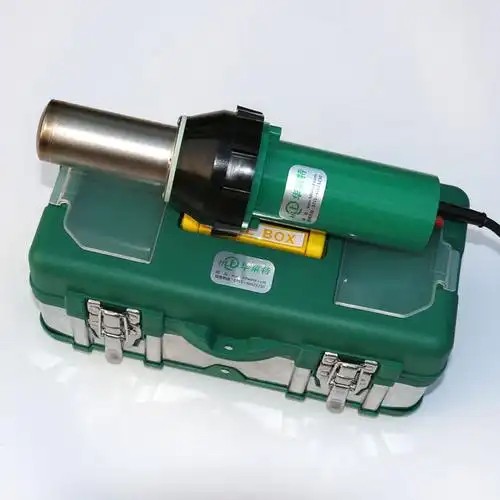
Hot air welding machine
Advantages of Hot Air Welding
The main advantages include:
- Relatively low equipment cost
- Simple operating principle
- Portable equipment
- Suitable for repair and maintenance
- Suitable for large plastic sheets and structures
- Can weld relatively thick plastic materials
- Filler rods can be used to reinforce the joint
- Suitable for low-volume and custom fabrication
Because the equipment is relatively simple, hot air welding is widely used in workshops and field applications.However, the process relies heavily on operator skill.The operator must control the:
- Hot air temperature
- Airflow
- Welding speed
- Nozzle position
- Pressure
- Filler rod feeding
- Heating time
If the plastic is overheated, it may degrade or burn. If insufficient heat is applied, the joint may not achieve adequate fusion.
What Is Plastic Laser Welding?
Plastic laser welding is a joining process used primarily for thermoplastic components.Instead of heating the plastic surface with hot air, laser energy is selectively absorbed at the joint interface.One common method is transmission laser welding.
In a typical configuration, one plastic component allows the laser wavelength to pass through, while the mating component absorbs the laser energy.The absorbed laser energy is converted into heat at the interface. The thermoplastic surfaces then soften or melt and fuse together under controlled pressure.This creates a localized weld without heating the entire surrounding component.Laser welding is particularly attractive for applications requiring:
- High repeatability
- Precise weld positioning
- Clean appearance
- Low contamination
- Low thermal distortion
- Automated production
- High-volume manufacturing
However, plastic laser welding is not suitable for every plastic component.The optical characteristics of the materials are extremely important.Factors such as:
- Polymer type
- Laser wavelength
- Transparency
- Absorption
- Pigments
- Fillers
- Additives
- Part thickness
- Joint design
can all affect the welding process.Therefore, plastic laser welding normally requires material evaluation and process development before production.
Hot Air Welder vs Laser Welding: Key Differences
1.The biggest difference between the two technologies is how heat is delivered to the plastic.
A hot air welder heats the surface directly with hot gas.While laser welding concentrates energy at a defined location, allowing the heat to be generated primarily around the intended joint.
This difference leads to several practical advantages and disadvantages.
| Factor | Hot Air Welder | Plastic Laser Welding |
|---|---|---|
| Heat source | Heated gas | Laser energy |
| Equipment cost | Relatively low | Higher |
| Operator skill | High for manual welding | Lower after process development |
| Precision | Moderate | High |
| Weld speed | Moderate | High in suitable applications |
| Automation | Limited to moderate | Excellent |
| Weld appearance | Depends strongly on operator | Highly consistent |
| Thermal influence | Relatively large | Highly localized |
| Filler material | Often used | Usually not required |
| Contamination | Possible | Very low |
| Large plastic structures | Excellent | Application dependent |
| Small precision components | Limited | Excellent |
| Mass production | Less suitable | Highly suitable |
| Repair work | Excellent | Less practical |
| Complex optical requirements | Low | High |
Neither technology is universally better.
The correct choice depends on the application.
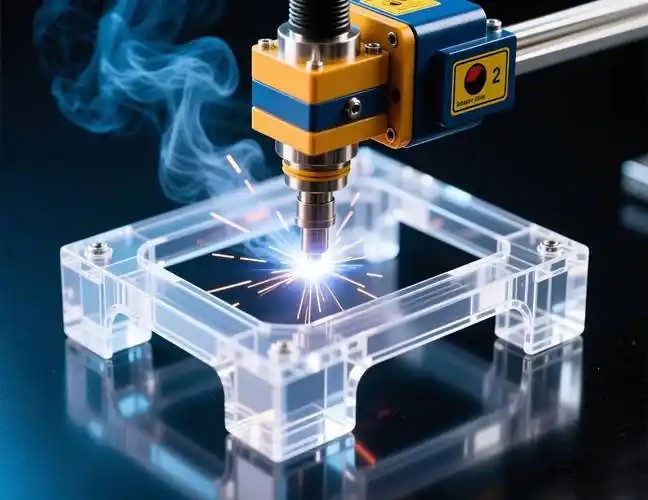
Laser welding plastic
2.Welding Precision and Heat Input
One of the most important differences is heat distribution.With hot air welding, the operator heats the plastic surface and surrounding area using a stream of hot gas.This creates a relatively broad heated zone.The operator must carefully balance temperature and welding speed.
Too much heat can cause:
- Material degradation
- Burning
- Excessive deformation
- Surface damage
Too little heat can result in:
- Incomplete fusion
- Weak joints
- Poor weld consistency
Laser welding can concentrate the energy much more precisely at the joint.The surrounding plastic can remain comparatively cool.This can reduce thermal influence and help minimize distortion, particularly for small or precision components.
However, this does not mean laser welding always has lower total heat input under every condition. The actual thermal behavior depends on laser power, welding speed, material absorption, joint design, and process parameters.
3.Weld Appearance
Weld appearance can also be significantly different.Hot air welding often produces a visible weld bead, especially when a filler rod is used.The final appearance depends strongly on:
- Operator technique
- Filler rod selection
- Heating temperature
- Welding speed
- Nozzle movement
- Surface preparation
For fabricated plastic tanks, ducts, pipes, and sheets, this appearance may be completely acceptable.
Laser welding can produce a much more controlled and localized weld.Because the process can be performed without a conventional filler rod, the finished joint can have a cleaner appearance.This makes laser welding attractive for products where appearance and dimensional accuracy are important.
Hot Air Welding Is Better for Large Plastic Fabrication
Hot air welding has an important advantage that should not be overlooked.It is highly practical for large plastic structures.For example, manufacturers may use hot air welding for:
- Plastic tanks
- Chemical storage tanks
- Ventilation ducts
- Plastic pipes
- Plastic sheets
- Liners
- Water-treatment equipment
- Plastic containers
These components can be large, irregular, or custom-made.A portable hot air welder can be moved around the workpiece relatively easily.The operator can also use different nozzles and filler rods according to the joint.For these applications, the simplicity and flexibility of hot air welding can be more valuable than the precision of laser welding.
Laser Welding Is Better for Precision Plastic Components
Plastic laser welding becomes particularly attractive when the component is relatively small, precise, and suitable for automated production.Typical applications include:
- Automotive components
- Sensors
- Electronic housings
- Medical devices
- Fluid-control components
- Microfluidic devices
- Plastic reservoirs
- Electrical components
- Consumer electronics
These applications often require consistent weld geometry and controlled thermal influence.Laser welding can be integrated with CNC motion systems, robotics, vision systems, and automated production lines.This makes it particularly attractive for manufacturers producing large quantities of identical plastic components.
Hot Air Welder vs Laser Welding for Production Volume
Production volume is another important consideration.For a small workshop producing different plastic products every day, a hot air welder can be a practical choice.The equipment is relatively inexpensive, flexible, and easy to move between jobs.For example, a manufacturer may produce:
- One plastic tank today
- A duct system tomorrow
- A custom plastic enclosure next week
A manual hot air welding system can handle this type of flexible production effectively.
Laser welding becomes more attractive when the production process is highly repetitive.
For example:Thousands of identical plastic housings need to be welded with the same joint geometry.In this situation, the initial investment in laser welding equipment can be justified by:
- Higher repeatability
- Automation
- Reduced operator dependence
- Consistent weld quality
- Higher production efficiency
Therefore, equipment cost should not be evaluated independently from production volume.
Which Plastic Materials Can Be Welded?
Material compatibility is critical for both technologies.Hot air welding can be used with many thermoplastics, provided that the material can be heated and fused appropriately.Common examples include:
- PE
- PP
- PVC
- ABS
- PVDF
- HDPE
However, different polymers have different melting behavior and thermal characteristics.
Laser welding has an additional requirement: optical compatibility.The plastic must interact appropriately with the selected laser wavelength.For transmission laser welding, one component generally needs to transmit enough laser energy while the mating component absorbs sufficient energy to generate heat.This means color, pigment, filler, transparency, and additives can have a major influence on the process.
For example, two plastic parts may be chemically compatible but still be difficult to laser weld because their optical properties are unsuitable.This is one of the major differences between conventional hot air welding and plastic laser welding.
Do Plastic Laser Welding Machines Need Filler Rods?
In many laser plastic welding applications, a separate filler rod is not required.The two plastic components are joined by melting the mating surfaces themselves.This provides several advantages:
- No filler rod preparation
- Cleaner weld appearance
- Less material variation
- Easier automation
- More controlled joint geometry
Hot air welding, on the other hand, commonly uses a filler rod when joining plastic sheets, plates, tanks, and other fabricated structures.The filler material must be compatible with the base plastic.
Equipment Cost: Hot Air Welder vs Laser Welder
Equipment investment is another major difference.A hot air welder is relatively simple.The main components may include:
- Heating system
- Air blower
- Temperature control
- Welding nozzle
- Handle
As a result, the initial investment can be relatively low.
A plastic laser welding system is considerably more complex.Depending on the system, it may include:
- Laser source
- Optical system
- Welding head
- Motion system
- Clamping system
- Control system
- Cooling system
- Safety enclosure
- Vision system
Therefore, laser welding generally requires a significantly higher initial investment.However, comparing only the purchase price can be misleading.For high-volume manufacturing, the productivity and automation advantages of laser welding can offset the higher equipment cost.
Which Process Is Easier to Operate?
For basic applications, a hot air welder can be relatively straightforward to start using.However, achieving consistently high-quality welds still requires experience.An experienced operator needs to understand how the plastic reacts to:
- Temperature
- Airflow
- Pressure
- Welding speed
- Filler material
Laser welding has the opposite characteristic.
The equipment itself is more complicated, and process development can be more demanding.However, once a stable process has been established, production can become highly repeatable.
In other words:
Hot air welding generally has lower equipment complexity but higher dependence on operator technique.
Laser welding generally has higher equipment complexity but greater potential for automated and repeatable production.
Can Laser Welding Replace Hot Air Welding?
In most cases, laser welding should not be considered a direct replacement for hot air welding.The two technologies are better suited to different types of work.Hot air welding remains highly useful for:
- Large plastic structures
- Plastic tanks
- Pipes
- Ducts
- Sheet fabrication
- Repair work
- Custom fabrication
- Low-volume production
Laser welding is more attractive for:
- Precision components
- Small plastic parts
- High-volume production
- Automated manufacturing
- Clean welding environments
- Consistent cosmetic requirements
- Components requiring controlled thermal influence
The right question is therefore not:Which technology is better?
Instead, manufacturers should ask:Which technology is better suited to my material, product design, production volume, and quality requirements?
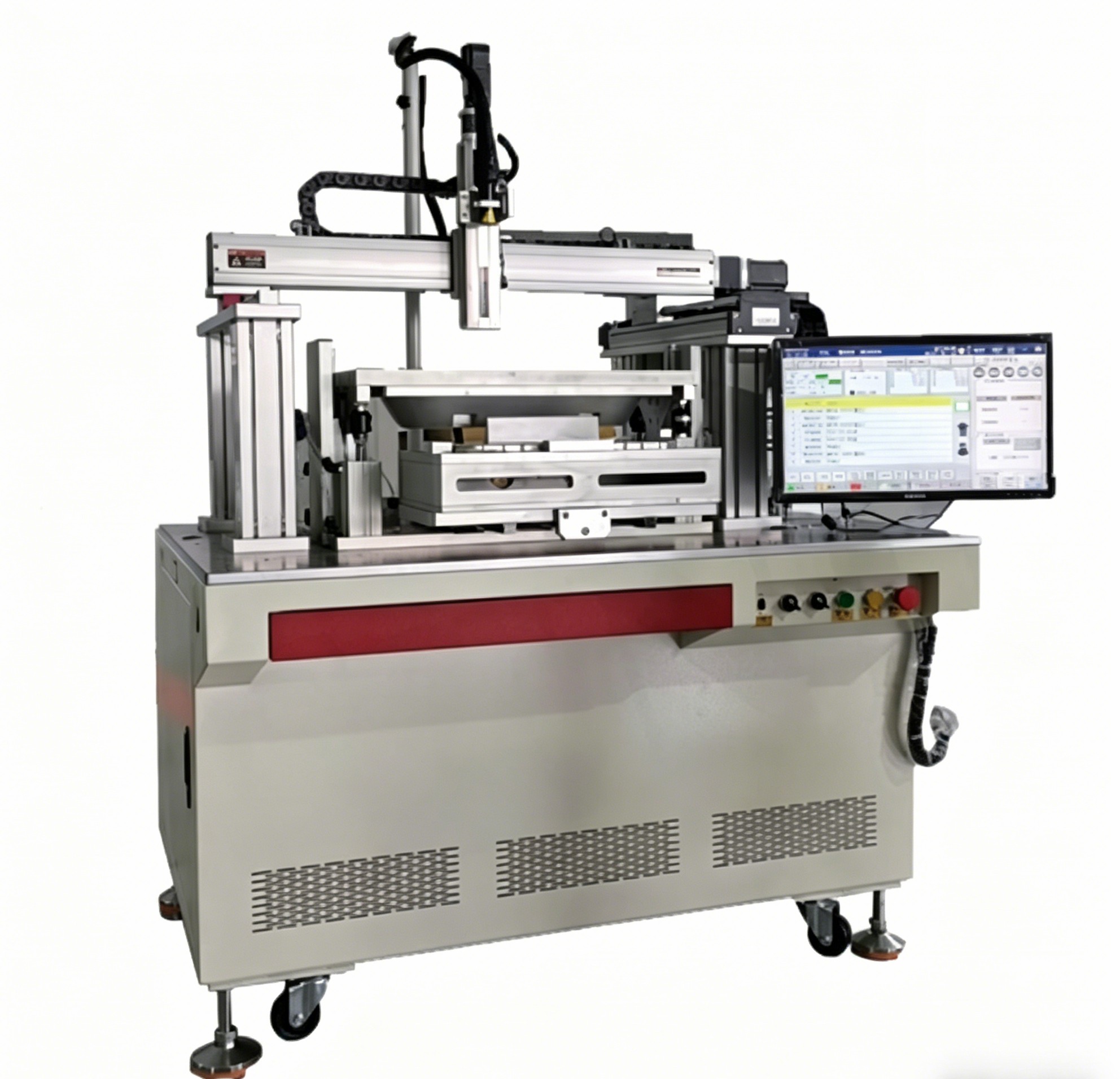
Gantry-type single-station plastic welding machine
Hot Air Welding vs Plastic Laser Welding: Final Comparison
Both technologies have important roles in modern plastic manufacturing.
A hot air welder is flexible, relatively inexpensive, portable, and particularly useful for large thermoplastic structures and repair work.
A plastic laser welding machine requires a higher initial investment and more process development, but it can provide excellent precision, repeatability, cleanliness, and automation potential for suitable thermoplastic components.
For a workshop producing large tanks, pipes, ducts, or custom plastic structures, hot air welding may be the more practical solution.
For an industrial manufacturer producing thousands of precision plastic components, laser welding may offer significantly greater production advantages.
The most important factor is not simply the welding machine. Material compatibility, joint design, production requirements, and process development ultimately determine whether a welding method is suitable.
Conclusion
Hot air welding and plastic laser welding represent two very different approaches to joining thermoplastics.
Hot air welding uses externally applied heat and remains an economical and versatile solution for plastic fabrication and repair.
Laser welding uses localized laser energy and offers greater potential for precision, repeatability, and automation.
Neither method is suitable for every application.
If you are selecting a plastic welding process, the first steps should be to identify the plastic material, thickness, joint design, production volume, required weld appearance, and mechanical or sealing requirements.
For suitable thermoplastic materials and properly designed joints, laser welding can be an advanced solution for modern automated plastic manufacturing, while hot air welding remains a highly practical choice for flexible and large-scale plastic fabrication.

WhatsApp
Scan the QR Code to start a WhatsApp chat with us.