 ZS Laser Equipment

A hand held fiber laser welder is a compact laser welding system designed for manually welding metal components with a focused fiber laser beam. Compared with traditional welding processes such as TIG and MIG, handheld fiber laser welding can provide higher welding speeds, concentrated heat input, narrow welds, and reduced thermal distortion in many suitable applications.That is why it is becoming increasingly popular in sheet metal fabrication, stainless steel fabrication, machinery manufacturing, automotive components, kitchen equipment, and other metalworking applications.
However, choosing a handheld laser welder is not simply a matter of selecting the highest laser power. The laser source, welding head, cooling system, wire feeder, material, thickness, joint design, and required welding speed all affect the final result.This guide explains how a hand held fiber laser welder works, what materials it can weld, where it is used, how it compares with TIG and MIG, and what to consider when choosing a machine.
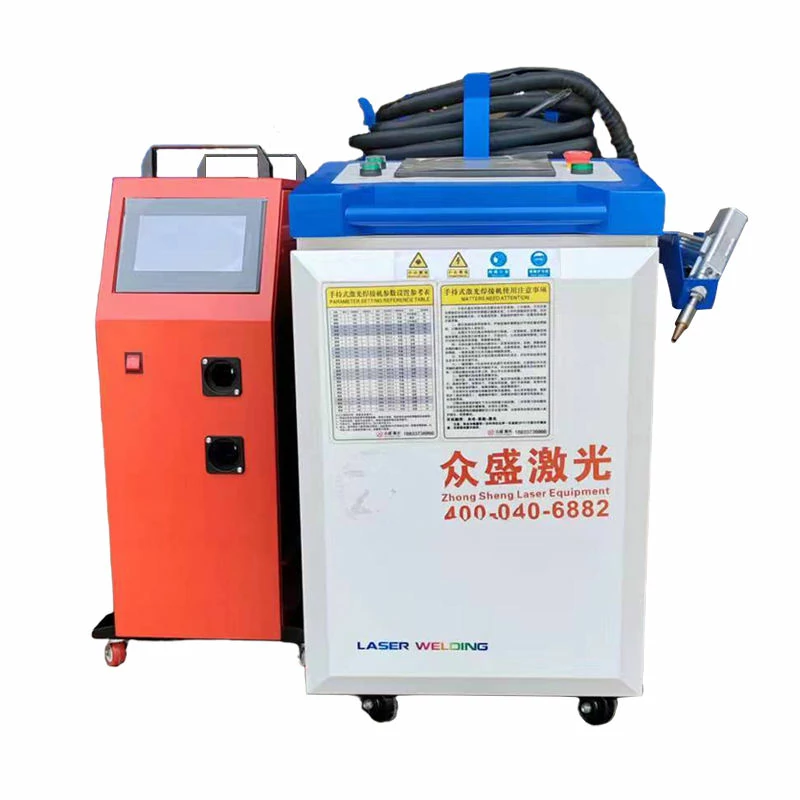
ZS Hand Held Fiber Laser Welder
What Is a Hand Held Fiber Laser Welder?
A hand held fiber laser welder is a laser welding machine equipped with a manually operated welding head.Instead of generating an electric arc like MIG or TIG welding, the machine uses a high-energy-density laser beam to heat and melt the material at the joint.A typical handheld fiber laser welding system includes:
- Fiber laser source
- Optical fiber delivery system
- Handheld laser welding head
- Welding control system
- Cooling system
- Shielding gas system(Generally, the customer needs to prepare it themselves.)
- Wire feeder, when required
The operator guides the welding head along the joint while the focused laser beam creates a localized molten pool.Depending on the material, thickness, joint design, and application, welding can be performed with or without filler wire.The main characteristic of this process is its highly concentrated heat input. This allows many thin and medium-thickness metal components to be welded with relatively high speed and limited thermal distortion.
How Does a Handheld Fiber Laser Welder Work?
The basic process can be understood as a series of steps.
1.First, the fiber laser source generates the laser beam. The beam is delivered through an optical fiber to the handheld welding head.
2.The welding head then focuses the beam onto the workpiece.
3.At the joint, the concentrated laser energy rapidly heats and melts the material. As the operator moves the welding head along the joint, the molten material solidifies behind the laser beam and forms the weld.
4.Shielding gas is normally supplied around the welding zone to protect the molten pool from atmospheric contamination.
5.For joints with a larger gap or applications requiring additional weld metal, a wire feeder can introduce filler wire into the molten pool.
The basic process can therefore be summarized as:
Fiber Laser Source → Optical Fiber → Welding Head → Focused Laser Beam → Molten Pool → Weld
The exact welding process depends on the material, thickness, joint configuration, laser power, focus position, welding speed, shielding gas, and other parameters.
Key Components of a Hand Held Fiber Laser Welder
A handheld laser welder is not simply a laser source and a welding gun. The performance of the complete system depends on how these components work together.
Fiber Laser Source
The laser source is one of the most important components of the machine.Common power levels for handheld fiber laser welding machines include:
- 1000W
- 1500W
- 2000W
- 3000W
Higher power can provide greater penetration capability and higher productivity in suitable applications, but higher power does not automatically mean better welding.The appropriate power depends on:
- Material
- Material thickness
- Joint design
- Required penetration
- Welding speed
- Thermal requirements
Laser source stability and beam quality are also important because variations in laser output can affect weld consistency.
Handheld Laser Welding Head
The welding head delivers and focuses the laser beam onto the workpiece.Many modern handheld welding heads use a wobble function, which moves the laser beam over a controlled pattern instead of maintaining a single fixed point.A wobble welding head can help accommodate certain joint configurations and produce a wider weld profile.Important features of a welding head include:
- Optical quality
- Focusing system
- Protective lens
- Wobble control
- Cooling
- Ergonomic design
- Availability of replacement parts
A well-designed welding head should provide stable optical performance while remaining comfortable for the operator during extended use.
Cooling System
The laser source and welding system generate heat during operation and require appropriate cooling.
Lower-power systems may use air cooling in some configurations, while higher-power systems commonly use water cooling.
The cooling system should be matched to the laser power and operating conditions.Insufficient cooling can negatively affect equipment stability and service life.You can refer to air cooled laser welding machine to know more about the difference between air cooled and water cooled system.
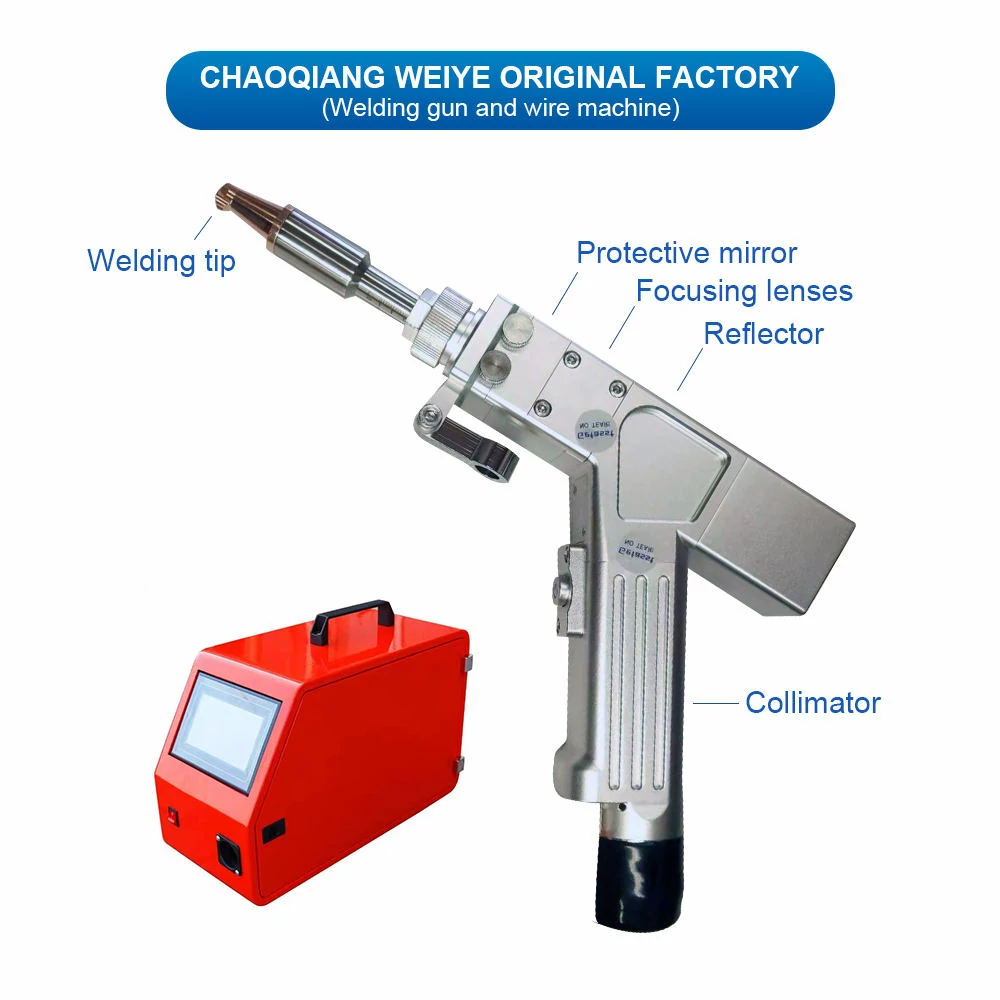
Welding Gun And Wire Feeder
Wire Feeder
A wire feeder is not necessarily required for every laser welding application.Laser welding can often be performed without filler wire when the joint fit-up is good and the base material can provide sufficient weld metal.Filler wire may be useful when:
- The joint gap is relatively large
- Additional weld reinforcement is required
- The joint design requires additional material
- The application requires a specific weld profile
Therefore, a wire feeder should be considered according to the actual application rather than treated as a mandatory component.
What Materials Can a Hand Held Fiber Laser Welder Weld?
Handheld fiber laser welding is commonly used for several industrial metals.However, different materials have different thermal, optical, and metallurgical characteristics. A welding process that works well for stainless steel may require substantially different parameters for aluminum or copper.
Stainless Steel
Stainless steel is one of the most suitable and widely used materials for handheld fiber laser welding.Applications include:
- Stainless steel sheets
- Kitchen equipment
- Tanks
- Cabinets
- Frames
- Handrails
- Food-processing equipment
- Decorative metal components
Laser welding can produce narrow and precise welds with concentrated heat input, helping reduce distortion in many thin-sheet applications.
Carbon Steel
Low-carbon and many commonly used carbon steels can be welded effectively with fiber laser systems.Common applications include:
- Sheet metal
- Machine frames
- Metal cabinets
- Automotive components
- Machinery parts
- Structural components
However, not all carbon steels have the same laser weldability.Higher-carbon steels and some high-strength or hardened steels can be more susceptible to cracking or metallurgical changes depending on their composition, thickness, cooling conditions, and welding parameters.Therefore, material grade and process development should always be considered rather than treating all carbon steel as the same material.
Aluminum
Aluminum can be laser welded, but it generally requires more careful process development than stainless steel.Aluminum has:
- High thermal conductivity
- High reflectivity at some laser wavelengths
- Different alloy characteristics
- Potential porosity and cracking concerns
Successful aluminum laser welding depends on appropriate laser power, beam characteristics, focus, welding speed, shielding gas, joint design, and material condition.For demanding aluminum applications, welding samples before production is strongly recommended.
Galvanized Steel
Galvanized steel can also be laser welded, but the zinc coating introduces additional challenges.When exposed to the concentrated laser heat, zinc can vaporize and contribute to:
- Porosity
- Spatter
- Weld instability
- Surface defects
Proper joint preparation and process development are therefore particularly important when welding galvanized materials.
This only lists a few common metals. Other metals, such as copper and titanium alloys, can also be laser welded. However, for galvanized parts and metals like copper, it is best to perform a sample test beforehand to ensure the welding effect.
Common Applications of a Hand Held Fiber Laser Welder
The compact design and flexibility of handheld laser welding make the technology suitable for many manufacturing and fabrication applications.
Sheet Metal Fabrication
Handheld laser welders are commonly used for:
- Metal cabinets
- Electrical enclosures
- Panels
- Frames
- Sheet metal assemblies
The relatively low heat input can be useful when controlling distortion is important.
Stainless Steel Fabrication
Stainless steel fabrication is one of the most common applications.Typical products include:
- Stainless steel tanks
- Kitchen equipment
- Counters
- Handrails
- Metal furniture
- Food-processing equipment
- Stainless steel enclosures
Machinery Manufacturing
Laser welding can also be used to manufacture and repair machinery components.Examples include:
- Machine frames
- Equipment housings
- Brackets
- Covers
- Metal components
The process can be useful where weld appearance, productivity, and distortion control are important.
Automotive Components
Depending on the specific component and production requirements, handheld laser welding can be used for:
- Brackets
- Sheet metal components
- Exhaust-related components
- Automotive structures
- Small assemblies
For high-volume automotive production, automated or robotic laser welding may be more appropriate than manual handheld welding.
Kitchen and Commercial Equipment
Stainless steel kitchen and commercial equipment often requires clean-looking welds and good dimensional control.Applications can include:
- Kitchen cabinets
- Stainless steel counters
- Food-processing equipment
- Commercial kitchen equipment
- Stainless steel containers
Advantages of a Hand Held Fiber Laser Welder
Higher Welding Speed
One of the main advantages of handheld laser welding is its potential for high welding speed.In suitable applications, laser welding can be significantly faster than TIG welding, particularly when welding thin stainless steel and sheet metal.Actual productivity depends on material, thickness, joint configuration, laser power, operator technique, and process parameters.
Concentrated Heat Input
The laser beam concentrates energy into a relatively small area.This can reduce the amount of surrounding material exposed to high temperatures and help control thermal distortion.This characteristic is particularly useful for thin sheet metal and precision components.
Narrow Welds
Laser welding can produce relatively narrow welds compared with many conventional arc welding processes.A narrow weld profile can be advantageous when appearance and dimensional accuracy are important.
Reduced Post-Weld Cleaning
When the process is properly developed, laser welding can produce relatively clean welds with limited spatter.This may reduce grinding and post-weld finishing compared with some conventional welding processes.However, the final result still depends strongly on material preparation and welding parameters.
Easier Integration with Automation
Although handheld welding is manually operated, the same fiber laser technology can also be integrated with:
- Automatic welding systems
- CNC welding systems
- Robotic welding systems
- Welding positioners
- Production lines
This makes fiber laser welding technology suitable for both flexible fabrication and higher-volume manufacturing.
Hand Held Fiber Laser Welder vs TIG Welding
TIG remains an important welding process, especially where precise manual control is required.
| Feature | Handheld Fiber Laser | TIG Welding |
|---|---|---|
| Welding speed | High in many applications | Generally lower |
| Heat input | Highly concentrated | More distributed |
| Thermal distortion | Often lower | Often higher |
| Weld appearance | Narrow and clean when optimized | Excellent |
| Filler wire | Optional depending on joint | Commonly used when required |
| Equipment cost | Higher | Lower |
| Learning curve | Often shorter for suitable applications | Requires significant operator skill |
| Automation | Easy to integrate | Also possible |
| Thin sheet welding | Excellent when properly developed | Excellent |
Laser welding is not a universal replacement for TIG.
TIG remains a strong choice for applications requiring precise manual control, specialized joint configurations, or lower initial equipment investment.
Hand Held Fiber Laser Welder vs MIG Welding
MIG welding is widely used in fabrication because of its relatively high deposition rate, versatility, and established equipment infrastructure.However, handheld fiber laser welding and MIG welding have different process characteristics.
| Feature | Handheld Fiber Laser | MIG Welding |
| Heat input | Concentrated | Generally higher |
| Welding speed | High in many thin-sheet applications | High |
| Spatter | Generally low when optimized | More common |
| Filler wire | Optional depending on joint | Required |
| Weld width | Generally narrow | Generally wider |
| Distortion | Often lower | Can be higher |
| Equipment cost | Higher | Lower |
| Thick material | Application dependent | Widely used |
| Automation | Easy to integrate | Easy to integrate |
MIG can remain a better choice for some thicker materials, larger gaps, structural fabrication, and applications where equipment cost and filler metal deposition are major considerations.
The best process depends on the actual joint rather than simply choosing the newest technology.
How to Choose a Hand Held Fiber Laser Welder
Choosing a handheld fiber laser welder should begin with the application rather than the machine’s maximum specifications.
1. Choose the Appropriate Laser Power
Common configurations include 1000W, 1500W, 2000W, and 3000W.The appropriate power depends on:
- Material
- Thickness
- Joint type
- Required penetration
- Welding speed
The following diagram provides a preliminary reference for selecting the thickness of common materials and their corresponding power ratings.
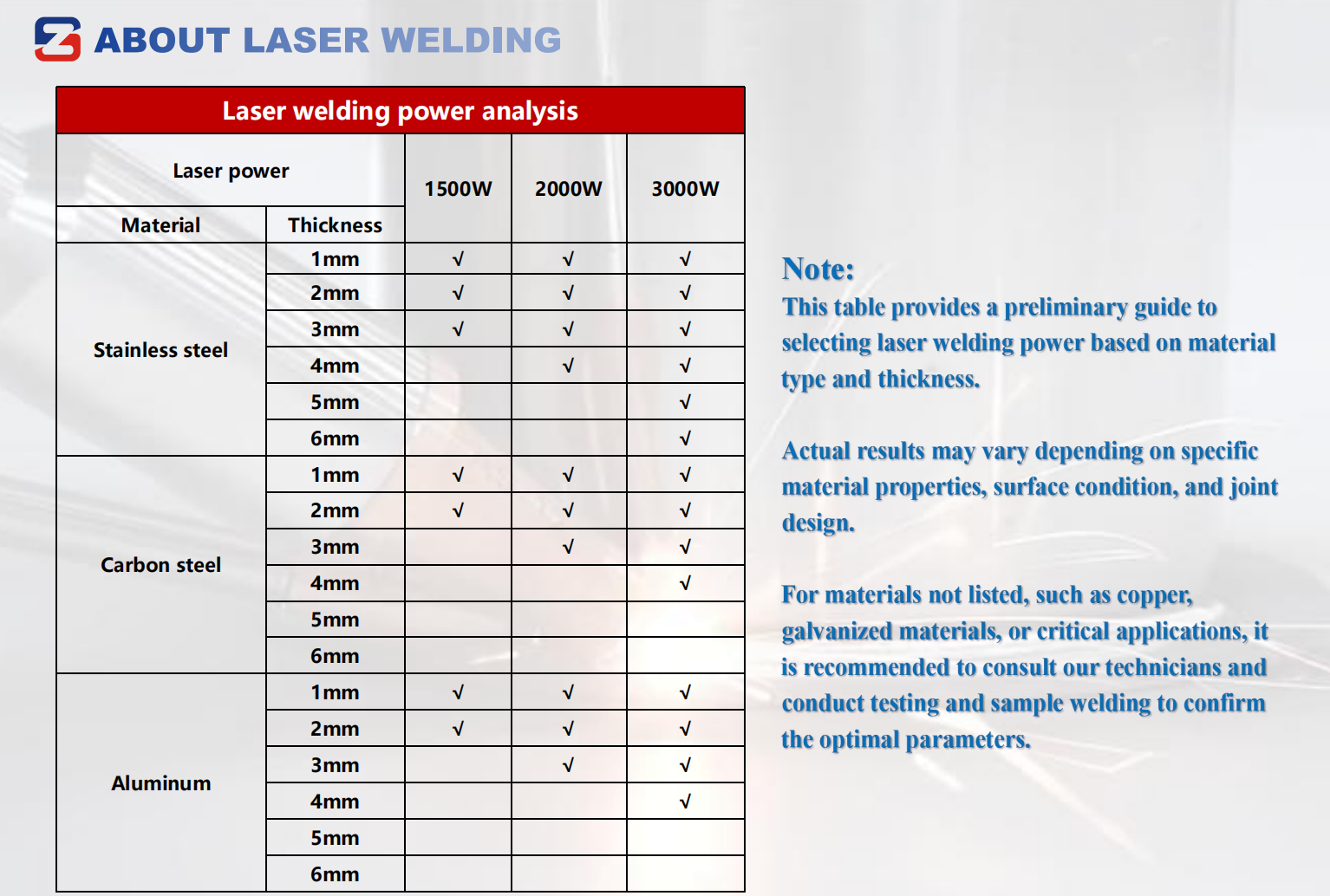
Laser welding power selection for different material thicknesses
2. Consider the Welding Head
The welding head directly affects beam delivery and operator experience.Look for:
- Stable optical performance
- Reliable protective lenses
- Appropriate wobble function
- Good cooling
- Comfortable operation
- Easy maintenance
Replacement lens and nozzle availability should also be considered.
3. Select the Right Cooling System
The cooling system should match the laser source and expected working conditions.For higher-power machines or long operating periods, adequate water cooling is particularly important.
4. Decide Whether You Need a Wire Feeder
If most joints have good fit-up and can be welded by melting the base materials, wire feeding may not always be necessary.For larger gaps or applications requiring additional weld metal, a wire feeder can be valuable.
5. Consider the Laser Source
When comparing machines, do not focus only on the nominal laser power.Also consider:
- Output stability
- Beam quality
- Reliability
- Service support
- Replacement cost
- Availability of technical assistance
Finally, I’ll give you a straightforward purchasing strategy: buy the configuration recommended by ZS Laser, and you’ll basically avoid major problems.
Laser brands: IPG, Max, or Raycus.
Water cooling system brands: Hanli or S&A.
Welding torch brands: Superpower, Qilin, Ruifa.
Choosing the right components for these major parts will ensure a smooth machine experience. At ZS Laser, we default to a wire feeder configuration, with single and dual wire feed options available. All other accessories are also from top-tier brands. By choosing us, you can save a lot of time and effort, and avoid after-sales issues.
Frequently Asked Questions About Hand Held Fiber Laser Welders
Is a Hand Held Fiber Laser Welder Worth Buying?
A hand held fiber laser welder can be a valuable investment for manufacturers who perform a significant amount of metal welding, especially thin and medium-thickness sheet metal fabrication.It can be particularly attractive when the manufacturer wants to:
- Increase welding productivity
- Reduce thermal distortion
- Improve weld appearance
- Reduce post-weld finishing
- Process stainless steel efficiently
- Improve production consistency
However, it may not be the best solution for every application.Traditional MIG or TIG welding can remain more economical for certain repair jobs, thick materials, large joint gaps, or applications with a low production volume.The correct decision should therefore be based on material, thickness, joint design, production volume, required weld quality, and total operating cost.
Handheld Laser Welding Safety
A handheld fiber laser welder is a high-power laser system and requires appropriate safety controls.Operators should follow the equipment manufacturer’s safety requirements and applicable local regulations.Depending on the installation and operating environment, laser safety measures may include:
- Appropriate laser protective eyewear
- Controlled welding areas
- Protective barriers or enclosures
- Proper warning signs
- Suitable operator training
- Fume extraction and ventilation
- Appropriate fire prevention measures
Handheld laser welding should never be treated as simply another type of conventional welding gun.Proper laser safety planning is an essential part of installing and operating the equipment.
Can a handheld fiber laser welder weld aluminum?
Yes, but aluminum generally requires more careful process development because of its thermal conductivity, reflectivity, alloy characteristics, and potential porosity or cracking.
Does laser welding require filler wire?
Not always. Many laser welding applications can be performed without filler wire when joint fit-up is good. A wire feeder can be used when additional weld metal is required.At ZS Laser, we will equip the machine with a wire feeder by default.
Is a handheld laser welder better than TIG?
Neither process is universally better. Handheld laser welding can offer higher productivity and lower heat input in many applications, while TIG remains excellent for precise manual welding and applications where lower equipment cost is important.
Is a handheld laser welder better than MIG?
It depends on the application. Laser welding can provide concentrated heat input, low spatter, and narrow welds, while MIG is highly versatile and well suited to many thicker-material and filler-metal applications.
How much power does a handheld fiber laser welder need?
Common machines are available in configurations such as 1000W, 1500W, 2000W, and 3000W. The appropriate power should be selected according to material, thickness, joint design, penetration requirements, and welding speed.
Conclusion
A hand held fiber laser welder combines the flexibility of manual welding with the concentrated energy of fiber laser technology.For suitable applications, it can provide high welding speed, narrow welds, low heat input, reduced distortion, and good production consistency. Stainless steel is particularly well suited to the process, while aluminum, galvanized steel, and certain carbon or high-strength steels may require more careful process development.
ZS Laser has been deeply involved in the laser equipment field for over ten years. We have extensive experience in project collaboration and can recommend the most suitable products for your application scenario. If you need assistance with your welding project, please feel free to contact us.

WhatsApp
Scan the QR Code to start a WhatsApp chat with us.