 ZS Laser Equipment

Offshore welding plays an important role in the construction, maintenance, and repair of marine and offshore structures.Unlike welding in a conventional workshop, offshore welding often takes place in environments where space, weather, accessibility, transportation, and operating conditions can make welding much more difficult.
Welders may work on offshore platforms, ships, subsea structures, pipelines, marine equipment, and offshore energy facilities. In many maintenance situations, equipment must be transported to the work location instead of bringing the workpiece back to a workshop.This makes mobility and equipment flexibility particularly important.
In this guide, we will look at what offshore welding involves, where it is used, which welding processes are commonly applied, and what types of welding equipment are suitable for offshore work.
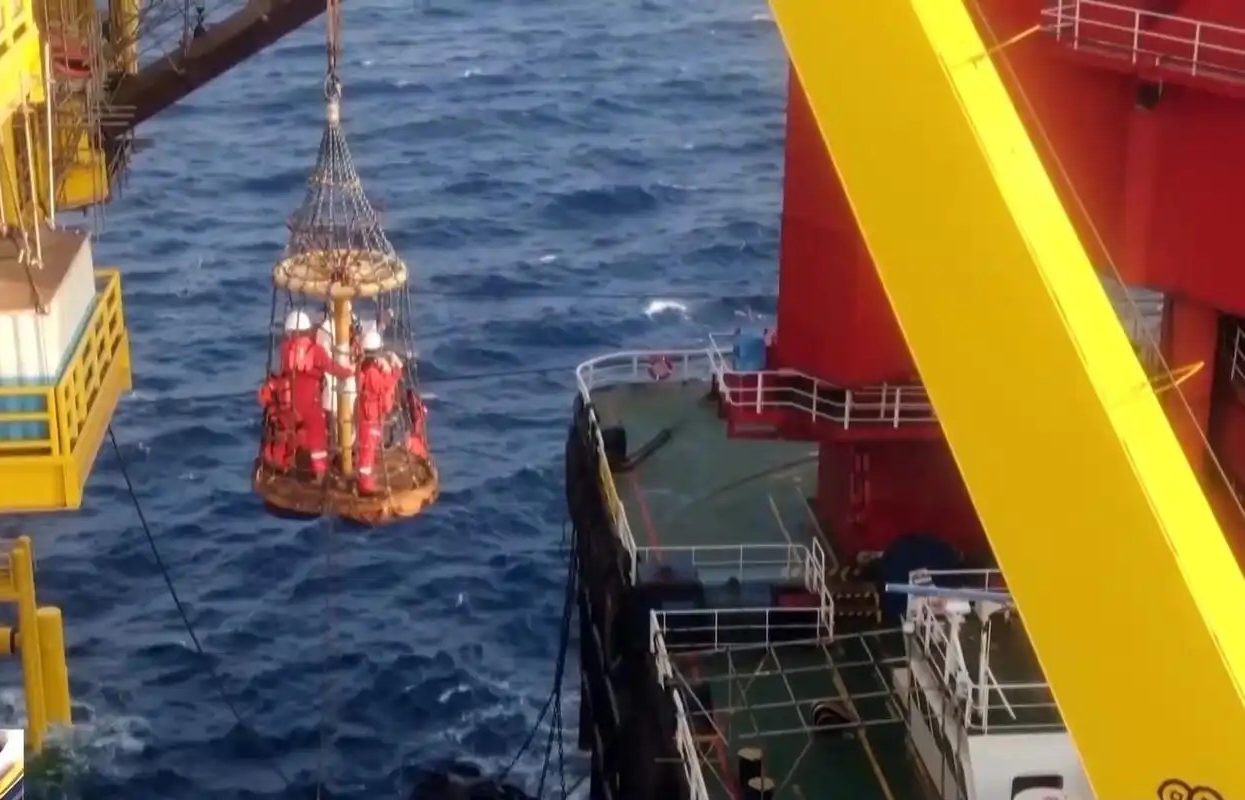
Offshore oil and gas platforms
What Is Offshore Welding?
Offshore welding refers to welding, fabrication, maintenance, and repair work carried out on offshore or marine structures and equipment.The term can cover a wide range of working environments, including:
- Offshore oil and gas platforms
- Offshore wind structures
- Ships and vessels
- Marine pipelines
- Offshore processing equipment
- Subsea structures
- Marine terminals
- Floating structures
- Offshore maintenance facilities
Offshore welding does not necessarily mean underwater welding.A large amount of offshore welding is performed above the waterline under normal atmospheric conditions. Underwater welding is a specialized category used when repairs or fabrication must be performed below the water surface. Wet and dry underwater welding require specialized procedures, equipment, and trained personnel.
Where Is Offshore Welding Used?
Offshore welding is primarily used wherever metal structures need to be constructed, maintained, modified, or repaired in a marine environment.
1. Offshore Oil and Gas Platforms
Offshore oil and gas platforms are among the most demanding applications for offshore welding.Welding may be required for:
- Structural members
- Platform supports
- Brackets
- Handrails
- Pipe supports
- Process piping
- Equipment foundations
- Tanks and vessels
- Maintenance repairs
The offshore platforms contain large amounts of welded steel structures. During their service life, corrosion, fatigue, accidental damage, and equipment modifications can create requirements for repair and maintenance welding.Because these structures are permanently installed offshore, transporting components back to shore is often impractical.Portable welding equipment can therefore be particularly valuable for maintenance teams.
2. Shipbuilding and Ship Repair
Ship repair is another major application of offshore and marine welding.Welding may be required for:
- Hull repairs
- Deck structures
- Bulkheads
- Pipe systems
- Brackets
- Machinery foundations
- Exhaust systems
- Storage tanks
- Marine equipment
Ship repair frequently involves working in confined or difficult-to-access areas.For this reason, portable welding machines are widely used for onboard maintenance and repair work. Marine welding equipment is commonly designed to be transported around the vessel rather than permanently installed in one workshop.
3. Offshore Wind Turbines
Offshore wind farms have created another growing application for offshore welding.Welding and repair work can be associated with:
- Tower structures
- Foundations
- Transition pieces
- Platforms
- Access structures
- Maintenance components
- Auxiliary steel structures
The offshore wind equipment is exposed to saltwater, wind, humidity, and cyclic mechanical loads.As a result, maintenance and repair activities may be required during the service life of the installation.
4. Offshore Pipelines
Pipelines are another important offshore welding application.Depending on the project, welding may be involved in:
- Pipeline fabrication
- Pipeline installation
- Pipe spool fabrication
- Repair work
- Structural supports
- Connections and modifications
Pipeline welding requires careful control because weld integrity can directly affect the reliability of the pipeline system.For subsea pipeline repair, specialized underwater or hyperbaric welding technologies may be required rather than conventional surface welding.
5. Marine and Offshore Maintenance
Not all offshore welding involves major structural fabrication.A large amount of work consists of relatively small maintenance tasks.Examples include:
- Repairing brackets
- Reinforcing damaged structures
- Repairing frames
- Fixing supports
- Repairing equipment housings
- Modifying steel structures
- Repairing corrosion damage
- Fabricating replacement components
These jobs often benefit from portable welding equipment because the welding machine needs to move with the maintenance team.
Common Welding Processes for Offshore Welding
Different offshore applications require different welding processes.There is no single welding method suitable for every offshore job.
Stick Welding / MMA Welding
MMA or stick welding remains a practical choice for many offshore repair applications.Its advantages include:
- Simple equipment
- Good portability
- No external shielding gas required
- Suitable for outdoor work
- Suitable for many structural steel repairs
This makes it particularly useful when working conditions make shielding gas difficult to manage.
MIG Welding
MIG welding can provide higher productivity than stick welding and is useful for suitable fabrication and repair applications.It can be used for:
- Structural components
- Steel fabrication
- Equipment repair
- General maintenance
- Production welding
However, shielding gas and wire-feeding equipment make MIG welding somewhat more sensitive to wind and environmental conditions than stick welding.For exposed offshore locations, appropriate shielding and working conditions are therefore important.
TIG Welding
TIG welding provides excellent control and can produce high-quality welds.It is commonly considered when welding:
- Stainless steel
- Aluminum
- Thin materials
- Precision components
- Critical joints
However, TIG is generally slower and requires more operator skill than some other welding processes.
Portable Welding Machines for Offshore Work
For offshore maintenance, portability can be just as important as welding power.A welding machine may need to be transported:
- Across a vessel
- Onto an offshore platform
- Into a confined maintenance area
- Between different work locations
- To remote repair sites
This is why compact and robust welding equipment is particularly valuable.A multi-function portable welding machine can be an efficient choice when maintenance teams need to handle different types of welding work.Depending on the machine configuration, one unit may support processes such as:
- MMA
- MIG
- TIG
- Cutting Fuctions
Multi-process equipment can reduce the number of machines that need to be transported and make field maintenance more flexible.Portable welding equipment is already used for onboard ship maintenance and offshore applications, with manufacturers emphasizing mobility, compact design, and versatility.
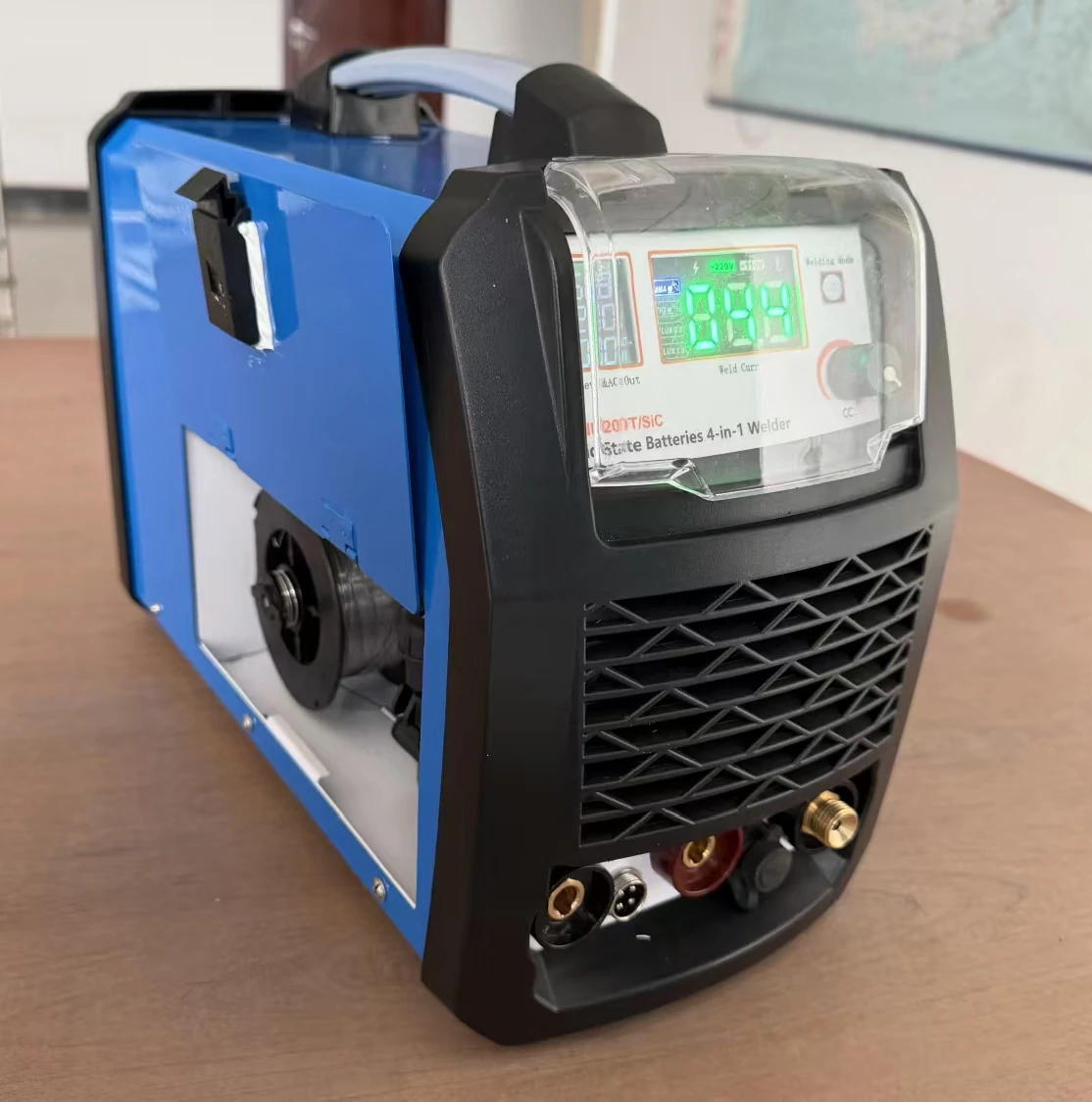
Portable stick welder
Laser Welding for Offshore Applications
Laser welding can also be considered for certain offshore fabrication and maintenance applications.Unlike conventional arc welding, laser welding uses a concentrated beam of energy to create the weld.Potential advantages include:
- High welding speed
- Concentrated heat input
- Narrow weld width
- Low thermal distortion
- Consistent weld quality
- Easy automation
It can be particularly attractive when working with suitable stainless steel, carbon steel, and other compatible materials in controlled conditions.However, laser welding is not automatically suitable for every offshore repair job.Material, thickness, joint design, surface condition, accessibility, and required weld penetration all need to be considered.
For offshore field work, a handheld laser welding machine may be suitable for certain accessible applications, while automated laser welding systems may be more appropriate for controlled fabrication environments.Laser welding should also be used with appropriate laser safety controls and a properly controlled work area.
What Should You Consider When Choosing Offshore Welding Equipment?
Offshore welding equipment needs to perform reliably in demanding working environments.Important factors include:
Portability
The machine should be practical to transport between different working areas.
Welding Processes
A multi-process machine can be useful when the team performs different types of repair work.
Power Supply
The equipment should be compatible with the available electrical power on the vessel, platform, or worksite.
Durability
Offshore equipment may be exposed to vibration, humidity, salt, dust, and difficult working conditions.
Weight and Size
Compact equipment can significantly simplify transportation and installation.
Welding Performance
The machine should provide stable output and appropriate control for the required materials and thicknesses.
Safety
Offshore hot work requires appropriate permits, isolation procedures, fire prevention, ventilation, PPE, and other site-specific controls. Welding and cutting operations can involve fire, fumes, burns, electrical hazards, and other risks.
Offshore Welding vs. Underwater Welding
These terms are sometimes confused.
Offshore welding is a broad term covering welding work performed in offshore and marine environments.
While underwater welding specifically refers to welding below the water surface.
Underwater welding can be divided broadly into:
- Wet welding
- Dry or hyperbaric welding
Wet welding is performed directly underwater using specialized equipment and procedures, while dry welding uses a controlled dry environment around the welding area.Because underwater welding involves diving, electrical hazards, water pressure, visibility limitations, and specialized welding procedures, it should not be treated as an ordinary portable welding application.
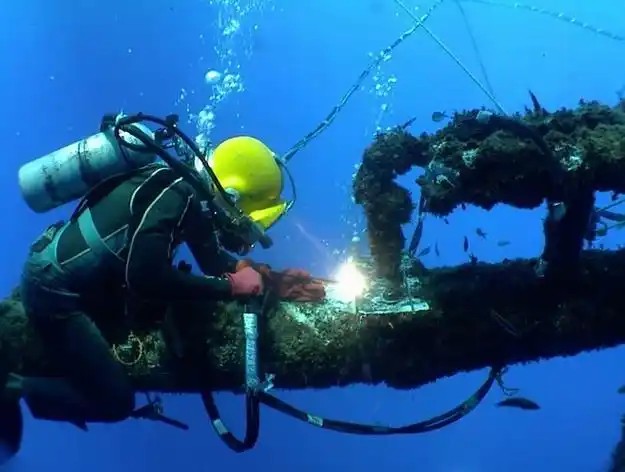
Submarine welding operations
How to Choose the Right Offshore Welding Machine
For many offshore maintenance and repair applications, portability, independence from external power, and multifunctional capability are more important than simply choosing a high-power welding machine.A portable welding machine should be easy to transport around offshore platforms, vessels, pipelines, and other remote work areas. It should also provide enough welding power for common repair work while minimizing the need to carry additional equipment.
Portable Stick Welder with Plasma Cutter
For general offshore maintenance, repair, and field fabrication, a battery-powered portable stick welder with an integrated plasma cutter can be a practical solution.
The machine combines MMA stick welding, plasma cutting, and a built-in battery power system in one compact unit. The model featured by ZS Laser provides up to 180A welding current, supports 2.5–4.0 mm electrodes, and includes a 50A plasma cutting function with a maximum cutting thickness of up to 25 mm for carbon steel.
Its integrated 2200Wh battery allows welding and cutting without relying directly on a grid power connection or carrying a separate generator. At approximately 17.7 kg, the machine can also be transported relatively easily between different work locations.
This makes it particularly interesting for offshore applications such as:
- Platform maintenance
- Ship repair
- Pipeline maintenance
- Structural steel repair
- Emergency field repairs
- Offshore equipment maintenance
Another advantage is that cutting and welding can be performed with the same machine. For example, a damaged section can be cut out with the plasma cutter before a replacement component is welded into position.
For more demanding applications requiring high-speed precision welding or automated production, laser welding machines can also be considered. However, for mobile offshore repair work where power availability, transportation, and versatility are major concerns, a compact battery-powered welding and cutting machine can be a particularly practical choice.
Conclusion
Offshore welding covers a wide range of construction, repair, and maintenance applications, from oil and gas platforms and ships to offshore wind structures and marine pipelines.
Because offshore work often involves difficult access and remote locations, portable, reliable, and versatile welding equipment is particularly valuable.
For general offshore maintenance, a portable multi-function welding machine can provide flexibility for different welding tasks. For suitable applications requiring higher speed, lower heat input, and precise weld control, laser welding machines can offer another solution.
The right equipment ultimately depends on the material, thickness, welding position, working environment, production requirements, and applicable welding procedures.
Offshore Welding Equipment from ZS Laser
ZS Laser can provide different welding equipment solutions for industrial and offshore-related fabrication and maintenance applications, including portable multi-function welding machines and laser welding machines.
If you need a welding machine with specific power, welding processes, size, or configuration, contact ZS Laser to discuss a suitable solution.

WhatsApp
Scan the QR Code to start a WhatsApp chat with us.