 ZS Laser Equipment

When a plastic part is cracked, broken, or needs to be permanently joined, there are several ways to repair or weld it. Two methods that are sometimes compared are plastic staple welding and plastic laser welding.Although both can be used with plastic components, they are designed for very different purposes.
A plastic staple welder is mainly used for repairing cracked or broken plastic parts. It uses heated metal staples to reinforce the damaged area.
Plastic laser welding, on the other hand, is an industrial joining process that uses laser energy to melt compatible plastic materials at the joint. It does not require metal staples and can produce clean, precise, and repeatable welds.
So, which one is better?
The answer depends on your application. If you need to repair a cracked bumper or broken plastic component at a low cost, a plastic staple welder can be an effective solution. If you are manufacturing plastic components and need clean welds, reliable sealing, high repeatability, or automated production, plastic laser welding is usually the better choice.
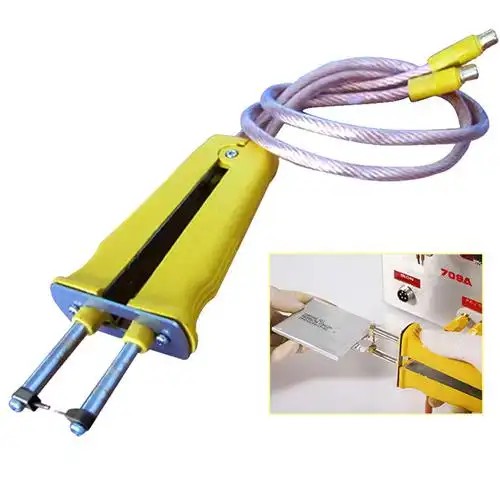
plastic staple welder
What Is a Plastic Staple Welder?
A plastic staple welder, also called a hot staple plastic welder or plastic repair welder, is a tool designed primarily for repairing cracked and broken plastic parts.Instead of melting the two plastic parts together across the entire joint, the machine heats a metal staple and pushes it into the plastic.
The heated staple melts into the surrounding plastic and becomes embedded in the damaged area. After cooling, the staple mechanically reinforces the crack or broken section.A typical repair process includes:
- Align the cracked or broken plastic parts.
- Place a suitable metal staple across the damaged area.
- Heat the staple with the welding tool.
- Push the heated staple into the plastic.
- Allow the plastic to cool.
- Cut or finish the excess material if necessary.
This process is relatively simple and does not require complicated equipment.
Common Applications of Plastic Staple Welding
Plastic staple welders are commonly used for repairing:
- Automotive bumpers
- Motorcycle fairings
- Plastic body panels
- Plastic brackets
- Plastic housings
- Broken mounting tabs
- Plastic containers
- Household plastic products
- Various cracked plastic components
The major advantage is that the staple provides additional mechanical reinforcement to the damaged area.
For repair shops and maintenance applications, this can be a fast and economical method.
What Is Plastic Laser Welding?
Plastic laser welding is a non-contact joining process that uses laser energy to create heat at the interface between compatible plastic components.Instead of inserting a metal staple into the plastic, laser welding joins the plastic materials themselves.In a typical through-transmission laser welding process, one plastic component allows the laser wavelength to pass through it, while the second component absorbs the laser energy.
The absorbed energy generates localized heat at the interface, causing the plastic to melt. When the laser moves away and the material cools, the two components form a welded joint.A simplified structure looks like this:Laser → Transparent/Transmitting Plastic → Absorbing Plastic → Weld Interface
Because the laser energy can be concentrated into a relatively small area, plastic laser welding can provide precise and controlled joining.There is also no metal staple or additional filler material left inside the plastic.
Plastic Staple Welder vs Plastic Laser Welding
The biggest difference is their intended purpose.A plastic staple welder is primarily a repair tool, while plastic laser welding is primarily an industrial joining technology.
| Feature | Plastic Staple Welder | Plastic Laser Welding |
|---|---|---|
| Main purpose | Plastic repair | Plastic joining |
| Process | Heated metal staple | Laser-induced melting |
| Metal staple | Required | Not required |
| Contact process | Yes | Non-contact |
| Appearance | Visible repair points | Clean and low-profile weld |
| Precision | Low to medium | High |
| Automation | Limited | Excellent |
| Production consistency | Operator dependent | Highly repeatable |
| Mass production | Limited suitability | Highly suitable |
| Initial investment | Relatively low | Higher |
| Repair applications | Excellent | Usually unnecessary |
| Cosmetic products | Limited | Excellent |
| Sealing applications | Limited | Excellent |
| Production-line integration | Limited | Excellent |
This comparison shows why these two technologies should not simply be treated as competing machines.
They solve different problems.
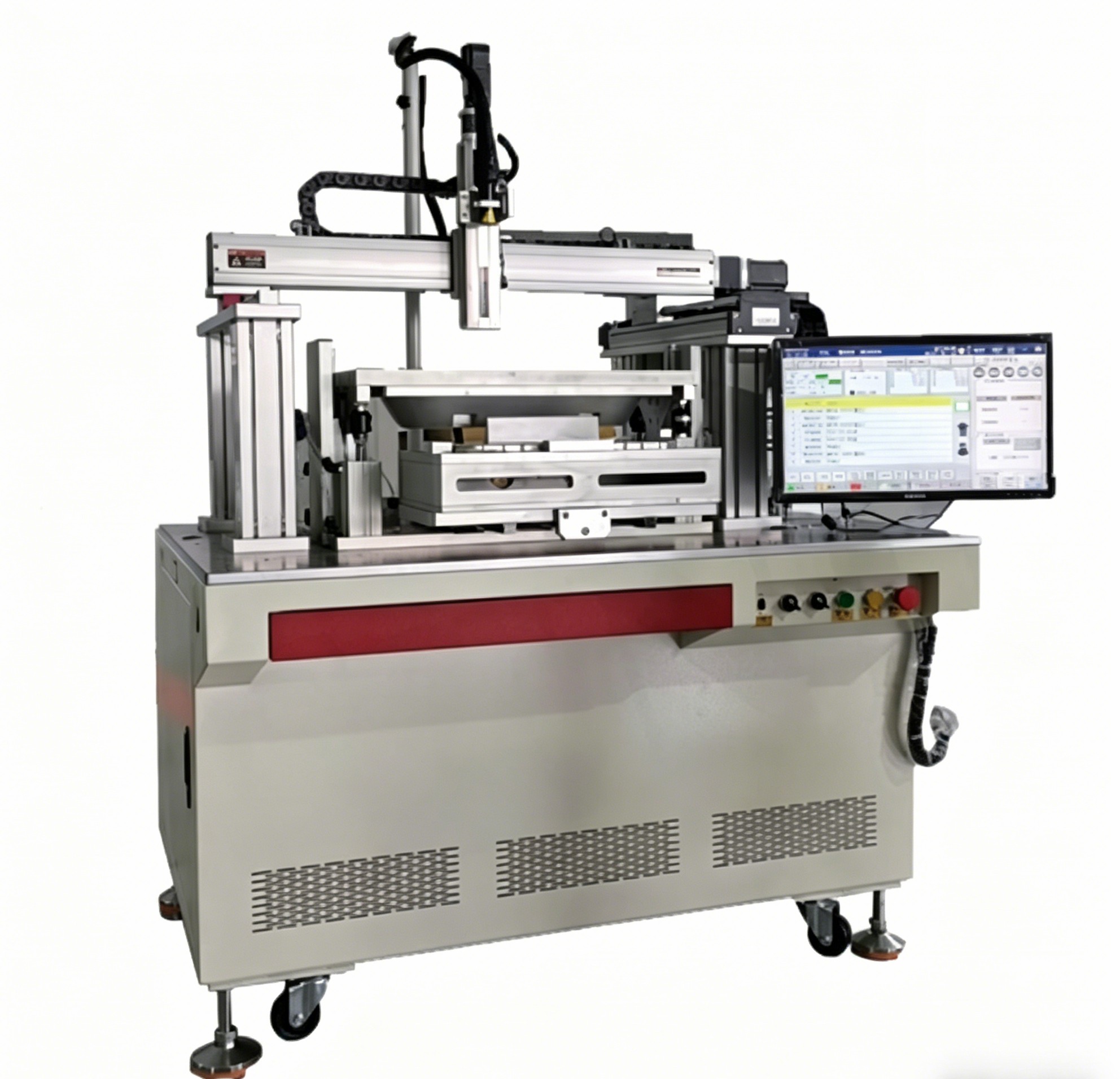
Gantry-type single-station plastic welding machine
Plastic Staple Welder: Best for Plastic Repair
If you have a cracked or broken plastic component and need to repair it quickly, a plastic staple welder can be a very practical choice.For example, imagine a cracked automotive bumper.The objective is not necessarily to create a completely invisible factory-quality weld. The main goal is to restore the structural integrity of the damaged area quickly and economically.In this situation, a plastic staple can provide additional reinforcement across the crack.
Advantages of a Plastic Staple Welder
A plastic staple welder offers several advantages for repair applications:
Low Equipment Cost
Compared with industrial plastic laser welding equipment, plastic staple welding tools have a much lower initial investment.
Simple Operation
The basic process is easy to understand, making the technology accessible to repair technicians.
Fast Repair
Cracks and broken sections can often be reinforced quickly without complicated fixtures or programming.
Strong Mechanical Reinforcement
The embedded metal staple provides additional mechanical reinforcement to the damaged area.
Suitable for Irregular Cracks
A staple can be placed across irregular cracks and broken sections where a controlled laser welding process may not be practical.
For these reasons, plastic staple welding remains useful for automotive repair, maintenance, and other repair-oriented applications.
Plastic Laser Welding: Best for Manufacturing
Plastic laser welding becomes more attractive when the objective changes from repairing a damaged part to manufacturing a finished plastic product.Manufacturers may need to join hundreds, thousands, or even millions of plastic components with consistent results.In this situation, the advantages of laser welding become much more important.
Clean Welding Without Metal Staples
Plastic laser welding does not require metal staples.The plastic components are joined directly at the interface, which helps maintain a clean appearance and avoids introducing another material into the assembly.
High Precision
Laser energy can be accurately controlled and concentrated along the required welding path.This makes laser welding suitable for components where dimensional accuracy and controlled heat input are important.
Repeatable Results
Once suitable welding parameters have been developed, the same process can be repeated from one workpiece to the next.This is particularly valuable in industrial manufacturing, where consistent quality is essential.
Easy Automation
Plastic laser welding can be integrated with:
- Robotic systems
- Automatic fixtures
- Vision systems
- Linear stages
- Production lines
- Automated loading and unloading systems
This makes it suitable for high-volume manufacturing.
Which Is Better for Automotive Plastic Parts?
The answer depends on whether you are repairing or manufacturing the automotive component.
Automotive Plastic Repair
For repairing a cracked bumper, broken bracket, or damaged plastic body panel, a plastic staple welder is often a simple and economical solution.Typical examples include:
- Cracked bumpers
- Broken mounting tabs
- Damaged motorcycle fairings
- Cracked plastic panels
- Broken brackets
The metal staple reinforces the damaged area and helps restore the part’s structural integrity.
Automotive Plastic Manufacturing
For manufacturing automotive components, plastic laser welding can be much more suitable.Automotive manufacturers may need to join:
- Sensor housings
- Lighting components
- Fluid containers
- Plastic housings
- Electronic components
- Interior components
- Engine-related plastic components
Manufacturing applications often require clean welds, repeatability, sealing, and automated production.
These requirements are better suited to laser welding technology.
Plastic Staple Welder vs Laser Welding: Which Has Better Appearance?
Appearance is another major difference.With plastic staple welding, the metal staples remain embedded in the repaired plastic. Even if the area is subsequently trimmed or finished, the repair may still be visible.This is acceptable for many repair applications because structural restoration is more important than appearance.
Plastic laser welding can provide a much cleaner result.Because there is no metal staple, the joint can have a more uniform appearance. With appropriate material selection, joint design, and laser parameters, the weld can be narrow and minimally visible.This makes laser welding attractive for products where appearance matters.
Examples include:
- Consumer electronics
- Automotive components
- Medical components
- Household products
- Transparent plastic assemblies
- Precision plastic housings
If cosmetic quality is a major requirement, plastic laser welding generally has a significant advantage over staple welding.
Which Method Provides a Stronger Plastic Joint?
It is difficult to say that one method is always stronger.The final strength of a plastic joint depends on many factors, including:
- Plastic material
- Material compatibility
- Joint design
- Welding area
- Welding parameters
- Temperature
- Cooling conditions
- Surface preparation
- Part geometry
Plastic staple welding creates mechanical reinforcement using a metal staple.
Plastic laser welding creates a welded interface between the plastic components themselves.
For properly designed laser-welded parts, the joint can provide excellent mechanical strength and, depending on the design and materials, reliable sealing performance.Therefore, strength should be evaluated through actual sample testing rather than simply comparing the two technologies by name.
Which Plastics Can Be Laser Welded?
Not every plastic can be laser welded directly.Successful plastic laser welding generally requires suitable material compatibility and appropriate optical characteristics.Commonly processed plastics may include:
- ABS
- PC
- PA
- PBT
- PP
- PE
- PMMA
- PET
- TPU
- TPE
However, the fact that two plastics belong to the same general material family does not automatically mean they can be laser welded successfully.The material formulation can contain:
- Pigments
- Fillers
- Reinforcing fibers
- Additives
- Coatings
These can significantly affect laser transmission and absorption.Therefore, material identification and sample testing are important before selecting a plastic laser welding machine.
How Does Through-Transmission Plastic Laser Welding Work?
One of the most common approaches to plastic laser welding is through-transmission laser welding.The basic concept requires two plastic components with different optical characteristics.The upper component needs to transmit the selected laser wavelength, while the lower component absorbs the laser energy.
When the laser passes through the transmitting material, it reaches the interface and is absorbed by the lower material.This generates localized heat and melts the joining surfaces.After the laser stops or moves away, the molten plastic cools and forms the welded joint.This process can produce a controlled weld without heating the entire component.That is one of the major reasons plastic laser welding can achieve low deformation and clean results compared with some conventional plastic joining methods.
Common Plastic Laser Welding Methods
Plastic laser welding is not limited to one process.Depending on the application, different welding methods can be used.
Contour Welding
In contour welding, the laser follows a predefined welding path around the joint.It is suitable for relatively simple shapes and applications where the laser can follow the required contour.
Quasi-Simultaneous Welding
The laser rapidly scans the welding area multiple times.This approach can provide relatively uniform heating and is useful for certain production applications.
Simultaneous Welding
In simultaneous welding, multiple areas of the joint can be processed at the same time using an appropriate optical system.This can be useful when high production efficiency is required.The best welding method depends on the component geometry, joint design, material, production volume, and required cycle time.
Plastic Staple Welder vs Plastic Laser Welding Cost
Initial equipment cost is one area where the plastic staple welder has a clear advantage.A plastic staple welding tool is relatively inexpensive and requires limited supporting equipment.Plastic laser welding systems have a higher initial investment because the system may include:
- Laser source
- Laser optics
- Welding head
- Motion system
- Fixtures
- Control system
- Safety enclosure
- Vision system
- Automation equipment
However, machine price should not be the only consideration for industrial manufacturing.For mass production, manufacturers should also consider:
- Labor cost
- Cycle time
- Scrap rate
- Product consistency
- Automation
- Maintenance
- Finishing requirements
- Production capacity
A higher initial investment in plastic laser welding may be justified when the production volume is high and the process requires automation and consistent quality.
Plastic Staple Welder vs Plastic Laser Welding: Which Should You Choose?
The easiest way to choose between the two is to first identify your application.
| Application | Recommended Method |
| Repair a cracked bumper | Plastic Staple Welder |
| Repair broken plastic parts | Plastic Staple Welder |
| Repair plastic brackets | Plastic Staple Welder |
| Low-cost plastic repair | Plastic Staple Welder |
| Cosmetic plastic products | Plastic Laser Welding |
| High-volume manufacturing | Plastic Laser Welding |
| Automated production | Plastic Laser Welding |
| Precision plastic components | Plastic Laser Welding |
| Sealed plastic housings | Plastic Laser Welding |
| Electronic housings | Plastic Laser Welding |
| Medical plastic components | Plastic Laser Welding |
| Industrial plastic assemblies | Plastic Laser Welding |
In simple terms:
Choose a plastic staple welder when you need to repair a damaged plastic component.
Choose plastic laser welding when you need to manufacture plastic components with clean, precise, repeatable, and potentially automated joining.
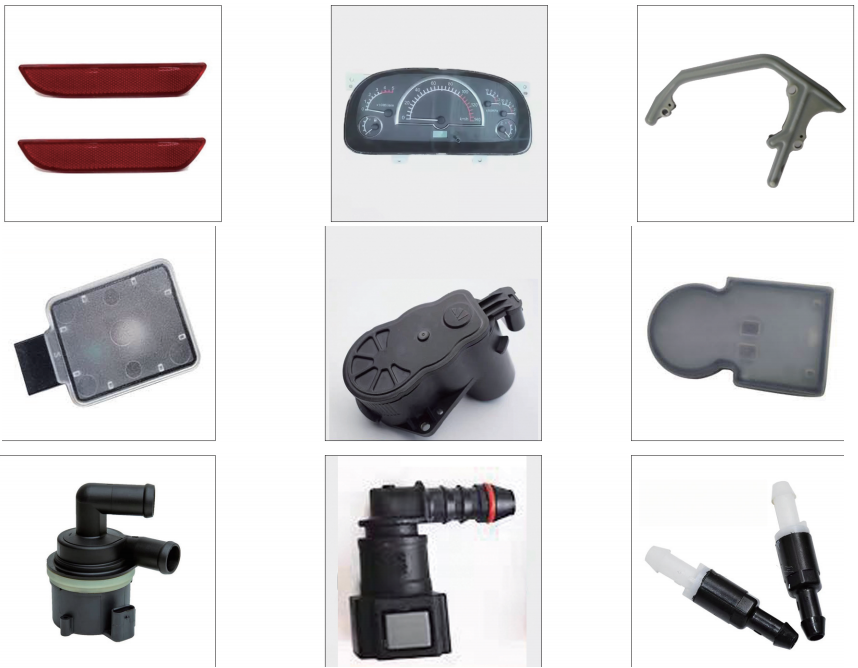
Automotive parts welding samples
Can Your Plastic Parts Be Laser Welded?
Before purchasing a plastic laser welding machine, it is important to confirm that your materials and product design are suitable for laser welding.The most important information includes:
- Plastic material
- Material color
- Part dimensions
- Joint design
- Required welding strength
- Required sealing performance
- Welding area
- Production volume
- Required cycle time
Because different plastics and product designs behave differently under laser energy, sample testing is recommended before finalizing the machine configuration.A practical test can determine:
- Whether the materials can be welded
- Suitable laser power
- Welding speed
- Laser spot size
- Clamping pressure
- Welding method
- Expected weld quality
- Production cycle time
Conclusion
Plastic Staple Welder vs Plastic Laser Welding is not simply a question of which technology is better.They are designed for different applications.
A plastic staple welder is an economical and practical choice for repairing cracked and broken plastic components, especially automotive bumpers, brackets, body panels, and other irregular plastic parts.
Plastic laser welding is a more advanced joining technology for manufacturers that need clean welds, precise processing, repeatable results, reliable sealing, and production-line automation.
If you are repairing plastic parts, a plastic staple welder may be all you need.If you are manufacturing plastic products and need a professional joining process, plastic laser welding can provide a more suitable long-term solution.
If you are considering plastic laser welding for your products, send us your plastic material, product drawings or photos, welding area, and production requirements. ZS Laser can evaluate the application and recommend a suitable plastic laser welding solution.

WhatsApp
Scan the QR Code to start a WhatsApp chat with us.