 ZS Laser Equipment

A welding turntable is a rotating positioning device designed to rotate a workpiece during welding. Instead of requiring the operator or welding torch to move continuously around the workpiece, the turntable rotates the part at a controlled speed, helping maintain a more consistent welding position and travel speed.
Welding turntables are commonly used for pipe welding, flange welding, tank fabrication, cylindrical components, circular seam welding, and automated welding applications. They can be used with MIG, TIG, laser welding, and robotic welding systems.However, not all welding turntables are the same. The motor, gearbox, bearing system, turntable structure, controller, load capacity, and workholding system can significantly affect performance.
For standard applications, an off-the-shelf welding turntable may be sufficient. For large, heavy, eccentric, or automated workpieces, a custom welding turntable may be required.
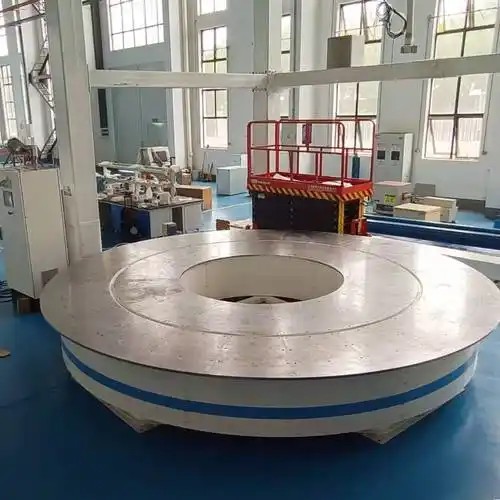
Welding Turntable
What Is a Welding Turntable?
A welding turntable is essentially a motor-driven rotary platform that holds and rotates a workpiece during welding.
Its main functions are to:
- Rotate the workpiece at a controlled speed
- Maintain a consistent welding position
- Reduce manual repositioning
- Improve welding repeatability
- Make circular and circumferential welding easier
- Support semi-automatic and automatic welding
A welding turntable does not normally perform the welding itself. Instead, it provides controlled workpiece movement while the welding operator, welding torch, laser head, or robot performs the welding operation.
Depending on the design, a welding turntable can be used with:
- MIG welding machines
- TIG welding machines
- Laser welding machines
- Robotic welding systems
- Automatic welding equipment
For example, when welding a cylindrical component, the workpiece can rotate while the welding torch remains in a relatively fixed position. This can make it easier to maintain a consistent welding speed around the circumference.
What Are the Core Components of a Welding Turntable?
The basic concept of a welding turntable is simple, but its performance depends heavily on the quality and design of its components.
Rotary Drive System
The rotary drive system provides the torque required to rotate the workpiece.
Common components include:
- Motor
- Gearbox
- Speed controller
- Servo drive or stepper drive
A good drive system should provide smooth rotation, especially at low speeds.
For welding applications, excessive speed fluctuation can affect weld consistency. This is particularly important for processes such as laser welding, where the welding area is relatively small and precise control of movement is required.
Turntable Plate
The turntable plate is the main platform on which the workpiece or fixture is mounted.
Important specifications include:
- Table diameter
- Maximum load
- Plate thickness
- Surface flatness
- Mounting-hole pattern
- Structural rigidity
A larger or heavier workpiece does not simply require a larger table. The structure underneath the table must also be designed to support the load without excessive deformation or vibration.
Chuck and Workholding System
The workholding system secures the workpiece during rotation.
Depending on the application, a welding turntable may use:
- Three-jaw chucks
- Four-jaw chucks
- Clamps
- Bolted fixtures
- Pneumatic fixtures
- Custom workholding fixtures
For pipe and cylindrical welding, a chuck may be used to hold the workpiece concentrically. For irregular components, a custom fixture may provide better positioning and stability.
Controller
The controller determines how the turntable operates.
A basic system may provide:
- Start and stop
- Forward and reverse rotation
- Rotation-speed adjustment
More advanced systems can include:
- Servo control
- Foot-pedal control
- PLC control
- Programmable rotation
- Welding-machine synchronization
- Robot integration
For automated laser or robotic welding, the control system becomes particularly important because the turntable may need to communicate with the welding system.
Welding Machine Interface
For production applications, the welding turntable may need to work together with the welding equipment.
Depending on the process, it can be integrated with:
- MIG welding systems
- TIG welding systems
- Laser welding systems
- Robotic welding cells
The goal is not simply to rotate the workpiece, but to coordinate movement with the welding process.
What Makes a Good Welding Turntable?
A low-cost welding turntable may look similar to a high-quality unit from the outside, but important differences can exist in the drive system, structure, bearings, control system, and manufacturing accuracy.
Stable Rotation
A good welding turntable should rotate smoothly without noticeable jerking or sudden speed changes.
Stable rotation is particularly important for circular seam welding because changes in travel speed can affect weld appearance and process consistency.
Low-Speed Performance
Some welding applications require relatively slow and controlled rotation.
A poor drive system may produce:
- Jerky movement
- Speed fluctuations
- Difficulty maintaining low-speed rotation
A properly selected motor and gearbox can provide more stable movement across the required speed range.
Structural Rigidity
The turntable must resist deformation under load.
If the platform or supporting structure is too weak, the workpiece may move or vibrate during welding.
This can become especially problematic with:
- Large workpieces
- Long workpieces
- Heavy fixtures
- Eccentric loads
Positioning Accuracy
For automated welding, repeatable positioning is important.
Factors such as gearbox backlash, bearing clearance, machining accuracy, and assembly quality can influence rotational positioning.
Reliable Workholding
Even a high-quality rotary drive cannot compensate for a poorly secured workpiece.
The fixture or chuck must hold the component securely while allowing the required rotation.
Good Welding Turntable vs. Low-Quality Turntable
The difference can be summarized as follows:
| Good Welding Turntable | Low-Quality Turntable |
|---|---|
| Smooth and stable rotation | Uneven or jerky rotation |
| Good low-speed performance | Poor low-speed stability |
| Rigid structural design | Excessive vibration or deformation |
| Suitable motor and gearbox | Undersized drive system |
| Reliable bearings | Excessive mechanical clearance |
| Accurate positioning | Large positioning deviation |
| Strong workholding system | Unstable fixture |
| Suitable load capacity | Load capacity overstated |
| Flexible control options | Limited control |
| Welding-system integration | Standalone operation only |
The important point is that maximum load capacity alone should not be used to judge the quality of a welding turntable.
The actual performance depends on the complete mechanical and electrical system.
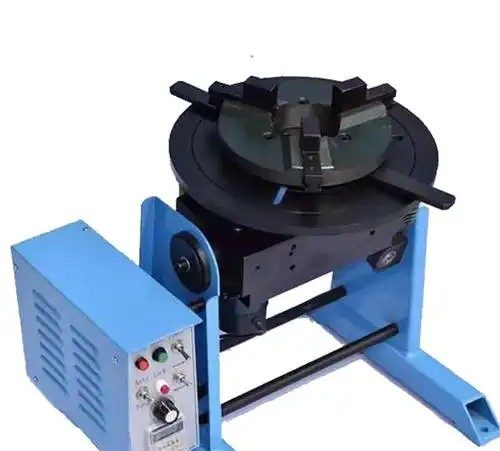
Argon arc welding rotary table
Welding Turntable Load Capacity: More Than Just a Number
When selecting a welding turntable, buyers often focus on the maximum load, such as 100 kg, 500 kg, or 1,000 kg.However, the stated load capacity does not tell the whole story.The actual requirements can also depend on:
- Workpiece center of gravity
- Workpiece diameter
- Workpiece length
- Fixture weight
- Eccentric loading
- Required rotation speed
- Moment of inertia
For example, a long and eccentric workpiece may place considerably more demand on the rotary system than a compact workpiece with the same total weight.
This is why a 500 kg welding turntable should not automatically be assumed to handle every 500 kg workpiece under every operating condition.
For custom applications, the workpiece geometry and center of gravity should be evaluated before selecting the motor, gearbox, bearings, and supporting structure.
Standard vs. Large Custom Welding Turntables
Standard welding turntables are suitable for many common applications.
Typical applications include:
- Small tanks
- Flanges
- Pipes
- Cylinders
- General metal fabrication
Standard models normally offer advantages such as:
- Lower cost
- Shorter delivery time
- Easier maintenance
- Standard components
- Simpler installation
However, large welding turntables are a different engineering challenge.
Why Are Large Welding Turntables Difficult to Build?
Increasing the table diameter is not simply a matter of making the same design larger.
As the size increases, several engineering problems become more significant.
Structural Rigidity
A large platform must support the workpiece without excessive deflection.
Even relatively small deformation can affect workpiece positioning and welding accuracy.
Drive Torque
A large or heavy workpiece requires greater driving torque, especially when starting or stopping.
The motor and gearbox must be selected according to the actual load and operating conditions rather than table diameter alone.
Bearing and Support Design
Large turntables require an appropriate bearing and support structure.The design must account for:
- Radial load
- Axial load
- Eccentric load
- Moment loads
Load Distribution
The workpiece may not be centered on the table.An eccentric load can produce additional mechanical stress and affect rotational stability.
Rotation Accuracy
As the platform becomes larger, manufacturing and assembly tolerances become more important.
Runout, alignment errors, bearing clearance, and structural deformation can all influence the actual movement of the workpiece.
For this reason, large welding turntables are often designed according to the specific application rather than simply selected from a standard catalog.
Welding Turntable vs. Rotary Welding Fixture
The terms welding turntable and rotary welding fixture are sometimes used interchangeably, but they generally emphasize different functions.
Welding Turntable
A welding turntable primarily focuses on rotation.Its core components may include:
- Rotary table
- Motor
- Gearbox
- Controller
- Basic workholding system
Its main purpose is to rotate the workpiece at a controlled speed.
Rotary Welding Fixture
A rotary welding fixture places more emphasis on workholding, positioning, alignment, and rotation.It may include:
- Custom clamps
- Pneumatic fixtures
- Chucks
- Positioning mechanisms
- Dedicated supports
- Automatic loading or unloading systems
For example, a simple motorized rotary table used to rotate a flange can be considered a welding turntable.
If the same system is designed specifically for a particular component and includes dedicated clamping, positioning, and automatic operation, it is closer to a rotary welding fixture.
The terminology is not completely standardized across the industry, so suppliers may use these terms differently.
The more important question is what the equipment actually needs to do.
How to Choose a Welding Turntable
Before purchasing a welding turntable, it is useful to provide the supplier with detailed information about the workpiece and welding process.
Important factors include:
1. Maximum Workpiece Weight
Include both the workpiece and any fixture mounted on the turntable.
2. Maximum Workpiece Diameter
The required table diameter and clearance should be considered.
3. Workpiece Length
Long components may require additional support.
4. Center of Gravity
This is particularly important for eccentric or irregular components.
5. Required Rotation Speed
The required speed depends on the welding process, material, joint design, and workpiece diameter.
6. Required Positioning Accuracy
Higher accuracy may be required for automated or laser welding.
7. Welding Process
Specify whether the turntable will be used for:
- MIG welding
- TIG welding
- Laser welding
- Robotic welding
8. Chuck or Fixture Requirements
The workholding method should match the geometry of the workpiece.
9. Automation Requirements
Consider whether the system needs:
- PLC control
- Servo control
- Foot-pedal operation
- Automatic cycling
- Robot integration
10. Welding Machine Synchronization
For automated welding, the turntable may need to exchange signals with the welding system.
Instead of simply telling a supplier, “I need a 1,000 mm welding turntable,” it is much better to provide information about the workpiece, weight, diameter, center of gravity, fixture, rotation speed, and welding process.
This allows the turntable to be designed or selected according to the actual application.
Welding Turntables for Laser Welding
Laser welding has some specific requirements that should be considered when selecting a welding turntable.Because the laser beam produces a concentrated heat source and the welding process can be highly sensitive to workpiece position, stable movement is important.
A laser welding turntable should therefore be evaluated for:
- Rotation stability
- Low-speed performance
- Mechanical runout
- Positioning accuracy
- Fixture rigidity
- Workpiece concentricity
- Control-system compatibility
For cylindrical or circular components, excessive workpiece runout may change the relative position between the laser head and the joint.
This can affect:
- Weld width
- Penetration
- Focal position
- Process consistency
For automated laser welding, the turntable should therefore be treated as part of the overall welding system rather than as an independent rotating platform.
Common Applications of Welding Turntables
Welding turntables can be used for many rotary welding applications, including:
- Pipe welding
- Flange welding
- Circular seam welding
- Tank welding
- Cylinder welding
- Shaft welding
- Ring welding
- Automotive components
- Machinery components
- Stainless steel fabrication
They are particularly useful when the workpiece has a circular or cylindrical geometry and would otherwise require the operator to move around the component manually.
Conclusion
A welding turntable is more than a motorized rotating table. Its drive system, gearbox, bearing structure, controller, structural rigidity, load capacity, and workholding system all contribute to its actual performance.
For standard workpieces, a standard welding turntable can provide a practical and cost-effective solution. For large, heavy, eccentric, or automated applications, however, the equipment may need to be customized according to the workpiece geometry, center of gravity, required rotation speed, load, and welding process.
It is also important to distinguish between a basic welding turntable and a rotary welding fixture. While the former primarily provides controlled rotation, the latter may combine rotation with dedicated clamping, positioning, and automation functions.
ZS Laser can customize and manufacture welding fixtures, welding positioners, and welding turntables in different sizes, load capacities, rotation speeds, and configurations to meet specific welding requirements.
Contact ZS Laser to discuss your custom welding equipment needs.

WhatsApp
Scan the QR Code to start a WhatsApp chat with us.